
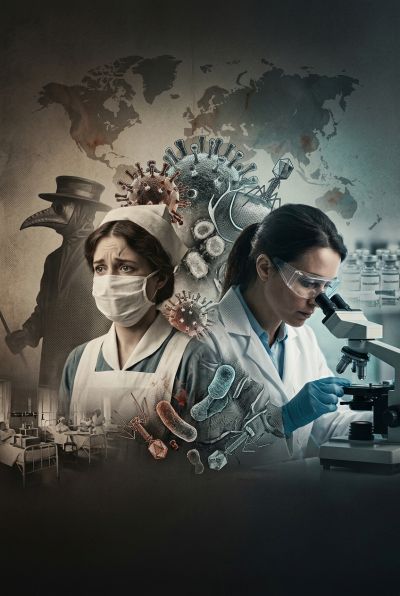
The following is an excerpt from “Infectious Diseases” by Brent Marek, available on MixCache.com.
Introduction
They are the unseen architects of human history, microscopic marauders that have felled empires, redrawn maps, and dictated the rise and fall of civilizations. Long before humankind developed the tools to even glimpse their existence, infectious diseases were shaping our destiny. They have stalked us through millennia, adapting and evolving alongside us, a constant, often terrifying, presence in the human story. From the fevers that swept through ancient cities to the pandemics that circle the modern globe, these illnesses, caused by an array of bacteria, viruses, fungi, and parasites, represent one of the most profound and persistent challenges our species has ever faced. This book is an account of that long, complex, and often brutal relationship – a history of humanity's deadliest diseases and the ongoing battle to understand and overcome them.
Understanding infectious diseases requires grappling with a fundamental paradox: the sheer scale of their impact versus the infinitesimal size of their agents. A virus particle, invisible to the naked eye and dwarfed even by the cells it invades, can bring global travel to a standstill. A bacterium, simple in structure, can trigger societal collapse. These are not mere biological curiosities; they are historical forces, potent catalysts for change. They exploit our interconnectedness, thriving in the very networks of trade, travel, and community that define human society. Their spread is often silent and insidious, the enemy unseen until its devastating effects become undeniable. For most of our history, we fought this enemy in the dark, attributing its wrath to foul air, divine anger, or celestial alignments, lacking the conceptual framework to grasp the true nature of contagion.
The story of infectious disease is, therefore, inextricably linked to the story of human understanding. It traces our slow, painstaking journey from superstition and fear towards scientific insight. It encompasses the moments of brilliant deduction, the patient observations, and the technological breakthroughs that gradually peeled back the layers of mystery surrounding these illnesses. But it is also a story of recurring patterns: the predictable waves of panic that accompany an epidemic, the search for scapegoats, the tension between individual liberty and public health, and the stark inequalities that often determine who suffers most. The history of disease is a mirror reflecting our own societal structures, prejudices, and vulnerabilities.
Think of the earliest human settlements, the shift from nomadic life to agriculture. This transition, fundamental to civilization, also created fertile ground for disease. Larger populations living in close proximity, accumulation of waste, domestication of animals – all provided new opportunities for pathogens to emerge and spread. Early cities became crucibles of infection, where diseases could sustain themselves in ways impossible among scattered hunter-gatherer bands. The very success of our species, our tendency to congregate and build, inadvertently fostered the agents of our own suffering. The concept of "contagion," the idea that illness could pass from person to person, flickered dimly in ancient minds, often tangled with beliefs about pollution or curses, long before its mechanisms were remotely understood.
This inherent tension – between the benefits of community and the risks of contagion – runs like a thread through our past. Trade routes that carried silks and spices also transported deadly microbes across continents, introducing populations with no prior exposure, and thus no immunity, to devastating effect. Wars and conquests have often been decided not just by strategy and weaponry, but by the diseases that ravaged armies and demoralized populations. Soldiers, packed into unsanitary camps and moving across territories, became unwitting vectors, spreading infections far and wide. The microbial world has frequently been the silent, unacknowledged victor in human conflicts.
Consider the sheer terror inspired by epidemics throughout history. Accounts from plague-stricken cities describe societal breakdown: the abandonment of the sick, the cessation of trade and daily life, the desperate search for explanations and cures. In the face of overwhelming, inexplicable death, social bonds frayed. Fear could turn neighbours against each other, fueling paranoia and persecution. Yet, amidst the despair, these crises also spurred acts of profound courage, compassion, and ingenuity. They forced communities to confront fundamental questions about health, governance, and collective responsibility. From the earliest attempts at quarantine to the development of sophisticated public health systems, the fight against infectious disease has driven innovation in surprising ways.
The narrative arc of this book follows humanity's evolving relationship with these invisible adversaries. We begin by exploring the nascent understanding of disease in the ancient world, where supernatural explanations held sway but keen observers sometimes noted patterns of transmission. We witness the cataclysmic impact of plagues that shook classical civilizations and the medieval world, altering demographics and power structures on a vast scale. The story then crosses oceans, examining the devastating role of disease in the encounters between the Old World and the New, a biological exchange with consequences that echo to this day.
A pivotal transformation occurs as we move into the era of scientific revolution. The gradual shift from miasma theories – the idea of disease caused by bad air – towards an understanding of specific causative agents marks a turning point. We will trace the development of crucial interventions, like variolation and vaccination, born from observation and empirical testing long before the underlying principles were fully grasped. The nineteenth century brings dramatic breakthroughs: the birth of epidemiology through meticulous investigation of cholera outbreaks, and the golden age of microbiology, when scientists like Pasteur and Koch finally identified the specific microbes responsible for ancient scourges like tuberculosis, cholera, and anthrax. Germ theory revolutionized medicine and public health, providing a rational basis for prevention and control.
Armed with this new knowledge, the twentieth century witnessed unprecedented progress. The development of antibiotics seemed to promise an end to bacterial infections, while vaccines offered powerful tools against viral diseases like polio and measles. Global campaigns were launched with the audacious goal of eradicating ancient foes like smallpox. Yet, this era of optimism was tempered by new challenges. The emergence of HIV/AIDS presented a novel, complex threat that initially baffled scientists and exposed societal fault lines. The terrifying speed and lethality of hemorrhagic fevers like Ebola highlighted the potential for devastating outbreaks from previously obscure pathogens.
And the battle is far from over. We now face the growing spectre of antimicrobial resistance, threatening to undo the hard-won gains of the antibiotic age. Climate change, deforestation, and globalization are altering ecosystems and increasing the risk of zoonotic spillover – diseases jumping from animals to humans. Recent pandemics, most notably COVID-19, have served as stark reminders of our continued vulnerability. The interconnectedness that defines modern life also makes us susceptible to the rapid global spread of new and re-emerging infections. Preparing for and responding to these threats remains one of the paramount challenges of our time.
This book aims to navigate this vast and complex history in an engaging and accessible manner. While the subject matter is often grim, the story is also one of human resilience, intellect, and adaptation. It is populated by dedicated scientists, pioneering physicians, tireless public health workers, and ordinary people caught in extraordinary circumstances. We will strive to present the scientific and historical facts plainly, exploring the interplay between biology and society without sermonizing. The goal is not just to recount tales of past plagues, but to understand how our relationship with infectious disease has fundamentally shaped who we are, how we live, and the challenges we face today.
The invisible world of microbes has always been intertwined with the visible world of human affairs. By exploring the history of diseases like smallpox, cholera, tuberculosis, influenza, and AIDS, alongside the development of concepts like contagion, immunity, vaccination, and epidemiology, we gain a deeper appreciation for the forces that have driven historical change. It is a story of fear and courage, ignorance and discovery, catastrophe and progress. It is the ongoing saga of humanity's confrontation with its deadliest microscopic enemies, a battle that continues to unfold with profound consequences for us all. Welcome to the human history of infectious diseases.
Read “Infectious Diseases” on MixCache.com →
Please log in or create an account to leave a comment.
No comments yet. Be the first to say something.