
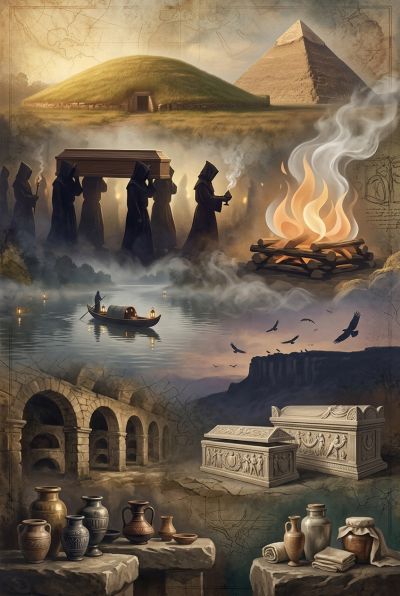
The following is an excerpt from “How We Got Rid Of The Bodies” by Raymond Maxwell, available on MixCache.com.
Introduction
Let’s be honest, it’s the oldest problem in the book. Not love, not war, not even how to get that stubborn lid off the pickle jar. The oldest problem is a practical one, a logistical one, and, if we’re being perfectly frank, a slightly fragrant one. What, precisely, do we do with the bodies? From the moment the first of our ancestors looked down at a fellow hominid who had ceased to be, the question has hung in the air, sometimes more literally than others. It’s a universal dilemma that every single human society, from the most technologically advanced to the most isolated, has had to solve. This book is about how we’ve answered that question.
It's a story that begins, as so many do, with a bit of digging. Humans have been burying their dead for at least 100,000 years. But why? It seems like a lot of effort for something that, on the surface, provides little immediate benefit. You can’t eat it, you can’t wear it, and you certainly can’t ask it to help you hunt a mammoth. Yet, across millennia and continents, we have dug, built, burned, and even, on occasion, eaten our dead. The sheer variety of our solutions is a testament to human ingenuity, a peculiar brand of creativity sparked by the ultimate deadline.
This isn't just a grim catalogue of corpse disposal techniques, however. How we treat our dead says volumes about how we live. It’s a mirror reflecting our deepest beliefs about life, the afterlife, and our place in the universe. Our funerary practices are a complex tapestry woven from threads of sanitation, sentiment, spirituality, and social status. They are shaped by everything from the fear of vengeful spirits to the very practical concern that leaving dear old Uncle Thag to decompose in the corner of the cave is, to put it mildly, unpleasant for everyone else.
The history of dealing with the dead is, in many ways, the history of humanity itself. It’s a subject that touches on our fears, our hopes, our art, and our science. The first deliberate burials, found in places like Qafzeh in Israel, show evidence of ritual, with bodies carefully arranged with items like deer antlers, suggesting that even 115,000 years ago, death was more than just a biological event. It was an occasion that demanded a certain level of performance. These early efforts were perhaps the first stirrings of the elaborate ceremonies, solemn rituals, and sometimes outright bizarre traditions that have characterized our relationship with the deceased ever since.
Consider the options. The default, of course, is to do nothing. Just walk away and let nature take its course. Many animals do just that. But at some point in our evolutionary journey, that became unacceptable. Perhaps it was simple hygiene. A decaying body is a health hazard, and our ancestors, while not exactly versed in germ theory, would have understood the connection between rot and sickness. The World Health Organization today notes that while the risk of epidemics from dead bodies is often overstated, contamination of water sources is a real concern. So, getting the body out of sight, and out of the water supply, was a pretty good idea.
But it quickly became about so much more than sanitation. The act of disposal became a ritual, a ceremony freighted with meaning. It became a way for the living to process their grief, to support one another, and to make sense of the profound mystery of death. Funerals, in essence, are for the living. They provide a safe, structured space to express sorrow, share memories, and begin the long, slow process of converting a relationship of physical presence into one of memory. It’s a psychological pressure valve, a necessary step in healing and reaffirming social bonds.
This book will take you on a global tour of our most inventive, and sometimes startling, solutions to the body problem. We’ll start, as humanity did, with putting them in the ground. The simple act of burial has been our go-to method for eons, a practice that indicates a respect for the dead and a desire to keep the unpleasantness of decomposition hidden from view. From there, we will travel to ancient Egypt, where the elite went to extraordinary lengths not just to dispose of the body, but to preserve it for eternity, believing it was an essential vessel for the soul’s journey in the afterlife.
Then we'll feel the heat with the rise of cremation, a practice favored by ancient Greeks and Romans. For some, fire was seen as a purifying agent, a way to release the spirit from its fleshy prison. For others, like the Hindus on the banks of the Ganges, it was, and still is, a sacred rite intended to help the soul escape the cycle of reincarnation. We’ll look at why some cultures burned their dead with gusto while others found the practice abhorrent, a desecration of the sacred body.
But burying and burning are just the beginning. Have you ever considered leaving your dearly departed on a mountaintop as an offering to vultures? The Tibetan practice of sky burial does exactly that, viewing the body as an empty vessel and its consumption by birds as a final act of generosity. It's a method that is both deeply spiritual and startlingly practical, providing sustenance to other living creatures. The Zoroastrians had a similar idea, placing their dead on "Towers of Silence" for the same purpose, believing that burial or cremation would defile the sacred elements of earth and fire.
We will sail with the Vikings, who sometimes sent their chieftains off in flaming ships, a fiery and dramatic send-off fit for a warrior. We’ll explore the curious traditions of the Philippines, where the Tinguian people might dress a corpse in its finest clothes and sit it in a chair with a cigarette, or the Benguet people blindfold their dead and place them at the entrance to their homes. We’ll even delve into the "dancing with the dead" ceremony in Madagascar, where families periodically exhume their ancestors to re-wrap them in fresh shrouds and dance with them before returning them to the tomb.
Of course, the way we handle our dead is also profoundly shaped by religion. The rise of Christianity, with its emphasis on the resurrection of the body, led to the development of the modern cemetery. The word itself comes from a Greek term for a "sleeping chamber," a place where the faithful would rest until Judgment Day. This belief made cremation a taboo in much of the Christian world for centuries and cemented burial as the proper, respectful way to treat a believer's remains.
We’ll also examine how these practices reflect social structures. From the grand pyramids of the pharaohs to the massive burial mounds built for Anglo-Saxon kings, the scale and expense of a funeral have always been a reliable indicator of wealth and power. In ancient Rome, cremation became a status symbol, with the wealthy commissioning elaborate pyres and tombs. Conversely, in times of crisis, all ceremony goes out the window. We'll look at the stark reality of plague pits and mass graves, where the sheer volume of the dead overwhelmed all customs and the primary goal became simple, rapid disposal to protect the living.
The rituals surrounding death are not just about the body itself. They are also about the performance of grief. The Victorian era, for instance, saw mourning elevated to a high art form, with complex rules of etiquette, specific dress codes, and elaborate mementos made from the hair of the deceased. It was a time when the public display of sorrow was not only encouraged but expected, a stark contrast to modern Western sensibilities that often treat grief as a private, almost embarrassing, affair.
And what of the words we leave behind? From the simple "Rest in Peace" to humorous, angry, or deeply poignant epitaphs, tombstones are our final, permanent statements to the world. They are a miniature biography, a warning, a joke, or a declaration of love, etched in stone for posterity. We’ll explore how these final messages have evolved and what they tell us about the people who lie beneath them.
This journey is not confined to the distant past. The story of how we get rid of the bodies is constantly evolving. We'll investigate the birth of the modern funeral industry in America, a business that transformed the simple act of burial into a complex commercial enterprise. We’ll see how cremation, once a fringe practice in the West, has made a dramatic comeback, and we’ll examine the astonishing economics of dying, where a final farewell can cost as much as a new car.
In recent decades, our options have expanded in ways our ancestors could never have imagined. Worried about your carbon footprint? You might consider a "green burial," where your unembalmed body is placed in a biodegradable shroud or coffin and allowed to decompose naturally. For the technologically minded, there’s alkaline hydrolysis, a process that dissolves the body in a heated, alkaline solution, leaving behind only sterile liquid and bone fragments. It’s cremation by water instead of fire.
Feeling more adventurous? Your cremated remains can be incorporated into an artificial coral reef, helping to restore marine ecosystems. They can be compressed under immense pressure to create a memorial diamond. For those with celestial ambitions, a portion of your ashes can even be launched into space, achieving a form of immortality among the stars. And for those who refuse to accept that the end is the end, there is the chilly promise of cryonics, where the body is preserved at extremely low temperatures in the hope that future technology will be able to revive it.
We are also facing new challenges. In crowded cities around the world, cemetery space is running out, leading to the development of vertical cemeteries—high-rise buildings for the dead. The digital age has presented us with a new kind of afterlife: our online presence. What happens to your social media profiles, your emails, and your vast digital archive after you’re gone? It’s a new frontier in estate planning that we are only just beginning to navigate.
Ultimately, the question of what to do with the body is a question about what it means to be human. It’s about our ability to find meaning in the face of oblivion, to create order out of the chaos of loss, and to honor the connections that bind us together. It is a story of love, fear, faith, and practicality. It is a story that is at once deeply personal and universally shared. From the first shallow grave dug in the ancient earth to the latest rocket carrying human ashes into orbit, we have always found a way. This book is the story of how.
Read “How We Got Rid Of The Bodies” on MixCache.com →
Please log in or create an account to leave a comment.
No comments yet. Be the first to say something.