
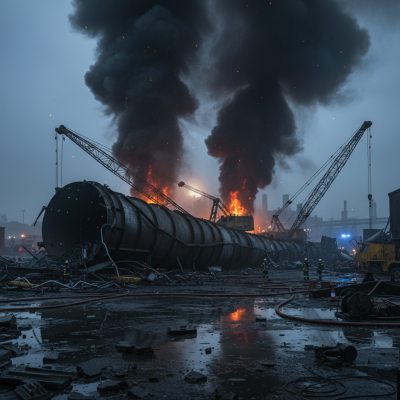
The following is an excerpt from “Great Industrial Accidents” by Dr Alex Bugeja PhD, available on MixCache.com.
Introduction
Progress is a hungry machine, and its fuel, for much of human history, has been risk. From the first tentative experiments with gunpowder to the complex calculus of splitting the atom, the drive to innovate, to build bigger, faster, and more powerful things has always walked hand-in-hand with the potential for spectacular failure. This book is a chronicle of those failures. It is an examination of moments when the complex, interwoven systems of human ingenuity and industrial might came undone, often with terrifying and tragic consequences. These are the stories of the great industrial accidents, events that serve as grim milestones in our technological journey.
What elevates a workplace mishap to the level of a "great industrial accident"? It is a matter of scale and significance. An industrial accident, for our purposes, is not merely an incident where a worker is injured, however tragic that may be. It is a catastrophic event where the systems of production themselves break down, resulting in significant loss of life, widespread destruction of property, or severe environmental damage. These are events that rupture the fabric of a community, and sometimes, a nation. They are disasters born from the very processes of industry—explosions, fires, chemical releases, and structural collapses. The incidents in this volume are "great" not in a laudatory sense, but in the magnitude of their impact. They are the explosions heard for miles, the fires that darken the sky, the chemical clouds that drift over sleeping towns, and the collapses that bury hundreds. They are disasters that, through their sheer destructive force, command our attention and demand examination.
The story of industrial progress is also the story of a slow, often painful, awakening to the dangers that accompany it. In the early days of the Industrial Revolution, workplaces were fraught with peril. Factories with unguarded machinery, poor ventilation, and nonexistent fire escapes were the norm. Miners, including young children, faced the daily threats of tunnel collapses, toxic gases, and explosions. The prevailing attitude was often one of grim acceptance; danger was simply the price of progress. The first tentative steps toward regulation were modest and often poorly enforced. In 1877, Massachusetts passed the first safety and health law in the United States, mandating guards on belts, shafts, and gears, as well as adequate fire exits. Yet, as late as 1912, between 18,000 and 21,000 workers were killed annually in American industries.
It was often the shock of a major disaster that spurred meaningful change. The Triangle Shirtwaist Factory fire in 1911, where 146 garment workers died, many leaping to their deaths from a building with locked exit doors, led to sweeping reforms in factory safety standards. Throughout the 20th century, a series of legislative actions gradually built a framework for worker protection. In the United States, this culminated in the passage of the Occupational Safety and Health Act (OSHA) in 1970, a landmark piece of legislation born from the reality that in the preceding decade, around 14,000 workers were dying on the job each year. Similar movements occurred across the industrialized world, with governments stepping in to regulate industries and establish a "duty of care" for employers. This evolution was a direct response to the lessons written in the wreckage of factories and the loss of countless lives.
At the heart of nearly every industrial accident is a complex interplay between human action and technological vulnerability. It is tempting to seek a single, simple cause—a faulty valve or a careless worker—but the reality is almost always more nuanced. The concept of "human error" is frequently cited, and studies have often attributed a high percentage of accidents, perhaps 60 to 80 percent, to this cause. Yet, this label can be misleading. Human error is often not the root cause, but rather a symptom of deeper, systemic problems. Herbert William Heinrich, in his 1931 book Industrial Accident Prevention, was among the first to systematically analyze accidents, concluding that the vast majority were caused by "unsafe acts of people" rather than "technical failure." This perspective, while influential, has been refined over time. Modern analysis recognizes that errors are often induced by the system itself. Factors like poor equipment design, inadequate training, immense pressure to meet production quotas, fatigue from excessive workloads, and poor communication can all create an environment where mistakes are not just possible, but probable.
A recurring theme in the disasters covered in this book is the failure to heed warning signs. These are rarely bolts from the blue. More often, they are the culmination of a series of smaller failures, near misses, and ignored concerns. Major accidents are typically the result of multiple faults occurring together in unforeseen ways. This is sometimes described as the "Swiss Cheese Model," where an accident occurs only when the holes in multiple layers of safety and defense line up perfectly. These layers can include technical safeguards, operating procedures, and human supervision. A lapse or failure in any one layer is usually not enough to cause a catastrophe. But when a design flaw aligns with a procedural shortcut, which in turn aligns with an operator's momentary lapse in attention, the path to disaster is cleared. The challenge in preventing these events is that the complex interactions between different parts of a system can make it difficult to anticipate how they will fail.
Furthermore, the drive for profit and production can create powerful incentives to cut corners or delay necessary maintenance. Investigations into major disasters frequently uncover a history of lax safety standards, deferred maintenance, and a general disregard for established safety protocols, often driven by a desire to reduce costs or accelerate production. This "poor management philosophy" can be a more significant factor than any single technical or human error. When the culture of an organization prioritizes output over safety, it systematically erodes the very defenses designed to prevent disaster. Warnings from engineers may be downplayed, safety procedures may be viewed as inconvenient obstacles, and aging equipment may be pushed beyond its limits. In this context, a worker's "error" may simply be the final, visible link in a long chain of poor decisions made at a much higher level.
The nature of industrial risk is also inextricably linked to the pace of technological innovation. Each new leap forward, from the harnessing of steam to the development of synthetic chemicals and the advent of nuclear power, introduces new and often poorly understood hazards. The very materials that promise progress can carry the seeds of destruction. Gunpowder, guncotton, dynamite, ammonium nitrate, methyl isocyanate—these are just some of the substances that feature in the following chapters. Their stories are part of a larger narrative about humanity's often-troubled relationship with its own creations. The development of new technologies frequently outpaces the development of the regulations and safety cultures needed to manage them. As industrial processes become more complex and tightly coupled, the potential for a small failure to cascade into a full-blown catastrophe increases. In such systems, what are sometimes termed "normal accidents" can occur—failures that are an inherent, almost unavoidable, consequence of the system's own complexity.
The accidents in this book span centuries and continents, from 17th-century Holland to 21st-century Bangladesh. They cover a vast range of industries: munitions and explosives, mining and metallurgy, chemicals and textiles, and nuclear power. Each story is a product of its time, reflecting the technology, the economic pressures, and the societal attitudes of its era. Yet, for all their diversity, they share unsettling commonalities. They are tales of ignored warnings, of commercial pressures overriding caution, and of the devastating consequences when complex systems fail.
This book does not seek to moralize or to assign blame in hindsight. Its purpose is to present the factual accounts of these events in a straightforward manner. The goal is to understand what happened and how it happened, to explore the chain of events that led from normal operation to disaster. By examining these moments of catastrophic failure, we can gain a clearer perspective on the hidden costs of industrialization and the enduring challenge of balancing progress with safety. The stories that follow are grim, but they are also essential. They are cautionary tales, reminders that the systems we build to serve us can, in the blink of an eye, turn against us with ferocious power. They are the history of how we learned about the risks of our own ingenuity, a lesson often taught at a terrible price.
Read “Great Industrial Accidents” on MixCache.com →
Please log in or create an account to leave a comment.
No comments yet. Be the first to say something.