
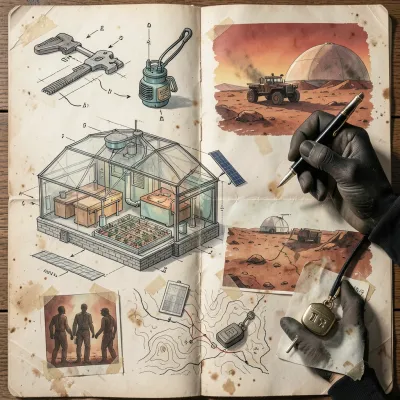
The following is an excerpt from “Field Guide to Martian Survival” by Daniel Gomez, available on MixCache.com.
Introduction
If you are reading this on final approach, the ship’s spin has likely eased and the cabin smells faintly of warm plastic and nervous breath. You can see the rust-red arcs of canyons under you and, for the first time, the thinness of an atmosphere that will never oblige your lungs. Welcome. This field guide was written for that moment and for the thousand smaller ones that follow—when a seal squeaks and you don’t know yet if that’s normal, when your first sip of recycled water tastes like a promise you’re not sure you can keep, when everyone else moves through the airlock like dancers and you stand there counting the lights. It is a manual, yes, but it is also a story, because on Mars the two are the same thing.
The colony runs on three truths: the air is thin, the ground is cold, and the water is finite. Engineering answers all three, but culture keeps the answers working. You will learn how to reclaim water from breath and sweat; you will learn how to stitch the skin of a suit without letting your hands shake; you will learn when to speak softly and when to speak in numbers. We pair each technique with a lived moment, because a diagram can show you where the gasket goes, but only a long night in the valve room will teach you why the person next to you matters more than the wrench.
You will meet Ari—a rookie, like you—whose first month here is a sequence of thresholds: a first EVA, a first repair that holds, a first mistake that does not. Ari is assigned to Maintenance by day and, by night, to the school of listening. Through Ari’s eyes, the colony is a tangle of pipes and people, both of which must be kept at pressure. You will walk with them into an airlock crowded with unspoken rules, stand with them in hydroponics where the colony keeps its green courage, and sit with them on Habitat Night when we tell the stories that keep the dust from getting inside our heads.
This guide is organized the way we live. Each chapter opens with a field technique—how to read a condensation map, how to patch a suit cuff, how to budget a liter through a long shift. Then the page turns, and you are inside a scene: a filter clogs during Founders’ Night; a storm makes the hab sing; a quiet vote changes how we share heat. You will learn the social heuristics alongside the schematics: announce before cycling an airlock; return what you borrow drier than you received it; when the suit is on, speak in numbers; when the helmet is off, speak in kindness.
What this book is not: it is not a substitute for your habitat’s standard operating procedures, nor does it claim to know the quirks of every outpost and every engineer. Models vary; seals age; we improvise. Where there is a conflict, follow your lead tech and your local protocols. What travels with you, no matter where you settle, are principles: measure before you trust; redundancy saves lives; contamination is a social phenomenon as much as a technical one; consent applies to resources; apologies are repairs, too.
How to use this book: read it once through, like a story, and then keep it nearby as a tool. Memorize the first fifteen minutes after touchdown. Practice the knot for wrist seals until your fingers do it without asking your brain. Walk the colony with the “warm map” of heat and power in your head. When you can, teach what you’ve learned to the next arrival. Teaching is our most reliable redundancy.
Belonging on Mars is a practice. At first you will hear only alarms and pumps. Soon you will learn the music: the hush of a satisfied seal, the whisper of water creeping home through membranes, the polite cough someone makes before taking the last orange from hydroponics. You will try on jokes that don’t land and tools that don’t fit. You will earn the trust to open doors and to hold them open. By the end, if we do our jobs and you do yours, you will not feel like a guest in the habitat, or in your own skin.
There will be errors in these pages, as there are in our days. We will correct them the way we correct leaks: by finding them together, by resisting blame, by choosing the fix that keeps the most people safe. The colony is a long conversation carried across thin air; this book is our side of it, offered to you as you add your voice. We are glad you are here. Tie down your heart, check your seals, and step through.
Read “Field Guide to Martian Survival” on MixCache.com →
Please log in or create an account to leave a comment.
No comments yet. Be the first to say something.