
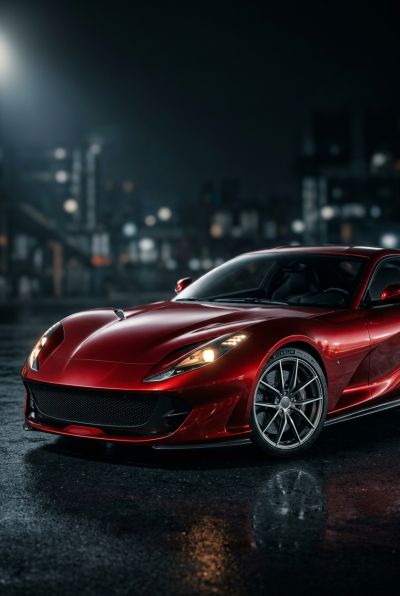
The following is an excerpt from “Ferrari” by Luca Romano, available on MixCache.com.
Introduction
Some names are simply words, a collection of letters assigned to a person, place, or thing. Others transcend their literal meaning to become something more: a symbol, an idea, a feeling. Ferrari is one of those names. It is more than the third most common surname in Italy, derived from the humble profession of the blacksmith. To utter the word "Ferrari" is to evoke a potent and immediate cascade of images and emotions: a flash of brilliant red, the deafening scream of a twelve-cylinder engine, the glint of sunlight on impossibly low and seductive bodywork. It is a name synonymous with speed, luxury, exclusivity, and an Italian passion so fierce it borders on religion.
For decades, this single word has represented the pinnacle of automotive desire. It is the poster on a child's bedroom wall, the ultimate status symbol for the wealthy and successful, and a cultural icon featured in films and music as a shorthand for a life lived without compromise. But Ferrari is not merely a brand; it is a narrative. It is the story of one man's singular, obsessive vision, born in the crucible of post-war Italy and forged in the heat of motorsport. It is a tale of breathtaking triumphs and devastating tragedies, of bitter rivalries and unwavering loyalty, of artistry and engineering fused into rolling sculptures that are as much a feast for the senses as they are a testament to mechanical perfection.
At the heart of this story is a fundamental duality. Ferrari, the builder of some of the most coveted and expensive road cars in history, was founded by a man who, by many accounts, had little interest in them. For Enzo Ferrari, the magnificent grand tourers and berlinettas that bore his name were primarily a means to an end. They were the beautifully crafted but necessary evil that financed his one true love: racing. The soul of the company was not to be found in the polished showrooms of Geneva or Beverly Hills, but in the grime and glory of the pit lane at Monza, Le Mans, and Spa-Francorchamps. Every road car sold was another piston, another chassis, another chance at victory for his beloved Scuderia Ferrari—the "Ferrari Stable".
This relentless focus on competition is the very DNA of the marque. It is why, for decades, the brand's identity has been inextricably linked to the highest echelon of motorsport, Formula One. The technology developed and proven on the world's most demanding circuits would eventually find its way into the cars offered to the public, ensuring that every Ferrari possessed the soul of a racer. This commitment created a feedback loop of excellence: racing success burnished the brand's reputation, driving demand for the road cars, which in turn provided the funding for more racing. It was a self-perpetuating cycle of speed and desire that established Ferrari as a legend.
The color itself, Rosso Corsa, or "Racing Red," was not initially a branding choice but a bureaucratic one. In the early days of international motor racing, cars were painted in national colors: blue for France, green for Britain, and red for Italy. It was a uniform, a designation of origin. But as Enzo Ferrari's scarlet machines began to dominate race tracks in the 1950s and '60s, winning championships and capturing the public's imagination, that particular shade of red became forever associated not just with Italy, but with Ferrari itself. The rules may have made the cars red, but it was Ferrari that made the color legendary.
Equally as important as the color is the sound. To hear a Ferrari is an experience unto itself. It is not a generic roar or a simple hum; it is a complex, multi-layered symphony that rises from a deep burble to a piercing, high-pitched scream that can raise the hair on one's arms. This auditory signature, particularly that of the classic V12 engines, is no accident. It is the result of meticulous acoustic engineering, a deliberate tuning of intake and exhaust systems to create a sound that is as emotionally resonant as it is mechanically efficient. It is a sound that speaks of untamed power and precision, a visceral connection to the heart of the machine that other manufacturers have often tried, and failed, to replicate artificially.
This universe of passion is orbited by a legion of devotees known as the tifosi. The Italian word for "fans," the term is most closely associated with the unwavering, almost fanatical supporters of Scuderia Ferrari. They are the sea of red that floods the grandstands at the Italian Grand Prix in Monza, a global community united by a shared devotion to the Prancing Horse. Their loyalty is a testament to the brand's power to inspire an emotional connection that goes far beyond mere ownership or spectatorship. To be one of the tifosi is to be part of an extended family, bound by a common faith in the scarlet cars from Maranello.
And presiding over this entire world was the man himself, Enzo Anselmo Ferrari. A complex and often contradictory figure, he was known as Il Commendatore (The Commander), a formal title he received from the Italian state that came to define his authoritative and demanding leadership style. He was also called Il Drake, a nod to the English privateer Sir Francis Drake, reflecting his cunning and ruthlessness in competition. Often seen in his signature dark sunglasses, he was a remote and enigmatic patriarch who commanded absolute loyalty and dedication from his drivers and engineers. He could be charming and inspiring, yet also famously stubborn and difficult, a man who grieved deeply for the drivers who lost their lives in his cars yet continued to push the boundaries of speed and risk.
His philosophy was simple and uncompromising: a racing car only becomes beautiful when it wins. This book will tell the story of that pursuit of beauty through victory. It will chronicle the journey from Enzo's early days as a race car driver for Alfa Romeo to the founding of his own Scuderia and, eventually, the creation of the first car to bear his name, the 125 S. We will journey through the decades of motorsport, from the heroic early victories in grueling road races like the Mille Miglia to the long-standing and storied dominance in Formula One. We will explore the creation of the machines that became legends—the sculptural 250 Testa Rossa, the incomparable 250 GTO, the brutal F40, and the technological marvels of the modern era.
The narrative will also delve into the great rivalries that defined entire eras of racing, most notably the titanic struggle against Ford at Le Mans in the 1960s. It will celebrate the eras of legendary drivers, from Alberto Ascari to Niki Lauda and Michael Schumacher, who piloted the scarlet cars to glory. And it will not shy away from the tragedies that were an inescapable part of the sport during its most dangerous years. Beyond the track, we will examine how Ferrari navigated the world of business, from its crucial partnership with Fiat to its expansion into a global luxury brand whose power extends far beyond the automotive world, influencing fashion, art, and popular culture.
This is not just the story of a car company. It is the story of an idea—the idea that a machine can possess a soul, that engineering can be a form of art, and that the relentless pursuit of speed can create a legend that endures for generations. It is the story of passion, pride, and perfection. It is the story of Ferrari.
Read “Ferrari” on MixCache.com →
Please log in or create an account to leave a comment.
No comments yet. Be the first to say something.