
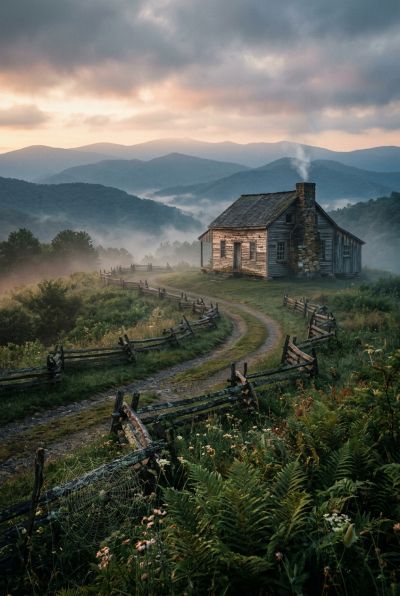
The following is an excerpt from “Appalachia” by Jennifer Ryberg, available on MixCache.com.
Introduction
The mountains are old. Older than the first oceans, older than bones. They began their slow, inexorable climb more than a billion years ago, the product of continental collisions that buckled the earth's crust and thrust stone toward the sky. In their prime, they may have rivaled the Himalayas in grandeur. For hundreds of millions of years, they have been ground down by wind and water, their once-jagged peaks softened into the rolling, forested ridges and deep, shadowed valleys we see today. This is Appalachia, a region carved by time, its geology a silent testament to a history that stretches back to the planet's Precambrian dawn.
The human story here, by contrast, is a recent and often turbulent one. It is a narrative as complex and folded as the mountains themselves, a story of ancient peoples, determined settlers, and powerful outside forces. It is a history that has been romanticized, stereotyped, and profoundly misunderstood. This book aims to trace the contours of that history, to move beyond the easy caricatures and explore the rich, varied, and often contradictory experiences of the people who have called these mountains home.
Defining Appalachia is itself a challenge. Geographically, it is a vast spine of mountains stretching from southern New York to northern Mississippi. The federally recognized boundaries, drawn by the Appalachian Regional Commission (ARC) in 1965, encompass a 206,000-square-mile area that includes all of West Virginia and parts of twelve other states. This definition, however, was based more on economic need than on cultural cohesion. The cultural boundaries of Appalachia are more fluid, a shifting map of shared traditions, dialects, and a common sense of identity rooted in the landscape. The very name, "Appalachia," is a hand-me-down from Spanish explorers who, in the 16th century, heard of a Native American people called the "Apalachee" and applied their name to the vast, unknown mountain interior.
For many Americans, the word Appalachia conjures a specific and often unflattering set of images: the "hillbilly," a caricature of a poor, uneducated, and isolated mountaineer. This stereotype, born in the late 19th century through the writings of outside observers and later cemented in popular culture by comic strips, television shows, and films, has proven remarkably persistent. It is an image of cultural and economic backwardness, of feuding families, moonshine stills, and a resistance to progress. While rooted in certain historical realities of poverty and isolation, these portrayals have often obscured the region's true diversity and resilience. They have flattened a complex population—which includes the descendants of Native American tribes, early European settlers, and African Americans who have been in the region for centuries—into a single, simplistic narrative.
This book will journey through the layers of Appalachian history, beginning long before the arrival of Europeans. We will explore the lives of the First Peoples, such as the Cherokee and Shawnee, who established complex societies and whose traditions are woven into the very fabric of the land. We will follow the first waves of European settlers, many of them Scots-Irish, as they pushed into the "backcountry," creating a frontier culture defined by fierce independence and self-reliance.
The narrative will trace the region's pivotal role in the shaping of the United States, from the conflicts that preceded the American Revolution to the deep divisions that fractured the mountains during the Civil War. We will examine the forces that transformed Appalachia in the late 19th and early 20th centuries: the timber boom that stripped the ancient forests and the rise of "King Coal," an industry that promised prosperity but often delivered exploitation and violent labor struggles. This era brought company towns, mine wars, and a fundamental reshaping of both the landscape and the society.
But history is more than wars and economic shifts. We will also delve into the vibrant cultural fabric of mountain life. The melodies of the fiddle and banjo, the intricate patterns of a handmade quilt, the timeless art of storytelling, and the defiant spirit of the moonshiner are all essential threads in the Appalachian tapestry. These traditions, born of shared experience and geographic isolation, have not only sustained communities but have also profoundly influenced American music and culture.
The 20th century brought new challenges and transformative projects. The Great Depression and the subsequent New Deal programs, particularly the Tennessee Valley Authority, forever altered the region's rivers and economy. The mid-century saw a massive out-migration as Appalachians sought work in the industrial cities of the North, creating urban Appalachian communities far from their mountain homes. The War on Poverty in the 1960s brought national attention and the creation of the Appalachian Regional Commission, a federal effort to address the area's persistent economic struggles.
In more recent times, Appalachia has grappled with the environmental consequences of strip mining, the devastation of the opioid crisis, and the ongoing challenges of economic diversification. Yet, it is also a region of immense creativity and innovation. We will explore the cultural preservation efforts of the Foxfire generation, the powerful voices of Appalachian writers and artists, and the new economic and technological initiatives that are shaping a modern Appalachia.
This book does not seek to present a single, definitive story of Appalachia. Rather, it offers a journey through its many histories. It is a story of a people profoundly shaped by a place, and a place profoundly shaped by its people. It is a story that is quintessentially American, reflecting the nation's highest ideals of independence and its deepest struggles with poverty, identity, and exploitation. The story of Appalachia is the story of an ancient land and a resilient people, a history that is far more complex, compelling, and vital than the stereotypes have ever allowed.
Read “Appalachia” on MixCache.com →
Please log in or create an account to leave a comment.
No comments yet. Be the first to say something.