
The following is an excerpt from “Alcohol” by Alex Bugeja, available on MixCache.com.
Introduction
It begins, often enough, with a toast. A clinking of glasses, a shared moment of celebration, ritual, or simple relaxation. Weddings, funerals, promotions, Friday nights, diplomatic summits, lonely evenings – across cultures and continents, spanning millennia, humanity has reached for a drink. Beer, wine, spirits; call it what you will, the active ingredient remains the same: ethanol. A simple molecule, C2H5OH, yet one capable of inducing profound changes in perception, mood, and behaviour. It is, arguably, the most widely used psychoactive substance on Earth, deeply woven into the very fabric of our social, cultural, and economic lives.
Yet, this familiar companion carries a darker, more complex reputation. It fuels arguments as readily as conversations, shatters families as often as it seals friendships, and underlies countless tragedies on roads, in homes, and within the hidden confines of the human body. It is both lubricant and abrasive, solace and sorrow, a source of immense pleasure and profound pain. Little wonder, then, that alcohol holds the title of the world’s most notorious drug – celebrated and condemned, desired and feared, legal in most corners of the globe yet responsible for a staggering burden of disease, injury, and social disruption.
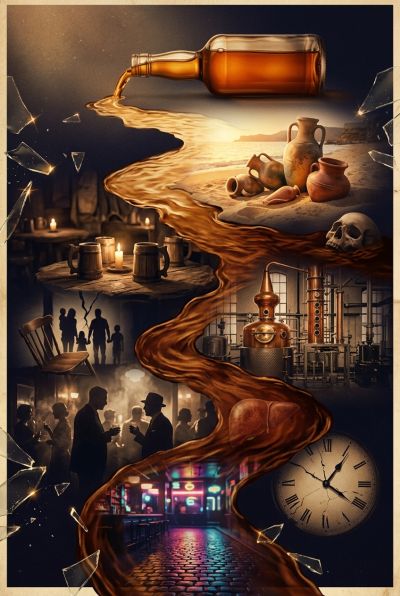
This book embarks on a journey to understand this paradoxical substance. We peel back the layers of familiarity to explore the intricate history, the potent science, and the far-reaching impact of alcohol. How did humanity first discover the intoxicating power of fermented fruits and grains? How did this discovery shape the course of civilizations, influencing religion, art, politics, and warfare from the ancient world to the modern era? We will travel back thousands of years, tracing the accidental origins of brewing and winemaking, exploring its role in sacred rites and secular revelries.
We will follow the evolution of alcoholic beverages, from the rudimentary brews of early societies to the sophisticated wines savoured in Roman villas and the potent distilled spirits that transformed drinking habits and fuelled colonial expansion. We’ll witness how monks meticulously cultivated vineyards and perfected brewing techniques during the Middle Ages, viewing alcohol not just as a beverage but also as medicine and a source of vital calories. The narrative will chart the rise of distillation, a technological leap that concentrated alcohol’s power, leading to new drinks, new industries, and new social challenges like the devastating Gin Craze in 18th-century England.
The story of alcohol is inseparable from the story of human migration, trade, and conflict. We will examine how drinks like rum became currency in the brutal triangle trade, how whiskey fuelled rebellions on the American frontier, and how the control and taxation of alcohol became central concerns for nascent states and sprawling empires. The desire for alcohol, and the profits derived from it, have shaped trade routes, financed wars, and defined cultural encounters across the globe, leaving an indelible mark on history.
But the relationship has never been entirely comfortable. Alongside celebration and commerce runs a parallel history of concern, condemnation, and control. We will investigate the roots of the temperance movements that swept across nations, driven by religious fervour, social reformist ideals, and growing awareness of alcohol’s destructive potential. This leads us to one of the most audacious social experiments in modern history: Prohibition in the United States. We’ll explore the motivations behind the “Noble Experiment,” its spectacular failure, the rise of organised crime, and the eventual repeal that reshaped how societies approached alcohol regulation.
Understanding alcohol requires looking beyond history and culture, delving into the intricate workings of the human body and brain. What exactly happens when ethanol crosses the blood-brain barrier? We will explore the neurochemistry of intoxication, examining how alcohol interacts with neurotransmitters to produce its characteristic effects – the initial euphoria, the lowered inhibitions, the impaired coordination, and, ultimately, the potential for dependence. We will demystify the science behind slurred speech, blurred vision, and the morning-after hangover, looking at the acute, short-term impacts on various bodily systems.
The effects, however, are not confined to a single drinking session. This book confronts the stark realities of long-term alcohol consumption. We will navigate the scientific evidence linking chronic heavy drinking to a wide array of health problems, including liver cirrhosis, various cancers, cardiovascular diseases, and neurological damage. While moderate consumption is sometimes linked to certain health benefits, we will critically examine this evidence within the broader context of alcohol’s overall impact on public health, separating marketing hype from medical fact.
A crucial aspect of alcohol’s notoriety stems from its addictive potential. We will explore the complex factors – genetic, psychological, environmental – that contribute to the development of Alcohol Use Disorder (AUD). What distinguishes social drinking from problematic use? How does dependence manifest, and what are the pathways to recovery? We will look at the science behind treatment approaches, acknowledging the challenges faced by individuals and families affected by alcoholism, while highlighting the possibilities for healing and change.
Beyond the individual, alcohol’s influence permeates the social sphere. It is often central to rites of passage, community gatherings, and moments of shared identity. A toast can seal a deal, a shared bottle can forge a bond. We will examine alcohol’s multifaceted role as a social lubricant, exploring diverse drinking cultures around the world, from the wine-centric societies of the Mediterranean to the beer gardens of Germany and the sake ceremonies of Japan. How do cultural norms shape drinking patterns, and how, in turn, does alcohol influence social interaction?
Yet, the same substance that can foster conviviality is frequently implicated in conflict and harm. The phenomenon of “liquid courage” can easily curdle into aggression. We will investigate the complex and often controversial link between alcohol consumption, violence, and criminal behaviour. Why does intoxication sometimes lower the threshold for hostility? We will examine the statistics and the underlying mechanisms, exploring alcohol’s role in domestic violence, public disorder, and other forms of illicit activity, without resorting to simplistic causal explanations.
The impact extends tragically onto our roads. Drink driving remains a major cause of preventable death and injury worldwide. We will confront the devastating consequences of driving under the influence, looking at the statistics, the personal stories, and the ongoing efforts – legal, technological, and educational – to combat this persistent menace. Furthermore, we explore the unseen victims, particularly children exposed to alcohol prenatally, resulting in Fetal Alcohol Spectrum Disorders (FASD), a range of lifelong developmental disabilities.
Given its potential for harm, how do societies attempt to manage alcohol? We will navigate the complex world of alcohol policy, examining the various strategies employed by governments – taxation, restrictions on availability and marketing, minimum legal drinking ages, public health campaigns. What works, what doesn’t, and what are the economic trade-offs? We delve into the colossal global alcohol industry, a powerhouse of marketing and lobbying, and analyse its influence on consumption patterns and policy decisions. The tension between public health objectives and commercial interests is a recurring theme.
Finally, we look at how alcohol is portrayed and perceived in contemporary culture. From sophisticated wine pairings featured in lifestyle magazines to depictions of binge drinking in movies and music, popular media and advertising play a significant role in shaping attitudes towards alcohol. We will critically analyse these portrayals, considering their potential impact, particularly on young people. Looking ahead, we contemplate the future of alcohol: emerging trends like low- and no-alcohol beverages, changing demographics, new scientific insights, and the ongoing challenges of mitigating harm while respecting individual choice.
Throughout this exploration, our approach is guided by a commitment to presenting the facts plainly, drawing on historical accounts, scientific research, and sociological studies. We aim for a balanced perspective, acknowledging alcohol’s deep cultural roots and its role in human pleasure, while unflinchingly examining its dark side – the addiction, the disease, the violence, the social costs. This book does not seek to preach or moralise; it does not offer simple answers or advocate for specific policies. Its purpose is to provide a comprehensive, engaging, and objective understanding of alcohol in all its complexity.
It is a substance that has been praised as a gift from the gods and condemned as a tool of the devil. It has inspired poets and fuelled bar brawls. It generates billions in revenue and costs billions in healthcare and lost productivity. It is legal, familiar, and for many, a benign part of everyday life. Yet, its potential for destruction remains undeniable, earning its reputation as notorious. Understanding this duality, this long, intricate, often troubled relationship between humanity and ethanol, is the journey we undertake in the chapters that follow. Prepare to explore the history and impact of the world's most ubiquitous, celebrated, and dangerous drug.
Read “Alcohol” on MixCache.com →
Please log in or create an account to leave a comment.
No comments yet. Be the first to say something.