
The following is an excerpt from “A History of Transylvania” by Ana Marinescu, available on MixCache.com.
Introduction
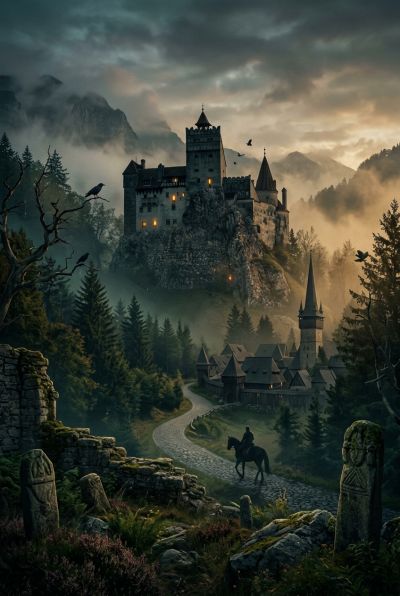
The name itself whispers of mist-shrouded mountains and Gothic castles. For many, Transylvania is a land of fiction, a dark, romanticized backdrop for tales of vampires and creatures of the night. This perception, largely born from the pages of Bram Stoker's 1897 novel Dracula, has cast a long and dramatic shadow over the region, shaping its image in the popular imagination worldwide. While this literary fame has brought a certain allure, it often obscures the rich, complex, and very real history of this fascinating land. This book is an journey into that history, a story that is far more compelling than any legend.
The name "Transylvania" is of Latin origin, first appearing in medieval documents, and it simply means "the land beyond the forest". The Hungarian name, Erdély, carries a similar meaning, "beyond the forest," reflecting the perspective of those arriving from the great Hungarian plain to the west. These names aptly describe the region's geography: a vast plateau embraced by the sweeping arc of the Carpathian Mountains. This dramatic landscape of rolling hills, dense forests, and fortified towns has been both a sanctuary and a battleground for millennia.
Its strategic location has made Transylvania a perpetual crossroads of civilizations. For centuries, it was the eastern frontier of the Kingdom of Hungary, a bastion against successive waves of invaders from the east. It has been a part of the Dacian Kingdom, the Roman Empire, and a semi-autonomous principality under the suzerainty of the Ottoman Empire. It later became a grand principality within the Habsburg Empire, was incorporated into Hungary during the Austro-Hungarian Compromise, and ultimately, following the tumult of the First World War, became part of modern Romania. Each of these chapters in its history has left an indelible mark on its culture, architecture, and the very fabric of its society.
The story of Transylvania is not just one of shifting borders and warring empires; it is the story of its people. It has long been a multi-ethnic and multi-confessional mosaic, a place where Romanians, Hungarians, and Germans (known as Saxons) have lived side-by-side for centuries, along with smaller communities of Serbs, Jews, and Roma. This diversity has been a source of both immense cultural richness and, at times, significant friction. The landscape is dotted with the fortified churches of the Saxons, the wooden spires of Romanian Orthodox churches, and the distinct architecture of Hungarian towns, all testifying to the complex interplay of these different groups.
Transylvania also has a unique religious history. In a time when religious wars tore through much of Europe, the Diet of Torda in 1568 issued an edict of religious tolerance, a remarkably progressive declaration for its time. This allowed for the peaceful coexistence of Catholicism, Lutheranism, Calvinism, and Unitarianism, making Transylvania a bastion of Protestantism in Eastern Europe. The Romanian Orthodox faith, while not granted the same official status, was also a significant presence. This legacy of religious pluralism is a crucial element of the Transylvanian identity.
From the ancient Dacians who first inhabited its hills and mountains, through Roman conquest, the great migrations, the arrival of the Magyars, and the settlement of the Saxons, Transylvania's story begins in a deep and contested past. It unfolds through a golden age as a principality navigating the treacherous politics between the Habsburg and Ottoman Empires, and continues through periods of rebellion, imperial rule, and the rise of national consciousness. The dramatic events of the 19th and 20th centuries—revolution, the Austro-Hungarian Compromise, two World Wars, and the long, dark years of communist rule—would radically reshape the region, leading to the Transylvania of today.
This book will journey through that history, exploring the people, the events, and the forces that have shaped this remarkable land. It is a story of conflict and coexistence, of empires and identities, a narrative that is as dramatic, complex, and captivating as the landscape itself. It is the history of a real place, a place far more interesting than fiction.
Read “A History of Transylvania” on MixCache.com →
Please log in or create an account to leave a comment.
No comments yet. Be the first to say something.