
The following is an excerpt from “A History of Scotland” by William Stewart, available on MixCache.com.
Introduction
To understand the story of Scotland is to understand a landscape and a people forged in conflict, resilience, and a stubborn refusal to be anything other than themselves. It is a history that echoes in the glens and mountains, a narrative carved into the very stones of its ancient castles and bustling cities. This is not a simple, linear tale of a nation's birth and steady progress. Instead, it is a saga of disparate peoples—Picts, Gaels, Britons, and Angles—who, through centuries of both cooperation and strife, would eventually coalesce into the kingdom of Scotland. Their story is one of enduring spirit, a constant struggle for identity and independence against powerful neighbors and the harsh realities of their own dramatic geography.
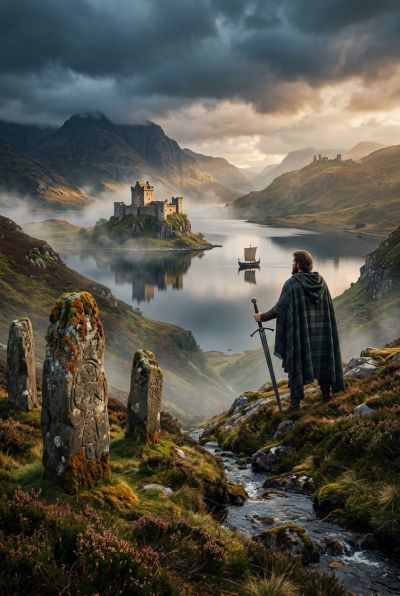
The physical landscape of Scotland has been a formidable character in its own right, shaping the destiny of its inhabitants. The rugged Highlands, with their deep lochs and windswept moors, fostered a resilient and often fiercely independent clan culture. The fertile Lowlands, by contrast, became the heart of the nation's agricultural and later, industrial, might. This geographical duality is a recurring theme, often mirroring the cultural and political divisions that have marked Scottish history. From the earliest hunter-gatherers who settled the land after the last Ice Age to the engineers of the Industrial Revolution who harnessed its resources, the story of Scotland is inextricably linked to its environment.
The recorded history of Scotland begins with the arrival of the Romans, who, despite their military prowess, found the northern tribes an indomitable force. They built walls, not to conquer, but to contain the Caledonians, a testament to the fierce resistance they encountered. In the centuries that followed the Roman withdrawal, the foundations of the modern Scottish nation were laid. The Gaels, or Scots, arrived from Ireland, bringing with them their language and Christianity, eventually uniting with the Picts to form the Kingdom of Alba. This was a pivotal moment, the forging of a new identity in the crucible of Viking raids and internal power struggles.
No history of Scotland could be complete without the towering figures of William Wallace and Robert the Bruce. Their leadership during the Wars of Scottish Independence in the late 13th and early 14th centuries has become the stuff of legend, immortalized in poetry and song. The Battle of Bannockburn in 1314, a decisive victory for the Scots, and the subsequent Declaration of Arbroath in 1320, a powerful assertion of Scotland's right to self-determination, are cornerstones of the nation's identity.
Yet, the relationship with its larger and more powerful neighbor to the south, England, would continue to define much of Scotland's subsequent history. The Union of the Crowns in 1603, which saw a Scottish king, James VI, ascend to the English throne as James I, was a moment of profound change. While it brought a personal union, the two kingdoms remained distinct political entities for another century. The contentious Act of Union in 1707, which formally merged the Scottish and English parliaments to create the Kingdom of Great Britain, was met with popular opposition and remains a subject of debate to this day.
The 18th century was a period of dramatic transformation. The violent suppression of the Jacobite risings, culminating in the brutal Battle of Culloden, marked the end of the Stewart dream of restoring their dynasty to the throne. This was followed by the Highland Clearances, a period of forced evictions that had a devastating and lasting impact on the Gaelic culture of the Highlands. Yet, this same century saw Scotland emerge as a major intellectual and industrial powerhouse. The Scottish Enlightenment produced some of the world's most influential thinkers, including Adam Smith and David Hume, whose ideas would shape modern economics and philosophy.
The 19th and 20th centuries brought further profound changes. The Industrial Revolution transformed Scotland's cities, with Glasgow becoming a major center for shipbuilding and engineering. Scotland played a significant role in the British Empire, with Scots at the forefront of exploration, commerce, and administration. The two World Wars had a profound impact on the nation, and the post-war years were marked by industrial decline and a growing sense of national identity. The discovery of North Sea oil in the latter half of the 20th century brought new economic opportunities and fueled the debate over Scotland's place within the United Kingdom.
This long and often turbulent journey has led to the modern Scotland of the 21st century, a nation with its own devolved parliament and a vibrant cultural life. The re-establishment of the Scottish Parliament in 1999 was a landmark moment, granting Scotland significant powers over its domestic affairs for the first time since 1707. The enduring questions of identity and self-governance continue to shape the political landscape.
This book will delve into the rich and complex tapestry of Scottish history, exploring the key events, the influential figures, and the cultural forces that have shaped this remarkable nation. From the ancient Pictish stones to the modern parliamentary debates, it is a story of a nation that has consistently punched above its weight, a people who have fiercely guarded their unique identity and made an indelible mark on the world. It is a story that is far from over, as Scotland continues to navigate its future, drawing strength and inspiration from its long and storied past.
Read “A History of Scotland” on MixCache.com →
Please log in or create an account to leave a comment.
No comments yet. Be the first to say something.