
The following is an excerpt from “A History of São Tomé and Príncipe” by Robert Stillwater, available on MixCache.com.
Introduction
Two small islands sit in the Gulf of Guinea, astride the Equator, cloaked in emerald green and ringed by the blue Atlantic. São Tomé and Príncipe, Africa’s second-smallest sovereign state, are little known to the wider world. Their names rarely grace international headlines, their contributions to global culture are seldom celebrated, and their history is often relegated to a footnote in the larger, more tumultuous chronicles of the African continent and the age of European expansion. Yet, within these volcanic specks of land lies a story of profound significance, a microcosm of the forces that forged the modern world. This is a history of creation from nothing, of exploitation and resistance, of immense wealth built on human suffering, and of a people’s persistent journey toward defining their own destiny.
Before the late 15th century, this story had no human characters. The islands were an isolated paradise, born of ancient volcanic eruptions along the Cameroon Line, uninhabited by people. Their discovery by Portuguese navigators, João de Santarém and Pêro Escobar, around 1470, marked an irrevocable turning point. These were not lands to be conquered, but blank slates to be written upon. The Portuguese Crown, driven by the era’s insatiable hunger for trade and territory, saw in the islands’ rich volcanic soil and strategic location a golden opportunity. They envisioned a new kind of colony, one that would become a laboratory for a system of agricultural production that would reshape economies and societies on four continents.
This book charts the five-and-a-half-century history of this island nation, a narrative that begins with a unique and cruel experiment. The first settlers were not eager colonists but "undesirables" deported from Portugal—convicts and, most tragically, thousands of Jewish children forcibly separated from their parents. To work the land, the Portuguese began to import enslaved Africans, first from the nearby Slave Coast and the Kongo Kingdom, then from Angola. Thus began São Tomé’s first incarnation: a sugar colony. It was here, in the equatorial heat, that the plantation system, an economic model pairing monoculture with enslaved labor, was perfected. For a brief, dazzling moment in the 16th century, São Tomé became the world's largest producer of sugar, a commodity so valuable it was dubbed "white gold." This brutal and lucrative experiment served as the blueprint for what was to come in Brazil and the Caribbean, making these small islands central to the architecture of the Atlantic slave trade.
The sugar cycle, however, was as volatile as the volcanoes that had created the islands. Competition from the Americas, coupled with constant and fierce resistance from the enslaved population, led to its decline. This history of resistance is a critical thread in the nation’s tapestry, from the establishment of independent Maroon communities in the island's interior by the Angolares—said to be the descendants of shipwrecked captives—to the 1595 revolt led by Amador, who proclaimed himself king of the enslaved and is now honored as a national hero. As the sugar economy faded, the islands found a new, grim purpose as a major transit point, an entrepôt for the transatlantic slave trade where captive Africans were held before the horrific Middle Passage to the Americas.
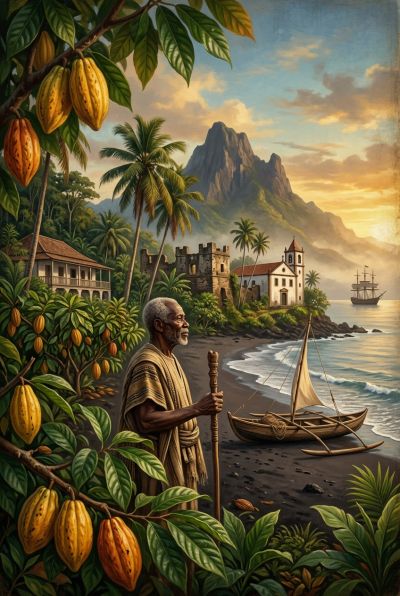
The 19th century brought a second boom, another cycle of exploitation under a different guise. Coffee and cacao (cocoa) were introduced, and the islands' fertile soil once again proved ideal for cash crops. By the early 20th century, São Tomé and Príncipe had become the world's leading producer of cocoa, earning the moniker the "Chocolate Islands." Though slavery had been officially abolished in 1876, it was replaced by a system of contract labor, the serviçais. Laborers were brought from other Portuguese colonies, primarily Angola, Mozambique, and Cape Verde, and subjected to conditions that were often indistinguishable from slavery. This period saw the consolidation of the roças, vast plantations that dominated the economy and social life, creating a rigidly stratified society.
Out of these centuries of forced migration, coercion, and cultural collision, a unique society was born. The intermingling of European settlers and enslaved Africans from diverse ethnic backgrounds forged a distinct Creole, or Forro, culture. New languages emerged, blending Portuguese with African linguistic substrates, and a complex social hierarchy took root, placing Portuguese elites at the top, followed by the mixed-race descendants of freed slaves, and the contract laborers at the bottom. This intricate social fabric, with its own tensions and dynamics, would profoundly shape the islands' path toward nationhood.
The 20th century was a period of growing unrest. The brutal realities of the roça system, combined with an emerging nationalist consciousness across Africa, began to fuel calls for change. A pivotal moment came in 1953 with the Batepá Massacre, where hundreds of protesting laborers were killed by colonial authorities. This event seared itself into the national memory, becoming a potent symbol of colonial oppression and a catalyst for the organized liberation movement. The Movement for the Liberation of São Tomé and Príncipe (MLSTP), operating initially from exile, channeled this growing desire for self-determination.
Independence did not come through a protracted armed struggle, as it did in some of Portugal's other colonies. Instead, the 1974 Carnation Revolution in Portugal, which toppled the long-standing dictatorship, signaled the end of the Portuguese empire. On July 12, 1975, São Tomé and Príncipe peacefully achieved its independence. The post-independence era, however, brought its own formidable challenges. The new MLSTP government established a one-party socialist state, nationalizing the plantations that were the backbone of the economy. But without the colonial managers and with a lack of trained personnel, the vital cocoa sector collapsed, plunging the new nation into economic hardship.
The subsequent decades are a story of adaptation and change. Faced with economic failure, São Tomé and Príncipe embraced multiparty democracy in 1990, becoming one of the first African nations to do so. The transition has been marked by a degree of political instability, yet the country has remained one of the more stable and democratic states in the region. In the late 20th and early 21st centuries, the discovery of offshore oil in the Gulf of Guinea presented both an immense opportunity and a potential peril, raising hopes for economic transformation while also carrying the risk of the "resource curse" that has afflicted many of its neighbors.
This book aims to guide the reader through this complex and compelling history. It will delve into the geological formation of the islands, the pristine ecology the first Europeans encountered, and the societal structures they imposed. It will explore the mechanics of the sugar and slave economy, the lives and culture of the enslaved, and their unceasing struggle for freedom. It will examine the second plantation boom of coffee and cocoa, the realities of life under the serviçais system, and the slow burn of nationalist sentiment that led to independence. Finally, it will trace the nation’s journey since 1975, through the trials of one-party rule, the transition to democracy, and the contemporary challenges of navigating a globalized world, from managing potential oil wealth to protecting its unique biodiversity. The story of São Tomé and Príncipe is a testament to resilience, a history forged in the crucible of global economic forces, and a narrative of how a nation, born from a void, has continually striven to create its own identity.
Read “A History of São Tomé and Príncipe” on MixCache.com →
Please log in or create an account to leave a comment.
No comments yet. Be the first to say something.