
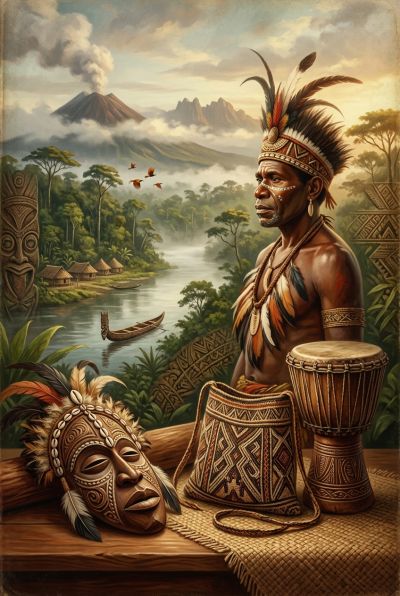
The following is an excerpt from “A History of Papua New Guinea” by James Taylor, available on MixCache.com.
Introduction
To write a history of Papua New Guinea is to attempt to capture the story of not one world, but many. It is a narrative set in a land of staggering contrasts, where snow-capped peaks give way to steaming jungles, and where the ghosts of some of humanity’s earliest migrations coexist with the hum of the 21st-century global economy. This is the story of an island, the second largest on Earth, that has for millennia been a crucible of human adaptation, a laboratory of cultural diversity, and a stage for some of modern history’s most dramatic conflicts and transformations. It is a history that stretches back into the mists of deep time, long before the pyramids were built, and which continues to unfold in complex and often unpredictable ways.
The sheer diversity of Papua New Guinea is a central theme of its history. With over 800 distinct languages spoken among its population, it is the most linguistically varied country in the world. This is not a historical accident but a direct consequence of its geography. The formidable mountain ranges of the interior, the dense rainforests, the swamps, and the scattered archipelagos have served as natural barriers, allowing countless cultures to develop in relative isolation. For much of its history, a person’s world might extend no further than the next valley, where the inhabitants spoke a completely different tongue and adhered to a different set of customs. This mosaic of societies, each with its own intricate systems of trade, ritual, and governance, forms the bedrock of the nation’s story.
Our journey begins some 50,000 to 60,000 years ago, when the first humans made their way to the great southern landmass of Sahul, a single continent that connected present-day Australia and New Guinea. These were among the world’s earliest seafarers, hunter-gatherers who adapted to a range of challenging new environments, from the tropical coasts to the chilly highlands. Archaeological evidence from sites like the Huon Peninsula provides a tantalizing glimpse into their ancient world of stone tools and forest foraging. This deep past represents the longest chapter in Papua New Guinea’s human story, a period of profound connection to the land that shaped the spiritual and cultural foundations of the societies to come.
Long before Mesopotamia or Egypt, the highlands of New Guinea became one of the world’s few independent centers of agricultural innovation. Around 7,000 BC, at places like the Kuk Swamp, people began to drain wetlands and cultivate crops such as taro, bananas, and yams. This was a revolution that unfolded slowly, a testament to the ingenuity of these early horticulturalists. The development of agriculture transformed highland societies, enabling larger populations, more settled communities, and the elaborate systems of exchange and ceremony that would come to characterize the region for millennia. It is a story that challenges the traditional narratives of civilization, proving that complex societies could flourish far from the great river valleys of Eurasia.
A later wave of migration, beginning around 3,000 years ago, brought Austronesian-speaking peoples to the coasts and islands. These newcomers were master mariners and potters, and their arrival is associated with the distinctive stamped pottery of the Lapita culture. They introduced new technologies, domestic animals like pigs and chickens, and new social customs. The interaction between these seafaring Austronesians and the established Papuan-speaking peoples of the interior was a dynamic process of exchange, conflict, and cultural fusion. This ancient encounter laid the groundwork for the complex patterns of trade and cultural identity that would define the coastal regions for centuries.
For most of its history, the island of New Guinea was a world unto itself, its interior peoples unaware of the empires rising and falling across the oceans. Life was governed by the rhythms of the seasons, the obligations of kinship, and the intricate politics of the village. Societies were largely small-scale and egalitarian, often led by charismatic "big men" who gained influence through their ability to organize feasts, exchange goods, and mediate disputes. Trade networks, like the famous Kula ring of the Massim archipelago and the Hiri trade of the Papuan coast, connected distant communities, allowing for the exchange not only of goods like shells and pottery but also of ideas, rituals, and magic.
Warfare was an endemic feature of many pre-colonial societies, often taking the form of ritualized conflicts and raids. Headhunting and cannibalism, while not universal, were practiced in some regions as part of complex belief systems related to absorbing the power of one’s enemies or honouring the dead. These practices, often sensationalized by later European observers, were deeply embedded in the social and spiritual fabric of the communities that engaged in them. They were part of a worldview in which the boundaries between the physical and spiritual realms were porous, and where the balance of power had to be constantly negotiated through both diplomacy and force.
The first fleeting glimpses of this world by outsiders came in the 16th century, with the arrival of Portuguese and Spanish navigators. In 1526, Jorge de Menezes landed on the island and is said to have named it "Ilhas dos Papuas," possibly from a Malay word describing the frizzled hair of its inhabitants. Two decades later, Yñigo Ortiz de Retez, struck by the resemblance he perceived between the people and those of the Guinea coast of Africa, christened the land "Nueva Guinea." For the next three centuries, however, European contact remained sporadic and limited to the coastlines, with the vast, rugged interior remaining a complete mystery to the outside world.
The 19th century brought more sustained and intrusive contact. Whalers, traders, and labour recruiters, known as "blackbirders," began to frequent the islands, seeking resources and manpower. This period was often marked by violence and exploitation, as thousands of islanders were taken, often against their will, to work on plantations in Queensland and Fiji. Christian missionaries also arrived, bringing with them not only a new faith but also new forms of education, medicine, and social organization. Their presence would have a profound and lasting impact, challenging traditional beliefs and laying the groundwork for many of the social changes that were to come.
By the 1880s, the "scramble for Africa" had its smaller, less-known counterpart in the Pacific. The growing strategic and economic interests of European powers led to the formal division of the eastern half of New Guinea. In 1884, Germany claimed the northeastern quarter, establishing German New Guinea, while Britain declared a protectorate over the southeastern portion, which became British New Guinea. The western half of the island had already been claimed by the Netherlands. This arbitrary drawing of lines on a map paid no heed to the existing social, linguistic, or political realities on the ground, creating artificial borders that would have consequences for generations to come.
German New Guinea was run primarily as a commercial enterprise, with the German New Guinea Company initially administering the territory. The focus was on establishing coconut plantations for the production of copra, and thousands of local people were employed as labourers. The German administration was often harsh, but it also saw the establishment of roads, towns, and mission stations. It was during this period that a pidgin language, Tok Pisin, began to evolve and spread, initially as a language of commerce and labour, but eventually becoming a powerful tool of communication and a symbol of a new, shared identity.
In the south, British New Guinea was administered with a somewhat different philosophy, though still firmly rooted in colonial paternalism. In 1906, control of the territory was transferred to the newly federated Commonwealth of Australia, and it was renamed the Territory of Papua. Australian administration, under figures like Sir Hubert Murray, sought to impose law and order, end tribal warfare, and "protect" the native population from the harsher aspects of commercial exploitation. While arguably more benevolent than the German approach, it was still a system based on racial hierarchy and the firm belief in the superiority of Western civilization.
The outbreak of World War I in 1914 brought a swift end to German rule. Australian forces captured German New Guinea with little resistance, and the territory was placed under Australian military administration for the duration of the war. After the conflict, the newly formed League of Nations granted Australia a mandate to govern the former German colony, which was now known as the Territory of New Guinea. For the next two decades, Australia would administer two separate territories—Papua in the south and New Guinea in the north—each with its own distinct legal status and administrative style.
The period between the wars was one of significant change. The discovery of gold at Edie Creek and Bulolo in the Mandated Territory of New Guinea sparked a gold rush, bringing an influx of Australian prospectors and fundamentally reshaping the colonial economy. It also spurred one of the great chapters in the history of exploration. It was during the 1930s that Australian patrol officers and prospectors, like Mick Leahy and Jim Taylor, ventured into the vast, previously unmapped highland valleys. To their astonishment, they found not an empty wilderness but a region teeming with over a million people living in sophisticated agricultural societies, completely unaware of the outside world. This "first contact" was a momentous event, a dramatic encounter between two long-separated branches of humanity.
The relative peace of the interwar years was shattered by the outbreak of World War II in the Pacific. The island of New Guinea became a critical battleground in the conflict between the Allied forces and the Empire of Japan. The Japanese invasion in 1942 brought the war to the very doorstep of Australia. The ensuing New Guinea campaign was one of the most brutal of the entire war, fought in some of the world’s most difficult terrain. The fighting raged along the Kokoda Track, at Milne Bay, Buna-Gona, and in the skies over Rabaul, which the Japanese had turned into a formidable fortress.
The war had a transformative effect on the people of Papua New Guinea. They served as soldiers, scouts, labourers, and, most famously, as the "Fuzzy Wuzzy Angels," who carried wounded Australian soldiers over the treacherous Owen Stanley Ranges. Their bravery and loyalty became legendary. The war exposed them to a vast new world of technology, ideas, and people. It also shattered the myth of European invincibility and planted the seeds of a new political consciousness. For the first time, people from different regions were brought together in a common cause, and the shared experience of the war helped to forge the beginnings of a national identity.
In the aftermath of the war, the world had changed. The old colonial certainties were gone, and the United Nations replaced the League of Nations. In 1949, Australia formally combined its two territories into the single administrative union of the Territory of Papua and New Guinea. The post-war years saw an acceleration of economic development, the expansion of education and health services, and the gradual introduction of a political system. A Legislative Council was established, and later a House of Assembly, which for the first time gave the indigenous population a majority voice in their own governance.
The 1960s and 70s were a period of rapid political awakening. Political parties began to form, most notably the Pangu Pati, led by a charismatic young leader named Michael Somare. A generation of educated Papua New Guineans began to agitate for self-government and, ultimately, independence. The Australian government, under the leadership of Gough Whitlam, recognized that the era of colonialism was over and began to work with local leaders to prepare the territory for nationhood. The process was remarkably swift and peaceful, a testament to the collaborative efforts of both Australian and Papua New Guinean leaders.
On September 16, 1975, the green, gold, and black flag of a new nation was raised for the first time. The Independent State of Papua New Guinea was born, with Michael Somare as its first Prime Minister. Independence was a moment of immense pride and optimism, but it also brought with it a host of formidable challenges. The new nation had to unify a vastly diverse population, build a modern economy, establish stable political institutions, and navigate a complex international environment. The early years were marked by political instability, with a revolving door of coalition governments and frequent votes of no confidence.
One of the most serious challenges to the new nation’s unity erupted on the island of Bougainville. Resentment over the environmental damage caused by the massive Panguna copper mine and the belief that the profits were not being fairly shared with the local people led to a secessionist movement. In 1988, this erupted into a brutal civil war that would last for nearly a decade, claiming some 20,000 lives. The Bougainville crisis was a traumatic period in the nation’s history, testing its military, its political institutions, and its very sense of identity. A peace agreement was eventually signed in 2001, granting the island a high degree of autonomy and paving the way for a future referendum on independence.
Economically, Papua New Guinea’s story has been one of booms and busts, largely driven by the fortunes of its vast natural resources. The country is rich in minerals, oil, gas, and timber, and the development of these resources has been central to its economic strategy. However, this reliance on extractive industries has also brought challenges, including environmental degradation, social disruption, and the difficulties of ensuring that the benefits are distributed equitably among the population. The country has grappled with financial crises, corruption, and the immense task of delivering services to a population scattered across rugged and remote terrain.
Alongside these economic and political struggles, the nation has also contended with significant social challenges. The persistence of tribal fighting in the highlands, the rise of urban crime and gang violence, and ongoing issues related to governance and law and order have been constant concerns. Yet, through it all, the resilience and adaptability of its people have remained a constant. The nation continues to be a vibrant tapestry of ancient traditions and modern aspirations, a place where customary law coexists with a Westminster-style parliament, and where the village remains the central pillar of social life for the majority of the population.
In the 21st century, Papua New Guinea stands at a crossroads. It faces the ongoing challenges of nation-building, the existential threat of climate change, and the complexities of its relationship with its larger neighbours, Australia and the nations of Asia. The historic 2019 referendum in Bougainville, in which an overwhelming majority voted for independence, has opened a new and uncertain chapter in the nation's story, posing fundamental questions about sovereignty and self-determination. The journey from the ancient world of Sahul to the modern nation-state has been a long and arduous one, and the path ahead remains uncharted.
This book aims to tell that story in all its richness and complexity. It is a history of the land and its first peoples, of the agricultural revolution that transformed the highlands, and of the seafaring cultures that connected the coasts. It is a history of colonial encounters, of the cataclysm of war, and of the peaceful, yet challenging, transition to independence. It is a story of a nation forging its identity in a rapidly changing world. It is, above all, the story of the many peoples of Papua New Guinea, whose resilience, creativity, and enduring connection to their cultures and their land lie at the heart of this remarkable history. Our story begins, as it must, in the deep past, with the first human footsteps on the island that would one day be called New Guinea.
Read “A History of Papua New Guinea” on MixCache.com →
Please log in or create an account to leave a comment.
No comments yet. Be the first to say something.