
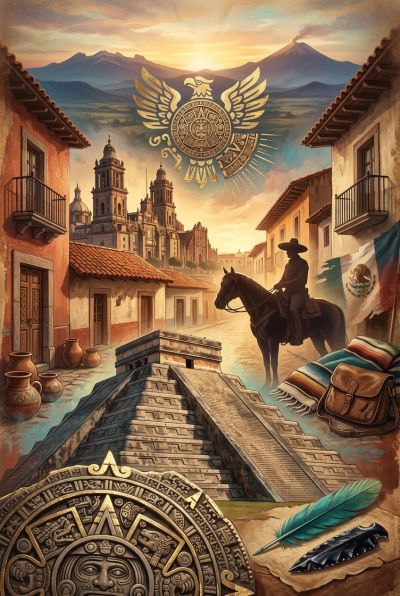
The following is an excerpt from “A History of Mexico” by Alonso de Quintana, available on MixCache.com.
Introduction
To write a history of Mexico is to tell a story of constant reinvention. It is a narrative woven from threads of ancient empires, cataclysmic conquests, fervent revolutions, and a relentless quest for a unified identity. The land itself, a canvas of searing deserts, humid jungles, and volcanic highlands, seems to foster extremes. It is a place where civilizations rose to astonishing heights of astronomical and architectural genius, only to collapse into ruin, and where the collision of worlds in the sixteenth century gave birth to a vibrant, and often turbulent, new society. This book is a journey through that tumultuous and captivating story, tracing the path from its earliest human inhabitants to the complex, modern nation that stands at a crossroads today.
The story begins, as it must, in the deep past of Mesoamerica, a cradle of civilization independent of the Old World. Long before any European mapmaker knew of its existence, this land was home to a succession of remarkable cultures. We will start with the first hunter-gatherers who cautiously ventured into this new world, and witness the slow, revolutionary dawn of agriculture—the cultivation of maize, beans, and squash—that would form the foundation for millennia of human settlement. From this agricultural bedrock rose the enigmatic Olmecs, Mexico's first known major civilization, who carved colossal stone heads with inscrutable expressions and laid a cultural and religious groundwork that would be inherited by all who followed.
Following the Olmecs, we will explore the flowering of distinct and powerful societies across the diverse landscapes of Mexico. In the southern lowlands and highlands, the Maya developed a sophisticated civilization of city-states, creating the most advanced writing system in the pre-Columbian Americas and making breathtaking advances in mathematics and astronomy. Simultaneously, in the central highlands, the magnificent city of Teotihuacan emerged, a sprawling metropolis of pyramids and palaces that, at its zenith, was one of the largest cities in the world. Its influence radiated across Mesoamerica, a beacon of power and culture whose true history remains shrouded in mystery. We will then trace the rise of the Toltecs, inheritors of Teotihuacan's legacy, and finally, the arrival of a wandering tribe into the Valley of Mexico: the Aztecs. In an astonishingly short period, this once-marginalized group would build a vast empire, with the magnificent island capital of Tenochtitlan at its heart—a city of canals, temples, and markets that awed all who saw it. The Aztec world was one of intricate social organization, profound religious belief, and the grim reality of ritual sacrifice, a practice rooted in their cosmology and essential to their view of the universe.
The year 1519 marks the story's most dramatic turning point. The arrival of a small band of Spanish conquistadors under the command of Hernán Cortés was not merely an invasion but a collision of two separate branches of human history. This "clash of worlds" was a brutal, complex affair of technological disparity, irreconcilable worldviews, and the devastating, unseen weapon of disease. The fall of the Aztec Empire in 1521 was not just a military conquest; it was a biological and cultural cataclysm that shattered the world of Mesoamerica and laid the foundations for a new colonial society under the Spanish crown.
For the next three hundred years, the territory would be known as New Spain, the jewel of Spain's American empire. This was an era of profound transformation, defined by the imposition of Spanish political and religious systems, the exploitation of vast mineral wealth, and the creation of a rigid, race-based social hierarchy known as the casta system. Yet, it was also a period of fusion. Spanish and Indigenous cultures blended in unexpected ways, creating a unique syncretism visible in religion, art, food, and language that would come to define Mexican identity. This new identity, a complex mix of the imposed and the resilient, began to germinate in the minds of the criollos—people of Spanish descent born in the Americas—who grew increasingly resentful of the political and economic power wielded by the Spanish-born peninsulares.
That resentment, fanned by the winds of the Enlightenment and the revolutionary turmoil in America and France, would eventually ignite the flames of rebellion. In 1810, a priest named Miguel Hidalgo y Costilla issued the "Grito de Dolores," a cry for independence that launched a long and bloody struggle against Spanish rule. After a decade of war, Mexico achieved its independence in 1821, but the birth of the new nation was anything but easy. The nineteenth century proved to be a period of chronic instability, a seemingly endless cycle of coups, civil wars, and foreign interventions. The presidency changed hands with bewildering frequency as centralists and federalists, conservatives and liberals, battled for the soul of the nation. This era of turmoil was tragically punctuated by the disastrous Mexican-American War, which resulted in Mexico losing more than half of its territory to the United States, and the audacious French Intervention, which briefly imposed a European emperor on a fiercely republican people.
Out of this chaos emerged two of Mexico's most defining figures: Benito Juárez, the liberal reformer who championed the separation of church and state, and Porfirio Díaz, the general who seized power and held it for more than three decades in an era of enforced stability and economic modernization known as the Porfiriato. Díaz's mantra of "Order and Progress" brought foreign investment and built railways and industry, but it came at a tremendous cost. The progress benefited a small elite, while the vast majority of Mexicans, particularly the rural peasantry, were dispossessed of their lands and denied political freedom.
By 1910, the simmering discontent boiled over into the Mexican Revolution, the first great social upheaval of the twentieth century. This was not a single, coherent conflict but a multi-sided civil war of breathtaking violence and complexity. Charismatic leaders like Francisco Madero, Pancho Villa, and Emiliano Zapata rallied armies of peasants and workers against the old regime and, eventually, against each other, each fighting for a different vision of a new Mexico. The Revolution, which cost over a million lives, ultimately tore down the old social order and gave birth to the 1917 Constitution, a document that enshrined principles of land reform, labor rights, and national sovereignty that would shape the country for the rest of the century.
The post-revolutionary period saw the consolidation of power under a unique political entity, the Institutional Revolutionary Party (PRI). For seven decades, the PRI ruled Mexico, maintaining political stability and overseeing a period of sustained economic growth known as the "Mexican Miracle." However, this stability was achieved through a combination of co-optation, corruption, and, when necessary, repression. By the late 1960s, the facade of a harmonious one-party state began to crack, culminating in the 1968 Tlatelolco massacre, a brutal suppression of student protests that exposed the authoritarian nature of the regime. The economic crises of the 1970s and 80s further eroded the PRI's legitimacy, leading to a shift toward neoliberal economic policies and the signing of the North American Free Trade Agreement (NAFTA).
The final chapters of our story will examine the momentous changes of the late twentieth and early twenty-first centuries. We will witness the slow and often difficult transition to a multi-party democracy, culminating in the historic defeat of the PRI in the presidential election of 2000. We will also confront the daunting challenges that continue to face contemporary Mexico: the rise of powerful drug cartels and the ensuing violence, persistent economic inequality, and the ongoing struggle to forge a path forward that reconciles its revolutionary ideals with the demands of a globalized world.
The history of Mexico is a story of survival and creation. It is the story of how ancient roots continue to nourish a modern nation, how centuries of conflict have forged a resilient and complex national character, and how a people, defined by their history but not bound by it, continue to shape their own destiny. This book aims to provide a clear and engaging guide to that epic journey.
Read “A History of Mexico” on MixCache.com →
Please log in or create an account to leave a comment.
No comments yet. Be the first to say something.