
The following is an excerpt from “A History of Lombardy” by Luigi Montanaro, available on MixCache.com.
Introduction
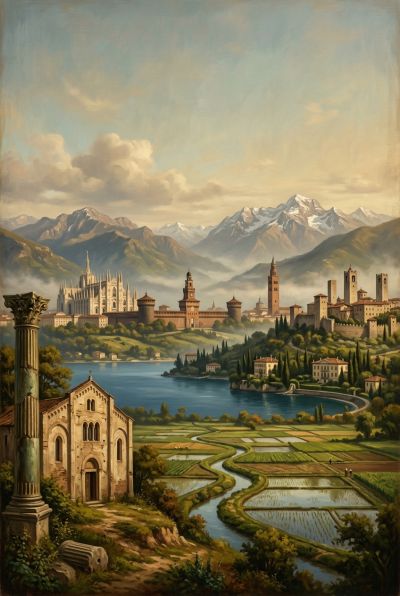
To understand Lombardy is, in many ways, to understand the history of Europe in miniature. Few regions on the continent have been so consistently at the heart of its convulsions, its artistic triumphs, and its economic transformations. Geographically, Lombardy is a place of dramatic contrasts, stretching from the icy ramparts of the Alps in the north to the fertile, flat expanse of the Po Valley in the south. This landscape is stitched together by a network of rivers and shimmering glacial lakes—Garda, Como, Maggiore, and Iseo—that have been a source of inspiration and a strategic prize for centuries. This unique position, a gateway between the Italian peninsula and the rest of Europe, has been both its blessing and its curse, making it a corridor for trade, ideas, and armies alike. History, it is often said, is shaped by geography, and nowhere is this more evident than in Lombardy. Its destiny has been forged in the Alpine passes and on the broad, open plains that were perfect for agriculture and for the movement of troops.
This book traces the long and often turbulent story of this remarkable region. It is a narrative that begins in prehistory, with the enigmatic rock carvings of the Camonica Valley and the settlement of Celtic tribes like the Insubres. These early inhabitants were eventually overwhelmed by the relentless expansion of Rome, which absorbed the region into what it called Cisalpine Gaul, or "Gaul on this side of the Alps." Under Roman rule, cities like Mediolanum (Milan), Cremona, and Mantua were founded or grew into significant centers of trade and administration. The region became one of the most developed and richest in Italy, its prosperity built on a foundation of well-engineered roads and thriving agriculture. So crucial did it become to the defense of the empire that in the late third century, Milan was elevated to the capital of the Western Roman Empire, the city from which Emperor Constantine would issue his famous Edict of Milan, granting tolerance to Christians.
The fall of Rome ushered in centuries of chaos and conflict, as waves of invaders swept across the plains. The region's modern name is a legacy of this period, a testament to the arrival of a Germanic people known as the Lombards, or Langobarden—the "long beards" or "long axes"—who established a powerful kingdom with its capital at Pavia. They would rule for two centuries, leaving an indelible mark on the culture and laws of the land before being conquered in turn by another Germanic warlord, Charlemagne, king of the Franks. His absorption of the Lombard Kingdom into the vast Carolingian Empire marked another pivotal shift, tethering northern Italy's fate to the political ambitions of rulers north of the Alps.
Yet, Lombardy’s story is not merely one of being acted upon by outside forces. As the authority of distant emperors waned, the region became a laboratory for new forms of political and social organization. In the 11th and 12th centuries, its burgeoning cities—enriched by their role as commercial intermediaries between the Mediterranean and Northern Europe—began to assert their independence, evolving into self-governing communes. This era of civic pride and fierce autonomy saw the formation of the Lombard League, a military alliance of cities that famously defeated the Holy Roman Emperor Frederick Barbarossa at the Battle of Legnano in 1176, a victory that secured their independence and resonates in Italian history to this day. These city-states were not just military powers; they were engines of economic innovation, where banking and trade flourished, and the word "Lombard" became synonymous with "banker" across Europe, a legacy immortalized in London's Lombard Street.
This era of communal independence eventually gave way to the age of the Signorie, as powerful families rose to dominate the political landscape. In Milan, the Visconti and later the Sforza dynasties established one of the most magnificent courts of the Renaissance. It was a golden age of artistic and cultural achievement, drawing talents like Leonardo da Vinci, who spent some of his most productive years in Milan, leaving behind masterpieces such as The Last Supper. In Mantua, the Gonzaga family fostered a similarly brilliant cultural environment, making these Lombard cities beacons of the Renaissance. The wealth and sophistication of the Duchy of Milan, however, also made it a coveted prize.
As the Renaissance waned, Lombardy’s strategic importance once again made it a battlefield for the great powers of Europe. The Italian Wars of the late 15th and early 16th centuries saw French, Spanish, and Imperial armies clash for control of the region. Ultimately, it fell under the dominion of the Spanish Habsburgs for nearly two centuries, a period of slow economic decline and political stagnation, followed by a century of Austrian rule. The arrival of Napoleon Bonaparte at the end of the 18th century brought radical change, sweeping away the old order and establishing a series of short-lived republics modeled on French revolutionary principles.
The Napoleonic interlude, though brief, ignited a new sense of Italian identity and a desire for independence. In the 19th century, Lombardy became a crucible of the Risorgimento, the movement for Italian unification. The "Five Days of Milan" in 1848, a popular uprising against Austrian rule, was a heroic, if ultimately unsuccessful, chapter in this struggle. Final unification would come in 1859, after the Second Italian War of Independence, when Lombardy was annexed to the Kingdom of Piedmont-Sardinia, which would soon become the Kingdom of Italy.
In the newly unified state, Lombardy rapidly emerged as the nation's economic engine. Drawing on a long history of commerce, craftsmanship, and agricultural productivity, the region became the heart of Italy's industrial revolution, a leader in textiles, manufacturing, and finance. This economic dynamism transformed its society, fueling rapid urbanization and creating both immense wealth and new social tensions. The 20th century would see Lombardy at the center of the nation's darkest and brightest moments, from the rise of Fascism and the devastation of two world wars to the heroic resistance against Nazi occupation and the remarkable post-war "economic miracle" that solidified its position as Italy's most prosperous region.
This book will guide you through these many ages of Lombardy. It is a journey through time, from the Roman centurion marching along the Via Aemilia to the medieval merchant calculating profits in a Milanese counting house; from Leonardo sketching designs for the Sforza court to the 19th-century patriot fighting on the barricades; and from the factory worker of the industrial boom to the designer shaping global trends in modern Milan. It is the story of a land and its people, constantly reinventing themselves in the face of conquest, conflict, and change. The history of Lombardy is a rich, complex, and deeply human tapestry, woven from the threads of countless lives and epic events, demonstrating how a single region can shape, and be shaped by, the grand sweep of history.
Read “A History of Lombardy” on MixCache.com →
Please log in or create an account to leave a comment.
No comments yet. Be the first to say something.