
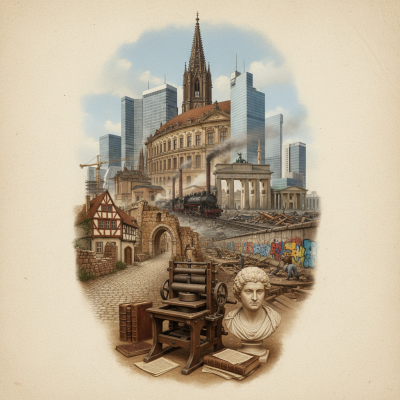
The following is an excerpt from “A History of Germany” by Matthias Vogel, available on MixCache.com.
Introduction
To write a history of Germany is to tell a story fraught with contradictions, a narrative of breathtaking cultural achievement and catastrophic moral failure, of frustrating fragmentation and forceful, often brutal, unification. For much of its existence, "Germany" has been more of a geographical expression than a unified state, a shifting mosaic of tribes, duchies, kingdoms, and principalities scattered across the heartland of Europe. This central location has been both a blessing and a curse. It made the German lands a crossroads of trade, ideas, and culture, but also a perennial battlefield for the continent's great powers. Understanding this history is not merely an academic exercise; it is crucial to understanding the evolution of Europe and the trajectory of the modern world.
The very concept of what it means to be German has been a work in progress for two millennia. The name itself can be traced back to Julius Caesar, who labeled the lands east of the Rhine as Germania to distinguish them from Gaul. For centuries thereafter, the people living in these territories did not primarily see themselves as "Germans." Their loyalties were local, belonging to a Bavarian duke, a Saxon king, a Swabian lord, or the burghers of a free city like Hamburg or Lübeck. A broader sense of shared identity, rooted in a common language, began to form in the Middle Ages but remained a secondary consideration to regional and dynastic allegiances for centuries. It would take the seismic shock of the Napoleonic Wars in the early 19th century to truly ignite the passions of nationalism and set the German-speaking peoples on the long, winding, and often violent road toward a unified nation-state.
This book traces that journey chronologically, from the misty forests of ancient Germania to the bustling, reunified republic of the 21st century. It is a story marked by several recurring and powerful themes that braid themselves through the centuries. The most prominent of these is the relentless tension between centrifugal and centripetal forces—the push and pull between division and unity. From the loose, decentralized structure of the Holy Roman Empire, a sprawling entity that was famously neither holy, nor Roman, nor an empire in the modern sense, to the Cold War division into East and West, the forces of fragmentation have been a constant. Yet, pulling against this was a persistent, yearning desire for a single, powerful German state, a dream that would be realized in dramatically different forms by figures like Otto von Bismarck and, with horrific consequences, Adolf Hitler.
A second critical theme is the enduring struggle between authority and liberty. German history is punctuated by moments when the rights of individuals and local communities clashed with the ambitions of centralized power. Martin Luther's challenge to the authority of the Pope in 1517 was not just a theological dispute; it was a profound act of rebellion that empowered princes and peasants alike, plunging the German lands into a century of religious conflict. The failed revolutions of 1848 saw liberals and nationalists demand a constitutional government, only to be crushed by the established aristocratic order. This tension reached its tragic climax in the 20th century, with the collapse of the fragile Weimar democracy and the surrender of individual liberty to the totalitarian Nazi regime, a catastrophe that remains a central question in the study of this nation's past.
The question of Germany's historical path has been the subject of intense debate among historians. Some have argued for the existence of a Sonderweg, or "special path," suggesting that Germany's development diverged from that of its Western neighbors like France and Britain, making the eventual rise of Nazism almost inevitable. This theory points to a supposed legacy of authoritarianism, militarism, and a weak liberal tradition as factors that set Germany apart. Other historians have challenged this view, arguing that no nation follows a "normal" path and that focusing solely on the Nazi outcome distorts a much more complex and contingent history. While this book will not seek to definitively resolve this debate, it will explore the historical evidence that has fueled it, allowing readers to draw their own informed conclusions.
The journey begins in the dense forests and swamps of ancient Europe, where disparate Germanic tribes first encountered the formidable power of the Roman Empire. Their victory in the Battle of the Teutoburg Forest in 9 A.D. famously halted Rome's expansion eastward and ensured that the lands east of the Rhine would develop along a different trajectory from Romanized Gaul. We will follow the fortunes of these tribes as they coalesce and migrate, ultimately playing a pivotal role in the collapse of the Western Roman Empire. From these tumultuous beginnings, the Frankish kingdom would emerge, culminating in the reign of Charlemagne, a figure claimed by both French and German history, who sought to revive the ideal of a unified Christian empire in the West.
His empire would not last, but its eastern portion, East Francia, would evolve into the Kingdom of Germany and, subsequently, the Holy Roman Empire under Otto I in 962. For the next eight centuries, this unique and often unwieldy political entity would define the German lands. It was a period of crusading knights, like the Teutonic Order expanding along the Baltic coast, and powerful emperors clashing with popes over the ultimate authority in Christendom. It was also the era of the Hanseatic League, a powerful confederation of merchant cities that dominated trade on the North and Baltic Seas, demonstrating a different kind of German power, rooted in commerce rather than conquest.
The early modern period was defined by a cataclysm that would permanently alter Germany and Europe: the Protestant Reformation. When Martin Luther nailed his Ninety-five Theses to a church door in Wittenberg, he unleashed a torrent of religious and political change. The subsequent religious wars, most devastatingly the Thirty Years' War (1618-1648), tore the Holy Roman Empire apart, leaving it a hollowed-out shell and its constituent territories decimated. The Peace of Westphalia that ended the conflict entrenched the political fragmentation of Germany, but also laid the groundwork for the modern system of sovereign states.
Out of the ashes of this conflict, a new power began its inexorable rise in the north: the Kingdom of Prussia. Through military discipline, bureaucratic efficiency, and the ambitions of rulers like Frederick the Great, Prussia would grow to challenge the traditional dominance of the Habsburg emperors in Austria. This Austro-Prussian dualism would become the central dynamic in German affairs for the next two centuries, a rivalry that would ultimately determine the shape of a unified Germany. It was also a period of immense cultural and intellectual flowering, the Age of Enlightenment, when German philosophers, writers, and composers like Kant, Goethe, and Mozart would fundamentally reshape Western thought and art.
The French Revolution and the subsequent Napoleonic Wars would bring the old order crashing down. Napoleon's armies swept across Central Europe, dissolving the thousand-year-old Holy Roman Empire in 1806. French occupation, however, had the unintended consequence of fanning the flames of German nationalism. A shared enemy and a common experience of humiliation gave rise to a powerful new sense of German identity, one based on language, culture, and a shared history. This nationalist fervor would erupt in the revolutions of 1848, a pan-European uprising where German liberals and patriots gathered in the Frankfurt Parliament to draft a constitution for a united, democratic Germany. The dream, however, was short-lived, crushed by the refusal of the Prussian king to accept a crown from the hands of the people.
Where the liberals of 1848 failed, the arch-conservative Prussian Chancellor, Otto von Bismarck, would succeed. A master of diplomacy and ruthless "blood and iron" politics, Bismarck orchestrated a series of wars against Denmark, Austria, and France, culminating in the proclamation of the German Empire in the Hall of Mirrors at Versailles in 1871. Germany was finally a unified nation-state, but it was a unity forged from the top down, an empire dominated by Prussian authoritarianism and military might, rather than the liberal ideals of 1848.
The next four decades would see this new German Empire, the Second Reich, rise to become an industrial and military powerhouse. It was an era of rapid technological advancement, soaring economic growth, and burgeoning social tensions as a new industrial working class emerged. German universities became global centers of science and research, while its arts and culture continued to flourish. Yet, beneath the surface of imperial grandeur lay deep-seated social divisions and an aggressive, expansionist foreign policy that would place Germany on a collision course with its neighbors.
The tumultuous twentieth century would subject Germany to the most extreme trials imaginable. The First World War, a conflict Germany's leaders did much to precipitate, ended in devastating defeat, the collapse of the monarchy, and a revolution that gave birth to the Weimar Republic. This first German democracy, born in the aftermath of war and burdened by the punitive terms of the Treaty of Versailles, was beset by political instability, economic crises, and violent extremism from both the left and the right. Its ultimate failure to withstand these pressures would pave the way for the darkest chapter in German, and perhaps world, history.
The rise of Adolf Hitler and the Nazi Party in 1933 led to the establishment of a totalitarian regime, the systematic persecution and murder of six million Jews in the Holocaust, and the unleashing of the most destructive war in human history. This book will examine the nature of the Third Reich, its ideology of racial supremacy, its brutal conquest of Europe, and its ultimate, crushing defeat in 1945. The end of the war left Germany in ruins, its cities flattened, its economy shattered, and its people confronting an unprecedented moral reckoning.
The post-war era saw Germany once again divided, this time by the ideological chasm of the Cold War. The country became the front line between the democratic West and the communist East. In the West, the Federal Republic of Germany, with the help of its Western allies, experienced an astonishing "economic miracle" and developed into a stable, prosperous democracy. In the East, the German Democratic Republic became a Soviet satellite state, its citizens living under a one-party dictatorship enforced by the infamous Stasi secret police. For forty years, the Berlin Wall stood as the starkest physical symbol of a divided nation and a divided world.
The unexpected and joyous fall of the Berlin Wall in 1989, driven by the courage of East German protestors and the shifting geopolitical landscape, led to the reunification of Germany in 1990. This momentous event brought both opportunities and immense challenges as two vastly different societies and economies sought to merge into one. The final chapters of this history will explore the journey of this reunified Germany, its role as a leading power within the European Union, and the new challenges it faces in the 21st century, from economic integration and an aging population to questions of immigration and national identity in a globalized world.
This history, then, is a sweeping narrative of a people and a nation at the heart of Europe. It is a story of profound light and profound darkness, of glorious creativity and devastating destruction. It is the story of how a loose collection of tribes became an empire, how that empire shattered and was reborn, and how, after plumbing the depths of moral depravity, it has sought to build a stable, democratic, and peaceful future. It is a complex, often uncomfortable, but ultimately indispensable history for anyone seeking to understand the world we inhabit today.
Read “A History of Germany” on MixCache.com →
Please log in or create an account to leave a comment.
No comments yet. Be the first to say something.