
The following is an excerpt from “A History of Florida” by George Andrews, available on MixCache.com.
Introduction
To understand America, one must first understand Florida. This might seem a presumptuous claim for a state often dismissed as the nation’s garish theme park, its sweltering waiting room for the hereafter, or simply the place where bizarre headlines are born. Yet, to dismiss Florida as a caricature is to miss the very essence of its improbable and profoundly American story. It is a peninsula of paradoxes, a place perpetually becoming, a land where the past is never truly past and the future arrives a little ahead of schedule. Its history is a chaotic, vibrant, and often brutal tapestry woven from the threads of conquest, reinvention, spectacle, and survival.
Florida is, first and foremost, a product of its geography. Jutting defiantly into the tropics, a thumb of limestone and sand separating the Atlantic Ocean from the Gulf of Mexico, its very existence is precarious. This low-lying landscape, a mosaic of beaches, swamps, pine flatwoods, and vast wetlands like the Everglades, has shaped every chapter of its human story. This is a land both blessed and besieged by water, a reality that dictated the lives of its earliest inhabitants, lured the first European explorers, and today presents existential challenges in an era of rising seas and intensifying hurricanes. Its climate, a siren song of warmth and sunshine, has been one of its most potent assets, attracting dreamers and schemers for centuries.
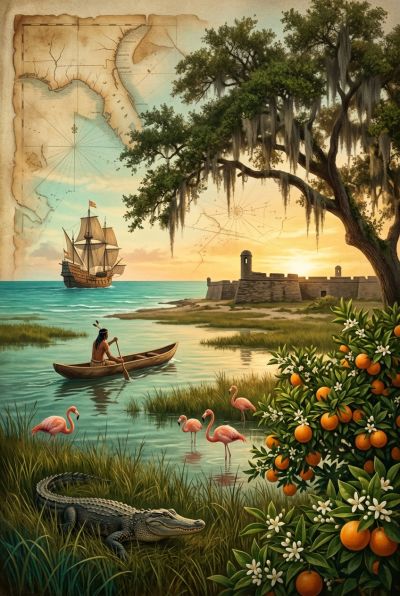
The story of Florida is the story of the people who have been drawn to this unique and demanding environment. Long before European sails broke the horizon, it was home to a multitude of Indigenous tribes who adapted to its rhythms over thousands of years. Then came the Spanish, led by Juan Ponce de León in 1513, who named the land La Florida ("the land of the flowers") and initiated a bloody, centuries-long struggle for control. The French, the British, and finally the Americans would all stake their claim, each leaving an indelible mark on the cultural landscape. St. Augustine, founded by the Spanish in 1565, stands as a testament to this deep colonial past, the oldest continuously inhabited European-established settlement in the United States.
But the parade of peoples did not stop there. Florida became a sanctuary for runaway slaves and displaced Native Americans, who forged a new identity as the Seminoles and fiercely resisted American expansion in a series of protracted and costly wars. After statehood in 1845, the peninsula was gradually settled by American pioneers, cattle ranchers, and planters who established an economy based on agriculture and, tragically, on the labor of enslaved people. By 1860, on the eve of the Civil War, nearly half the state's population was enslaved.
The end of the Civil War and Reconstruction set Florida on a new path. Visionary, and perhaps rapacious, capitalists like Henry Flagler and Henry Plant laid down railroads, connecting the remote tropical wilderness to the rest of the nation and birthing a new economy based on tourism and citrus. This era established a recurring theme in Florida's history: the cycle of boom and bust. The Gilded Age boom was followed by the even more frenetic Florida Land Boom of the 1920s, a period of wild speculation and rapid development that saw cities like Miami seemingly spring from the mangrove swamps overnight. The subsequent crash was just as dramatic, a painful prelude to the Great Depression.
World War II proved to be a pivotal turning point, transforming the state in ways few could have imagined. The year-round mild climate made it an ideal location for military training, bringing hundreds of thousands of service members to Florida, many of whom would return to make it their permanent home after the war. This influx kicked off a post-war boom that dwarfed all previous ones, fueling decades of explosive population growth, suburban sprawl, and infrastructure development that continues to this day. Once one of the least populated southern states, Florida grew into a megastate, surpassing New York in 2014 to become the third most populous in the nation.
This rapid growth has been fed by constant waves of migration. Retirees from the North, seeking sunshine and leisure, created entire new communities. The Cuban Revolution of 1959, and subsequent waves of immigration from Latin America and the Caribbean, radically reshaped South Florida’s demographic and cultural landscape, making it a bilingual, international crossroads. This constant churn of people, a dizzying mix of cultures, ages, and ambitions, has made Florida a dynamic and often volatile melting pot. It is a place where few people are from, a state of transplants perpetually seeking to reinvent themselves.
This reinvention is written onto the landscape itself. Florida is the place where swamps are drained to build suburbs, where a cattle town in the center of the state was transformed into the global capital of themed entertainment by Walt Disney World, and where a strip of coastal marshland became the launchpad to the moon. The arrival of the space program at Cape Canaveral and the opening of the Magic Kingdom in 1971 were not just transformative local events; they cemented Florida’s image in the national consciousness as a place where the fantastical could become reality.
Of course, this relentless development has come at a cost. The very natural beauty that draws people to Florida is under constant threat from the pressures of its own growth. The struggle to save the Everglades, to protect fragile coastlines, and to manage scarce water resources is a central and ongoing chapter in the state's history. The tension between development and environmental preservation is one of the fundamental paradoxes of modern Florida.
The state’s political landscape is just as complex. For decades, Florida has been a crucial swing state, a bellwether whose diverse electorate has often mirrored the political divisions of the nation at large. It has been at the epicenter of national political dramas, most notably the chaotic presidential election recount of 2000, which introduced the world to the "hanging chad" and highlighted the state’s pivotal role in determining the country's leadership. In more recent years, the state has trended more reliably Republican, but its dynamic and ever-changing demographics ensure it will remain a political battleground for the foreseeable future.
And then there is the weirdness. Any accounting of Florida’s history must acknowledge its reputation as a haven for the strange, the eccentric, and the downright bizarre. The "Florida Man" meme, a shorthand for outlandish news headlines, is more than just an internet joke; it reflects a certain reality. This reputation is partly a product of the state’s strong open-government laws, which make police reports unusually accessible to the media. But it also stems from its frontier history, its transient population, and its identity as a place on the edge—geographically, culturally, and sometimes behaviorally. It is a state where the lines between reality and fantasy can often seem to blur.
This book traces the long and winding story of this remarkable place, from its deep geological past to its complex and contested present. It is a chronological journey through the triumphs and tragedies, the booms and the busts, the characters and the conflicts that have shaped the Sunshine State. We will encounter the first peoples who carved out a life in a challenging land, the conquistadors who sought gold and glory, the pioneers who tamed a wilderness, the tycoons who sold paradise, and the diverse millions who continue to flock to its shores.
It is the story of a state that is quintessentially American, embodying the nation's best and worst impulses: its relentless optimism, its entrepreneurial spirit, its cultural diversity, its political divisions, and its often-destructive relationship with the natural world. Florida's story is not just a regional history; it is a vital and ongoing chapter in the larger American narrative. To understand where the country is going—demographically, environmentally, culturally, and politically—one need only look to the peninsula. The future, for better or worse, is being rehearsed in Florida.
Read “A History of Florida” on MixCache.com →
Please log in or create an account to leave a comment.
No comments yet. Be the first to say something.