
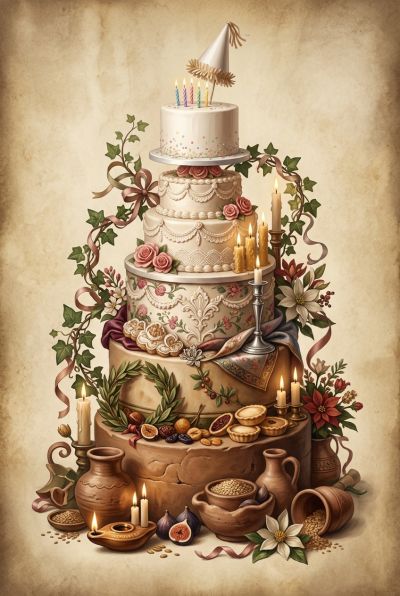
The following is an excerpt from “A History of Birthdays” by Samuel Rovanion, available on MixCache.com.
Introduction
Birthdays are among the most universal of human experiences. Across the globe, regardless of language, religion, or social standing, the anniversary of a person's birth is often treated as a moment of profound significance. We gather friends and family, consume specific ritualistic foods, and perform age-old customs such as blowing out candles or singing dedicated songs. Yet, despite the ubiquity of these traditions today, the concept of celebrating one’s own birth was not always a standard feature of human life. For vast stretches of history, the individual was secondary to the community, and the specific date of a person's arrival into the world was often unrecorded, forgotten, or deemed irrelevant.
The journey of the birthday celebration begins not with the common citizen, but with the divine. In the earliest civilizations, such as Ancient Egypt, the concept of a 'birthday' was reserved for those who bridged the gap between the earthly and the eternal. When a Pharaoh was crowned, they were believed to have been 'born' as a god. These royal anniversaries were the first recorded instances of birth celebrations, focusing on the transformation of a human being into a deity. It was a celebration of power and cosmic order rather than the personal milestone we recognize today.
As civilization progressed, the Greeks and Romans expanded these rituals. The Greeks introduced the symbolic use of fire and cakes to honor the moon goddess Artemis, creating a precursor to the modern birthday cake. Meanwhile, the Romans were the first to bring the celebration down to earth for the average person—or at least the average male citizen. They established private clubs and public festivals to mark the birth of family members and influential leaders. However, these practices were often deeply tied to the 'Genius,' a protective spirit that followed a man from birth, rather than a celebration of the person’s ego or identity.
The rise of organized religion, particularly early Christianity, saw a sharp decline in birthday festivities. To the early Church fathers, celebrating one’s birth was a pagan custom associated with vanity and worldly attachment. They believed that the day of a person's death—their 'birth' into the afterlife—was far more important than their entry into a world of sin. This shift in perspective meant that for centuries, 'Name Days' (the feast day of the saint for whom a child was named) took precedence over actual birth dates, a tradition that persists in parts of Europe and the Mediterranean to this day.
The modern birthday as we know it began to take shape during the Enlightenment and the Industrial Revolution. In 18th-century Germany, the 'Kinderfeste' emerged, prioritizing the joy and development of the child. This was the first time that the modern ingredients of a party—the cake, the candles (representing the 'light of life'), and the focus on the child’s future—came together in a recognizable form. As the 19th century dawned, mass production made sugar, flour, and greeting cards affordable for the middle and working classes, democratizing a ritual that had once been the exclusive domain of the elite.
This book explores the fascinating, winding path that birthday celebrations have taken through human history. We will examine how the 'Happy Birthday' song became a global phenomenon, why we fear certain milestones like 'turning thirty,' and how different cultures around the world have developed unique rites of passage to mark the transition from childhood to adulthood. By tracing these customs from ancient ziggurats to modern digital notifications, we gain a deeper understanding of our own need to be seen, to be celebrated, and to mark our place in the relentless flow of time.
Read “A History of Birthdays” on MixCache.com →
Please log in or create an account to leave a comment.
No comments yet. Be the first to say something.