
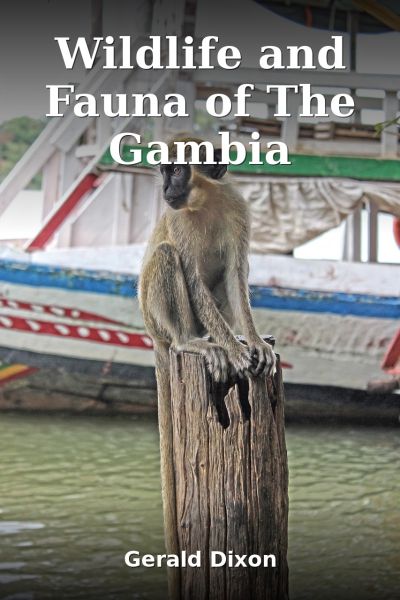
At just 11,300 square kilometers, The Gambia is Africa's smallest mainland country — a slender strip wrapped around its namesake river. Yet this modest footprint contains over 500 bird species, endangered primates, West African manatees, and ecosystems ranging from coastal mangroves to inland savannas. Gerald Dixon's guide unpacks how a single waterway creates such concentrated ecological richness.
What the Book Is About
The book moves systematically through The Gambia's physical and biological geography. Chapter 1 establishes the geographical and climatic stage: a flat, low-lying nation (highest point 53 meters) bisected by a 400-kilometer navigable river whose seasonal salinity shifts dictate habitat boundaries. Chapters 2–7 explore the resulting mosaic — riverine wetlands, coastal zones, estuarine mangroves, savannas (Guinea and Sudanian types), gallery and coastal forests, and the plant communities anchoring each. Chapters 8–12 survey mammals by ecological grouping: primates, antelopes and ungulates, small mammals (rodents, bats, pangolins), and aquatic/marine species. Chapters 13–15 dedicate extensive coverage to birds, including migration along the East Atlantic Flyway and detailed profiles of kingfishers, raptors, and storks. Chapters 16–20 cover reptiles, amphibians, turtles, fish, and marine invertebrates. The final five chapters address protected areas, conservation threats, community-based initiatives, cultural connections, and future directions. The work serves as both field reference and conservation overview for naturalists, travelers, students, and Gambian residents.
The River as Ecological Architect
The Gambia River is not merely a setting but the book's central organizing principle. Its tidal influence reaches 250 kilometers inland during the dry season, creating a salinity gradient that structures everything from mangrove zonation to fish distribution. As Chapter 2 explains, "The tidal effect can reach hundreds of kilometers upstream, although the point where saltwater gives way to purely freshwater conditions varies depending on the season." This dynamic shapes the "Banto Faros" — seasonally flooded riverine flats that become hypersaline deserts in the dry season and rice paddies in the wet. The river's bolons (creeks) extend this influence into a "vast, interconnected web of aquatic and semi-aquatic habitats." Chapter 4 notes that an estimated "80% of the commercial fish species caught off the coast of The Gambia depend on the mangroves for at least part of their life cycle." The river also enables the Chimpanzee Rehabilitation Project on the Baboon Islands (Chapter 21), where islands provide "a degree of isolation and protection that is crucial for its primary inhabitants."
Birdlife Beyond the Numbers
The 500+ species figure is impressive, but the book's value lies in explaining why such diversity concentrates here. Chapter 13 attributes it to "the varied habitats found across the nation, from the saline coastal lagoons and extensive mangrove forests to the freshwater swamps, gallery woodlands, and open savannas." Chapter 14 positions The Gambia on the East Atlantic Flyway, "a migratory pathway used by an estimated 90 million birds annually," where coastal wetlands become "temporary homes for large flocks of these long-distance travelers." The book doesn't just list species; it explains behavioral ecology. Chapter 15 details how the African Fish Eagle's "iconic cry" signals territory along the river, while the Palm-nut Vulture is "unusual among vultures for their diet which includes the fruit of oil palms and often crabs." Practical guidance appears too: the dry season (November–April) concentrates birds around remaining water, while the wet season offers breeding plumage displays and intra-African migrants.
Conservation in a Human Landscape
Dixon avoids both alarmism and complacency. Chapter 22 catalogs threats systematically: habitat loss from agricultural expansion, urban encroachment on coastal wetlands, illegal bushmeat hunting, overfishing (including "IUU fishing by foreign vessels"), human-wildlife conflict (baboons and warthogs raiding crops), and climate change impacts on sea level and rainfall patterns. Protected areas cover only "3.7% to 6.4% of the total land area" (Chapter 21), with a government target of 5%+. But the book highlights pragmatic responses. Chapter 23 describes community eco-tourism where "a fisherman who once hunted manatees becomes a protector of the species" — a shift driven by revenue-sharing from guided boat tours and craft sales. The Tumani Tenda Eco-tourism Camp exemplifies "community-led initiative that involves activities like farm tours and tree planting, demonstrating sustainable practices." Chapter 21 notes that Abuko Nature Reserve, at just one square kilometer, hosts "over 250 species recorded within its boundaries," proving small areas can punch above their weight when strategically placed.
Cultural Threads in Natural History
Chapter 24 distinguishes this guide from purely biological surveys by weaving wildlife into Gambian cultural fabric. Sacred crocodile pools at Kachikally, Folonko, and Berending function as "fertility shrines" where crocodiles are "intermediaries between the ancestors and the community." The Ninki Nanka — a "legendary creature said to inhabit the swamps and mangrove areas," described as "a large, reptilian, dragon-like beast with supernatural powers" — serves as both cultural touchstone and practical warning keeping children from dangerous wetlands. Proverbs encode ecological knowledge: "the croaking of frogs does not prevent the elephant from drinking" mirrors "dogs bark, but the caravan passes." Even the national coat of arms features lions (extinct in-country since the early 20th century) alongside the spotted hyena, the actual national animal. This chapter argues that conservation succeeds when it "builds on existing values and traditions" rather than imposing external frameworks.
The Future of Gambian Wildlife
The concluding chapter frames conservation as a series of solvable but resource-intensive challenges. Expanding protected areas requires "strategic" placement based on "sound ecological data and with the full participation and agreement of local communities." Fisheries management needs "enhanced surveillance and enforcement capabilities to combat IUU fishing" and careful assessment of fishmeal factories' impact on food security. Climate adaptation means restoring mangroves as "natural buffers against sea-level rise and coastal erosion." The book's final paragraphs emphasize that success depends on "a culture of conservation among all Gambians" — education, media campaigns, and making conservation "a shared value and a national priority." It's a measured roadmap, not a manifesto.
Who Should Read This
This guide serves birders planning a Gambian trip (the site-specific chapters on Abuko, Tanji, Bao Bolong, and Kartong are practically useful), West Africa-focused ecologists seeking a synthesized reference, and conservation practitioners interested in community-based models. General nature readers will appreciate the accessible structure and cultural context. Those wanting a photo-heavy field guide or a narrative travelogue should look elsewhere — this is a systematic, text-forward survey. For its intended purpose — a single-volume ecological and conservation overview of The Gambia — it is thorough, grounded, and refreshingly free of hyperbole.
Read “Wildlife and Fauna of The Gambia” on MixCache.com →
Please log in or create an account to leave a comment.
No comments yet. Be the first to say something.