
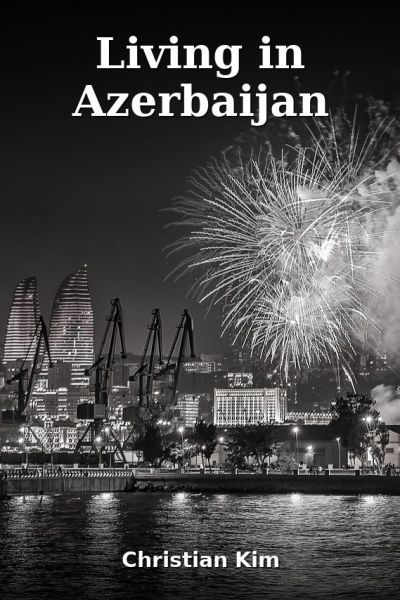
Azerbaijan markets itself as the Land of Fire, a crossroads of Europe and Asia where ancient fire temples sit beside futuristic skyscrapers. For expatriates considering a move, the romance of that image quickly collides with the reality of State Migration Service registration deadlines, manat exchange rates, and the etiquette of refusing tea in an Azerbaijani home. Christian Kim's guide meets that collision head-on, offering a structured, detail-heavy roadmap that treats the practical and the cultural as equally essential.
What the book is about
Organized into 25 chapters, "Living in Azerbaijan: A Guide for Expats" moves chronologically from arrival logistics through long-term integration. The first half tackles paperwork: e-visas, the mandatory three-day SMS registration, work permits tied to employer sponsorship, and the five-year path to permanent residency. The middle sections dissect daily economics — rent ranges, grocery budgets, utility costs, and the 18% VAT — while later chapters explore healthcare disparities between Baku and the regions, international school options, and the unwritten rules of Azerbaijani hospitality. The book assumes a reader who is either planning a relocation or recently arrived, and it writes for professionals, families, and retirees alike, with specific callouts for each. Its tone is instructional rather than narrative, favoring bullet-ready facts over anecdote.
The bureaucracy is a system, not a maze
Kim frames Azerbaijani immigration as a "well-trodden path" rather than a labyrinth, but he doesn't soften the requirements. Chapter Two makes clear that the 30-day e-visa is only a starting point; anything longer demands an embassy application, a tenancy contract, and registration with the State Migration Service within three days of arrival — a step that "isn't merely a suggestion; it's a legal obligation." The work permit process takes two to four weeks and requires the employer to prove no local candidate could fill the role. Temporary residence permits renew annually with updated proof of income, health insurance, and a clean criminal record. After five consecutive years, permanent residency becomes an option. Kim's practical advice: "Create physical and digital copies of everything" and "start gathering your documents and initiating applications well in advance of your intended move."
Cost of living comes with receipts
Chapter Three supplies the concrete numbers expats need for negotiation and budgeting. A single person's monthly costs in Baku average $548 before rent; a family of four runs $2,023. Rent for a one-bedroom in the city center spans €270–€800, dropping to €235–€424 outside the center. Groceries cost a single expat roughly €150 monthly, less if they shop at local bazaars. Utilities for an 85 m² apartment run €50–56, and a monthly metro pass costs $12. Dining out: €5–8 for a mid-range meal, €22–55 for two with drinks. The book also flags where savings vanish — imported luxury goods and international school tuition — so readers can plan around the outliers rather than be surprised by them.
Culture lives in the details of hospitality
Chapters Twelve and Twenty-Four treat etiquette as operational knowledge. Refusing tea, sweets, or fruit in an Azerbaijani home "can be considered impolite"; accepting at least a small portion signals respect. Greetings follow gendered scripts: men shake hands and often kiss cheeks; women hug and kiss once on the left cheek; a man greeting a woman should wait for her to extend her hand. Shoes come off at the door, hosts provide slippers. Toasts are mandatory when alcohol appears. Gift-giving carries its own choreography: odd-numbered flowers only (even numbers are for funerals), alcohol only if the host drinks, and the recipient "politely refuse[s] a gift at least twice before reluctantly accepting it." Kim also notes that during Ramadan, "it is considered considerate to avoid eating or drinking in public during daylight hours." These aren't presented as quaint customs but as social infrastructure that determines whether an expat is welcomed or merely tolerated.
Healthcare is a two-tier reality
Chapter Seven draws a sharp line between Baku and everywhere else. Private clinics like Medeks and Etiler offer modern equipment, English-speaking staff, and consultations at €30–50 — "generally quite reasonable when compared to private healthcare costs in many Western nations." Dentistry and cosmetic surgery are highlighted as particular strengths. Outside the capital, however, facilities "often lag behind" with older equipment, fewer specialists, and limited English. The takeaway is unambiguous: comprehensive international insurance with inpatient coverage and medical evacuation is "not just advised; it's practically mandatory." The book also recommends drinking only bottled water, keeping a list of private clinic contacts, and knowing that the general emergency number 112 may not have English-speaking operators.
Family life hinges on school choice and community
For expats with children, Chapter Eight and Chapter Twenty-Three make education the center of gravity. Baku's international schools offer British, American, French, and Russian curricula, often with IB or Cambridge accreditation, but tuition "can be substantial" — "several thousand to tens of thousands of US dollars per child" annually. Many employer packages include an education allowance, which the book advises confirming before committing. Beyond classrooms, the expat community clusters around schools, Baku Boulevard, and Facebook groups like "Expats Azerbaijan," organizing coffee mornings, hiking trips, and holiday celebrations. Domestic help (nannies, housekeepers, drivers) is "affordable" and common, though the book urges clear contracts and fair wages. For teenagers, the transition can be harder; the guide suggests sports teams, clubs, and counseling services available through international schools.
Who should read this
This guide serves best the expat who values checklists over storytelling — someone relocating for work or family who needs to know the exact documents for SMS registration, the average manat per kilowatt-hour for electricity, or the protocol for bringing flowers to a dinner party. Retirees and digital nomads will find the cost-of-living breakdown and visa pathways useful, though the book's employment focus means some chapters (work permits, employer-sponsored permits) are less relevant. Readers looking for cultural history, language lessons, or narrative travel writing should look elsewhere. For its intended audience, though, the book functions as a reference manual you'll keep open on your desk during the first six months, not a memoir you read once and shelve.
Read “Living in Azerbaijan” on MixCache.com →
Please log in or create an account to leave a comment.
No comments yet. Be the first to say something.