
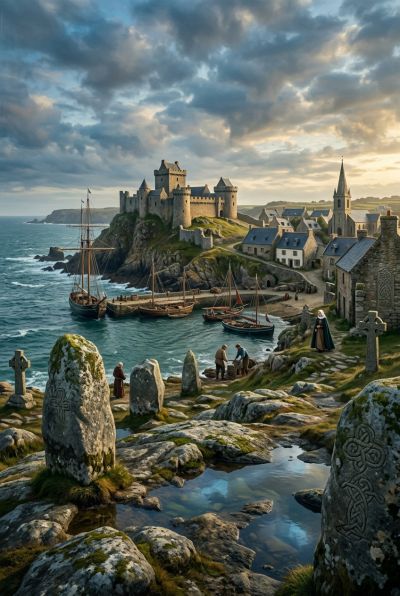
There is a land of granite and water that juts defiantly into the Atlantic from the western edge of France. This is Brittany, a peninsula with a spirit as rugged and enduring as its coastline. Julien Armand's A History of Brittany takes that opening image seriously, guiding readers across more than six thousand years — from the silent megaliths of Carnac and Barnenez to the offshore wind farms and housing crises of 2024 — without ever losing sight of the tension between a powerful central state and a people who, as the introduction puts it, "remained stubbornly, unmistakably, and proudly themselves."
What the book is about
The book unfolds in twenty-five chapters, moving chronologically from the Neolithic through the Roman conquest, the arrival of Britons from across the Channel, the rise and fall of early kingdoms, the unification under Nominoe, the Viking catastrophe, the Duchy's golden age, the union with France under Anne of Brittany, the Ancien Régime's tug-of-war over provincial privileges, the Chouannerie, the world wars, postwar modernization, the Breton language's near-collapse and revival, modern nationalism, the EU relationship, and contemporary culture and challenges. Armand writes for the general reader who wants a single-volume narrative that does not shy away from complexity: he names the treaties, the battles, the demographic shifts, and the cultural movements, but he also pauses to explain why the gabelle exemption mattered, how the fest-noz was resurrected, and what the marées vertes tell us about an agricultural model at war with its own environment. The tone is analytical but never dry; the structure rewards both cover-to-cover reading and chapter-by-chapter reference.
The landscape as protagonist
Armand establishes geography as a historical actor from the first page. The duality of Armor (the sea-facing coast) and Argoat (the wooded interior) structures everything from Neolithic settlement patterns — concentrated on fertile estuaries — to the Chouans' guerrilla tactics in the bocage, to the modern divide between booming Rennes and depopulating central Brittany. Chapter One makes this concrete: the Cairn of Barnenez, older than the Egyptian pyramids, was built on a peninsula overlooking the Bay of Morlaix because its builders "understood the rhythms of the sun and stars" and chose a place that commanded both land and sea routes. Centuries later, the same geography made Brest and Lorient indispensable to the German U-boat campaign and, today, to France's marine renewable energy ambitions. The book never lets the reader forget that history in Brittany is written on a stage of tides, granite, and hedgerows.
Language as a battleground
The trajectory of the Breton language runs like a fault line through the narrative. Chapter Three shows how the migration from Britain implanted a Celtic tongue that gave the peninsula its name — Breizh, "Little Britain" — and created the enduring divide between Breizh Izel (Lower Brittany, Breton-speaking) and Breizh Uhel (Upper Brittany, Gallo-speaking). Chapter Twenty-One documents the state's systematic suppression: the 1902 Combes circular forbidding priests from preaching in Breton, the schoolhouse *symbole* that forced children to wear a wooden clog or slate for speaking their mother tongue, the postwar rupture when parents "made the conscious decision not to pass the language on to their own children, believing that speaking only French would save them from the same humiliation." Yet the same chapter charts the reversal — Diwan immersive schools founded in 1977, bilingual streams in public and Catholic systems, the *Ofis Publik ar Brezhoneg* campaign, and UNESCO's 2012 recognition of the *fest-noz* as intangible heritage. The language is no longer simply inherited; it is, increasingly, a "conscious cultural and political choice."
Autonomy negotiated, lost, and reimagined
The book's political spine is the centuries-long negotiation between Breton particularism and French centralization. Nominoe's ninth-century victory at Ballon (Chapter Five) created a de facto independent church and state; the 1532 Edict of Union (Chapter Eleven) preserved Brittany's exemption from the *gabelle* and its own *Parlement* and Estates; the *Bonnets Rouges* revolt of 1675 (Chapter Twelve) erupted when Colbert imposed taxes without Estates' consent; the Chouannerie (Chapter Fourteen) was sparked as much by the Civil Constitution of the Clergy and the *levée en masse* as by royalist sentiment. In the twentieth century, the CELIB (Chapter Twenty) lobbied for a "Breton Plan" within the French state, while the FLB and ARB (Chapter Twenty-Two) turned to bombing — culminating in the 1978 Versailles attack and the fatal 2000 Quévert bombing that "effectively destroyed whatever shred of public sympathy the bombers had left." Today, the demand for reunification of Loire-Atlantique (Nantes) with the administrative region enjoys majority support but faces Paris's refusal to allow a referendum. The framework has shifted from armed struggle to institutional pressure, but the core argument — that Brittany's "rights, freedoms, and liberties" require a political vessel — persists.
Economic miracles and their toxic residues
Armand excels at showing how state-driven modernization remade Brittany in a single generation. The *remembrement* that bulldozed hedgerows, the tractorization that went from a few hundred machines in 1945 to tens of thousands by the 1960s, the rise of the *agro-alimentaire* sector and the Citroën plant at La Janais — all are narrated with an eye for both the prosperity they brought and the social fabric they tore. The environmental bill comes due in Chapter Twenty-Three: the Common Agricultural Policy "supercharged" intensive livestock farming, creating a nitrate surplus that fuels the *marées vertes*, "a chronic environmental plague" releasing lethal hydrogen sulphide. The Common Fisheries Policy and Brexit then shattered the coastal economy. The book's final chapter pivots to the new wager: marine renewables (the Saint-Brieuc wind farm, tidal test sites at Paimpol-Bréhat), cybersecurity in Rennes, and a demographic influx that has triggered a housing crisis — "the land of closed shutters" where second homes exceed 80% of stock in some communes. Armand presents these not as separate problems but as the integrated consequences of a development model that is now being renegotiated in real time.
Culture as resistance and reinvention
Chapter Twenty-Four demonstrates that Breton identity has migrated from the parish and the barricade to the festival, the brand, and the playlist. The *fest-noz* — revived in the 1950s, exploded in the 1970s, now UNESCO-listed — functions as a "living, breathing" social space where *kan ha diskan* coexists with electronic fusion (Denez Prigent) and Breton-language hip-hop. The *Gwenn ha Du* flag, once a militant banner, flies from town halls and car bumpers. The clothing brand À l'Aise Breizh and the "Produit en Bretagne" label turn identity into commerce without (entirely) emptying it of meaning. Even football derbies become "a passionate, noisy, and colorful manifestation of local pride." Armand avoids both nostalgia and boosterism: he notes that the Pont-Aven school produced a "romantic and stereotypical" vision, that TV Breizh abandoned its linguistic mission for profit, and that the new speakers are "often urban, well-educated, and politically engaged" — a demographic shift that reshapes what "being Breton" means.
Who should read this
Readers who want a single, well-structured narrative that connects the standing stones of Carnac to the offshore wind turbines of Saint-Brieuc will find exactly that. The book rewards anyone interested in how minority cultures negotiate survival within a centralized state, how language policy works in practice, or how environmental history and economic policy collide. It is less suited for readers seeking a narrowly focused study — say, only the Neolithic, only the Chouannerie, or only the EU period — since its strength is the long view. Specialists may quibble with compression in their own subfields, but the generalist will come away with a coherent framework for understanding a peninsula that, as Armand's final sentence has it, "now faces the task of navigating its own complex and uncertain future."
Read “A History of Brittany” on MixCache.com →
Please log in or create an account to leave a comment.
No comments yet. Be the first to say something.