
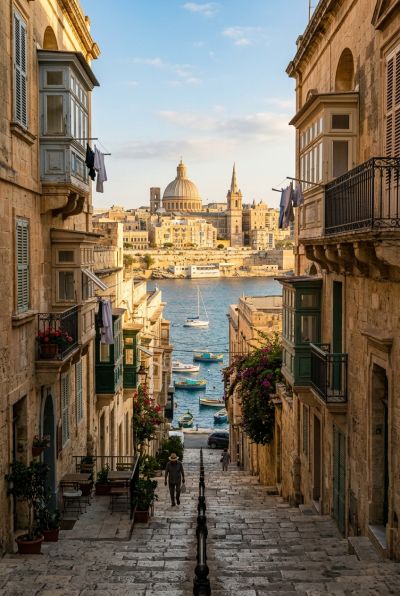
Valletta doesn't just sit on a peninsula — it grows out of one, its honey-coloured limestone streets laid out on a Renaissance grid that still channels sea breezes through the same alleys where knights once marched in armour. Dr Alex Bugeja's Valletta: A Guide to the Capital City of Malta treats the city not as a museum exhibit but as a functioning organism, one that has survived Ottoman bombardment, French looting, British colonial rule, and World War II saturation bombing to emerge as a UNESCO World Heritage site that still smells of fresh pastizzi and echoes with the noon cannon. This is a guide written by a historian who knows the archives but walks the streets, and it shows.
What the book is about
The book spans 25 chapters that move chronologically and thematically from Valletta's founding after the Great Siege of 1565 to practical advice for visiting in each season. Early chapters lay out the city's military and political history — the Knights of St. John, the French interlude, British naval dominance, and the road to independence. Middle sections function as a detailed walking guide: arriving and navigating (Chapter 2), the Grand Harbour fortifications (Chapter 3), and individual landmarks like St. John's Co-Cathedral (Chapter 4), the Grand Master's Palace (Chapter 5), and the Upper and Lower Barrakka Gardens with the Saluting Battery (Chapters 6–7). Later chapters branch into specialized interests: war museums (Chapters 8–9), lesser-known churches (Chapter 10), the Manoel Theatre (Chapter 11), archaeology (Chapter 12), the regenerated Waterfront (Chapter 13), shopping (Chapter 14), cuisine (Chapter 15), nightlife (Chapter 16), street-level exploration (Chapter 17), the Malta Experience audiovisual show (Chapter 18), festivals (Chapter 19), and day trips to Mdina/Rabat (Chapter 20) and the Three Cities (Chapter 21). The final chapters address niche audiences — art lovers (Chapter 22), families (Chapter 23), hidden courtyards (Chapter 24) — and close with a seasonal breakdown (Chapter 25). The intended reader is clearly a curious traveller who wants historical context alongside practical logistics, not a checklist tourist.
A city designed for defence that became a city for living
The tension between Valletta's martial origins and its civilian life runs through the entire book. Francesco Laparelli's 1566 grid plan was explicitly military: "wide, straight streets were designed to allow cooling sea breezes to circulate... and to enable the rapid movement of troops and weaponry from one end of the city to the other." Gerolamo Cassar then layered Baroque palaces, churches, and auberges onto that skeleton, creating what the Introduction calls "a city built by gentlemen for gentlemen." Bugeja traces how each ruler adapted the framework — the British adding neoclassical gates and red post boxes, the 2015 Renzo Piano project inserting a Parliament House and open-air theatre into the bombed Royal Opera House ruins. The result is a place where "ancient fortifications house contemporary art galleries, and historic palazzos have been transformed into boutique hotels." Chapter 17 captures the daily texture: "colourful laundry hanging from traditional enclosed balconies, small, family-run shops, and hidden chapels" coexisting with the grid's logic. The city's verticality — steep cross-streets dissolving into staircases (“taraġ”) built for armoured knights — remains its defining topological quirk.
The Grand Harbour as a layered manuscript of military engineering
Chapter 3 reads like a stratigraphy of the harbour's defences, showing how each power added its own layer without erasing the previous ones. The Knights began with Fort St. Angelo and the Birgu peninsula; the 1565 siege forced them to fortify the Sciberras Peninsula itself, creating Valletta's land front with its "massive, angular bastions” and dry ditch "hewn directly from the peninsula's rock." The Cottonera Lines (1670) encircled the Three Cities in a 4.5-kilometre outer shell. The British contributed the Grand Harbour Breakwater (1903–1910) to counter torpedo threats, and the Lascaris Battery casemated into the lower bastions. Fort Ricasoli and Fort St. Elmo still frame the harbour mouth in a deadly crossfire. Bugeja writes that "to look upon it today is to witness a breathtaking panorama of military architecture, a man-made landscape of golden limestone walls, bastions, and forts rising from the deep blue water." A boat tour, he argues, is the only way to grasp the system's scale: "From this perspective, the bastions reveal their true, intimidating height, and the strategic genius of the engineers who designed them becomes startlingly clear."
St. John's Co-Cathedral: where the floor is a history book
Chapter 4 devotes twenty pages to this single building, and the detail justifies it. The exterior's Mannerist restraint — "a fine example of the Mannerist style favoured by its architect, Gerolamo Cassar" — gives no hint of Mattia Preti's 1660s Baroque transformation. The ceiling's eighteen painted scenes from the life of St. John the Baptist use trompe-l'oeil so convincing that "figures that appear to be three-dimensional statues are, upon closer inspection, revealed to be cleverly painted illusions." But the floor may be the most arresting feature: "around 400 of the most illustrious Knights of the Order" lie beneath marble intarsia tombstones bearing "the coat of arms, epitaph, and symbols associated with the knight buried beneath." Skeletons with scythes (“memento mori”) alternate with angels blowing trumpets (fame). The Oratory holds Caravaggio's only signed work, The Beheading of St. John the Baptist, his signature written "in the red blood that spills from the Baptist's neck." Bugeja notes practical constraints too: a strict dress code, no stiletto heels (to protect the floor), and an included audio guide that "allows visitors to explore at their own pace."
Cuisine as a palimpsest of empire
Chapter 15 frames Maltese food as "a delicious and complex chronicle of its history, a layered narrative told through flavours, textures, and aromas." Each ruler left a trace: Arab influence in the date-filled imqaret and spice profiles; Sicilian in kannoli and pasta; British in the ubiquitous Cisk lager and the very concept of a "platter" of appetisers. The Knights' hunting restrictions inadvertently popularised rabbit (“fenek”), now the national dish, served as Stuffat tal-Fenek (red-wine braise) or Fenek Moqli (garlic-and-white-wine pan fry). The ftira, UNESCO-listed sourdough bread rubbed with “kunserva” (tomato paste) and packed with tuna, capers, olives, and mint, epitomises the “cucina povera” principle. Seasonal lampuka (mahi-mahi) appears in autumn pies with spinach and cauliflower. Indigenous grapes — Girgentina (white) and Ġellewža (red) — are having a renaissance. Bugeja maps where to eat: Is-Suq tal-Belt's restored Victorian market hall for variety, the Waterfront's Pinto Stores for harbour views, Strait Street's cellar bars for wine and platters.
Hidden Valletta: war rooms, cloisters, and the city's green lungs
Some of the book's most vivid passages describe spaces most visitors miss. Chapter 9 descends 150 feet into the Lascaris War Rooms, expanded from Knights-era slave tunnels into a 1943 Allied HQ where Eisenhower, Montgomery, Cunningham, and Tedder directed Operation Husky (the Sicily invasion). The restored Filter Room and two-storey Operations Room with its plotting table and WAAF plotters "moved counters across the map with long magnetic rakes" feel startlingly immediate. Chapter 24 reveals cloisters long closed to the public: St. Catherine's Monastery's "secret garden" (a former quarry turned orchard) accessed via the new Mysterium Fidei Museum, and the Augustinian Priory's restored 18th-century cloister. Public gardens get their due too — Hastings Gardens on the western bastions offers "a more modern panorama" toward Sliema, while Sa Maison Garden in Floriana preserves British regimental crests carved into bastion walls. The newest, Laparelli Gardens, landscaped into the once-impassable city ditch, gives "a humbling, worm's-eye view of the city's immense fortifications." These spaces, Bugeja argues, are "the lungs of the city, essential design features that provide light, air, privacy, and tranquillity."
Who should read this
Travellers who want a single volume that replaces a library of specialised guides — history, architecture, food, museums, family activities, seasonal planning — will find this indispensable. Readers interested in military history, Baroque art, or Mediterranean urbanism will appreciate the scholarly depth (Bugeja cites primary sources like the 1565 siege chronicles and Matteo Perez d'Aleccio's frescoes). The book is less suited for ultralight packers wanting a pocket map with top-ten lists; its 25 chapters demand selective reading or pre-trip study. But for anyone willing to engage with Valletta as a place where "history is not just observed but felt in the very fabric of its existence," this guide delivers both the facts and the feeling.
Read “Valletta” on MixCache.com →
Please log in or create an account to leave a comment.
No comments yet. Be the first to say something.