
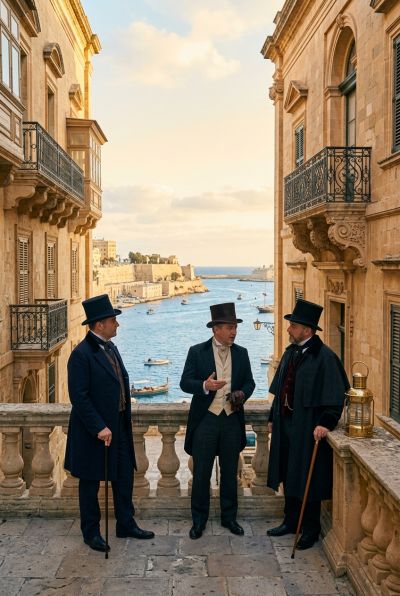
Valletta is a paradox carved in honey-colored limestone: a military machine designed to repel Ottoman cannon that doubled as a stage for aristocratic pageantry, and a city that has survived two existential sieges only to reinvent itself as a UNESCO jewel and European Capital of Culture. Charles Corbett's Valletta: The City Built By Gentlemen For Gentlemen unpacks this duality across 25 chapters that move from foundation stones to cruise-ship terminals without losing the narrative thread. The result is less a conventional chronicle than a guided walk through a city that Corbett clearly knows stone by stone.
What the book is about
The book follows a roughly chronological structure but organizes itself thematically within that spine. After an introduction that sets up the city's "essential duality" — fortress and beauty, war and civility — the first four chapters lay the groundwork: the Great Siege of 1565 (Chapter 3), the Grand Master who willed the city into being (Chapter 2), the Renaissance grid plan of Francesco Laparelli (Chapter 4), and the bastion system that made the grid defensible (Chapter 5). Chapters 6 through 14 explore the institutions and architecture the Knights built within that grid: the Auberges, St. John's Co-Cathedral, Caravaggio's tenure, the Grandmaster's Palace, the Sacra Infermeria, the Grand Harbour, the Manoel Theatre, and the domestic streetscape of palaces, balconies, and hidden courtyards. Chapters 15 through 18 pivot to the British era, the second great siege of World War II, post-war reconstruction debates, and the city's quiet rivalry with Mdina. The final chapters (19-25) cover the constellation of parish churches, the festival calendar, the waterfront's reinvention, culinary traditions, UNESCO designation, the Renzo Piano redevelopment, and a closing meditation on what "a city for gentlemen" means in a 21st-century republic. The intended reader is someone who wants more than a travel guide but less than an academic monograph — a serious generalist prepared to follow Corbett through military engineering, art history, urban planning, and social history in a single volume.
The grid as philosophy: order imposed on chaos
Corbett returns repeatedly to the founding insight that Valletta was "one of the first cities in Europe to be laid out on a completely new site with a rational, grid-like plan." Chapter 4 details how Laparelli's orthogonal streets served three masters at once: military mobility (troops and cannons could reach any bastion in minutes), public health (the grid channeled sea breezes through the city as a form of "16th-century air conditioning"), and sanitation (an integrated underground drainage system centuries ahead of London or Paris). The plan also encoded hierarchy: the spine of the peninsula held the Grandmaster's Palace, the Conventual Church, and the Auberges, while commerce and housing sloped down toward the harbours. Corbett notes the one famous failure — the Manderaggio, a planned inner harbour abandoned mid-excavation, which became a chaotic slum that "defied the founders' rational grid" until its clearance in the 1950s. The grid's survival, Corbett argues, is why Valletta remains legible today: "The grid imposes a discipline on the walker, a sense of moving through a deliberate and well-considered space."
The Knights as a multinational corporation of aristocrats
One of the book's most original contributions is its treatment of the Order not as a monolithic religious-military body but as a "multinational corporation of aristocratic warriors" (Introduction) whose internal structure shaped the city's physical and social fabric. Chapter 11 maps the eight Langues — three French, two Spanish, one each Italian, German, and English — each headed by a Pilier who simultaneously held one of the eight great offices of state (Grand Commander, Marshal, Grand Hospitaller, Grand Admiral, etc.). This "ingenious arrangement embedded the multinational principle into the very cabinet of the state." The Auberges (Chapter 6) were the Langues' palatial headquarters, and their architectural one-upmanship drove Valletta's evolution from Mannerist austerity to Baroque exuberance. Corbett writes that "the gentlemen were not content merely to be housed; they wished to be housed in splendour, and in a manner that outshone their rivals." The Auberge de Castille's transformation under Grand Master Pinto becomes a case study in how personal vanity and institutional pride produced the city's most flamboyant facade — now the Prime Minister's office.
Caravaggio's fifteen months: genius, knighthood, and disgrace
Chapter 8 delivers a self-contained narrative that reads like a novella. Caravaggio arrives in July 1607 as a fugitive from Roman justice, paints the Grand Master's portrait as an audition, earns a papal dispensation and knighthood ("Fra Michelangelo"), creates his largest and only signed work — The Beheading of Saint John the Baptist — for the Oratory, then blows it all in a brawl that wounds a senior knight. Imprisoned in the guva at Fort St. Angelo, he escapes, and the Order formally strips him of his habit in a ceremony held "in the looming presence of Caravaggio's own masterpiece," declaring him a membrum putridum et foetidum — "a foul and rotten member." Corbett uses the episode to illuminate the Order's contradictions: a brotherhood of warrior-monks that harbored a murderer for his art, then expelled him for the violence that was inseparable from his temperament. The painting remains, "a signature written in blood," the city's most visited single artwork.
Two sieges, one city: 1565 and 1940-43
The book's emotional core lies in its parallel accounts of the Great Siege (Chapter 3) and the World War II bombardment (Chapter 16). Corbett draws the structural analogy without forcing it: both sieges exploited the high ground of Mount Sciberras (Ottoman cannon in 1565, Axis airfields in Sicily in 1940); both targeted the Grand Harbour as the city's jugular; both were survived through a combination of desperate improvisation and external relief (the piccolo soccorso and gran soccorso in 1565; the Santa Marija convoy in 1942). The human detail is unsparing: in 1565, de Valette beheads Turkish prisoners and fires their heads from cannon; in 1942, the Royal Opera House takes a direct hit and becomes a "hollowed-out shell" that stands for sixty years as a ruin. Chapter 17's account of the post-war reconstruction debate — modernist planners versus Maltese preservationists — shows how the second siege's scars became a crucible for the city's modern identity. The Harrison-Hubbard plan to widen streets for cars was rejected; the city chose "healing of the city's wounds rather than a radical amputation."
UNESCO, Renzo Piano, and the paradox of the open fortress
The final chapters confront the tension that defines contemporary Valletta: a city built to exclude now depends on inclusion. Chapter 23 recounts the 1980 UNESCO inscription, which recognized the entire 55-hectare peninsula — 320 monuments — as "one of the most concentrated historic areas in the world." The designation halted decay but accelerated tourism and gentrification. Chapter 24 details the Renzo Piano City Gate project (2011-2014), which replaced a 1960s gate with an 8-meter breach in the bastions, a floating Parliament clad in a limestone brise-soleil, and the Pjazza Teatru Rjal — an open-air theatre nested in the Opera House ruins. Corbett calls it "a statement of intent" that Valletta would "engage in a bold dialogue with the present." The 2018 European Capital of Culture year brought MUŻA (the national art museum in the restored Auberge d'Italie), the Valletta Design Cluster, and the reborn Is-Suq tal-Belt food hall. Yet Chapter 25's closing meditation acknowledges the cost: soaring property prices, displacement of Beltin (Valletta natives), noise, and the "over-proliferation of tables and chairs" on historic pavements. The city's original motto — "a city built by gentlemen for gentlemen" — is reinterpreted not as exclusion but as a behavioral standard: "Valletta remains a city for gentlemen — and gentlewomen — because it gently coerces all who experience it into becoming one."
Who should read this
Readers who enjoy urban biography — books like Venice: Pure City or Istanbul: Memories and the City — will find Corbett's approach congenial. The book rewards anyone interested in military architecture, Baroque art, Mediterranean history, or the mechanics of heritage conservation. It assumes no prior knowledge of Malta but doesn't oversimplify; the prose is accessible but dense with names, dates, and architectural terminology. Casual travelers looking for a light overview may find the detail overwhelming. Scholars will miss footnotes (the book provides a bibliography but no citations). The sweet spot is the serious general reader who wants to understand how a city's physical form encodes its history — and how that history continues to shape daily life on a limestone peninsula in the middle of the Mediterranean.
Read “Valletta” on MixCache.com →
Please log in or create an account to leave a comment.
No comments yet. Be the first to say something.