
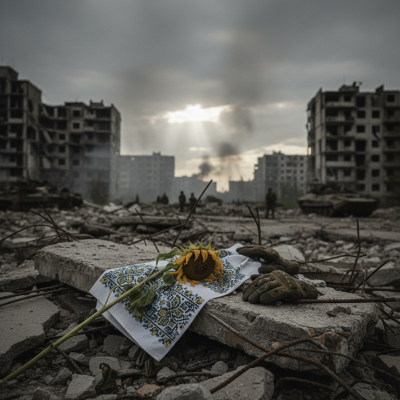
Writing the history of a war while it still rages is an act of both courage and necessity. Kairos Valente's The Russo-Ukrainian War embraces this challenge explicitly, calling itself a "first draft of history" composed in August 2025, when the front lines had settled into a grinding stalemate but the outcome remained unresolved. The result is a work that refuses the comfort of hindsight, offering instead a factual, clear-eyed foundation for understanding a conflict that has already defined a decade.
What the book is about
The book spans 25 chapters, moving chronologically from the shared origins of Russia and Ukraine in Kievan Rus' through the Maidan Revolution, the eight-year war in Donbas, the full-scale invasion, and the major campaigns that followed — Kyiv, Mariupol, Kharkiv, Kherson, Bakhmut, the 2023 counteroffensive, and the stalemate of 2024. It devotes equal attention to the air war, the Black Sea naval campaign, the sanctions regime, life under occupation, societal transformation in both countries, global ripple effects, war crimes investigations, diplomatic efforts, and the human toll. The intended reader is anyone seeking a single-volume, chronologically structured account that balances military detail with political, economic, and human dimensions. Valente writes for the serious general reader, not the specialist, assuming no prior expertise but demanding sustained attention.
The long shadow of Kievan Rus'
Valente opens not with February 2022 but with the 9th century, arguing that the war's roots lie in "centuries of intertwined and often fraught history" between two nations tracing legitimacy to the same medieval state. Chapter 1 traces how the Mongol invasion shattered Kievan Rus', sending its successor principalities into divergent orbits: Moscow under the "Tatar Yoke" developed autocratic centralization, while Ukrainian lands under Lithuania and Poland absorbed European legal traditions and a distinct Ruthenian identity. The 1654 Treaty of Pereiaslav becomes a hinge — "one of the most contentious and differently interpreted events in Eastern European history" — viewed by Moscow as reunification and by Ukrainians as a military alliance betrayed. This historical framing is not background; it is the interpretive key Valente returns to when explaining Putin's 2021 essay "On the Historical Unity of Russians and Ukrainians," which the author calls "a historical justification for war, a denial of Ukraine's right to exist as a separate and independent nation."
Warfare transformed: drones, glide bombs, and the death of platforms
Chapters 12, 13, and 22 document a conflict that became "the first in history to be defined by the mass-scale use of unmanned aerial vehicles." Valente shows how the Bayraktar TB2 gave way to FPV drones — "cheap, costing only a few hundred dollars each" — that "fundamentally altered ground combat" by 2024. Russia's answer was the glide bomb: "simple pop-out wing and satellite guidance kits (known as UMPK modules)" bolted onto Soviet-era FAB bombs, allowing Su-34s to "release these bombs from sixty to seventy kilometers away, far beyond the reach of most of Ukraine's frontline air defenses." At sea, Ukraine's "Sea Baby" and "MAGURA V5" naval drones achieved what no conventional navy could: they "effectively achieved sea denial in the western Black Sea," sinking or damaging roughly a third of the Black Sea Fleet and forcing its retreat to Novorossiysk. The book's through-line is the clash between Russia's "rigid, top-down, industrial-age model" and Ukraine's "decentralized, adaptive, information-age approach," epitomized by the GIS Arta targeting system soldiers nicknamed "Uber for artillery."
Two societies remade by war
Chapters 17 and 18 offer mirrored portraits of nations under pressure. In Ukraine, the "home front" became a parallel army: grandmothers weaving camouflage nets alongside teenagers, crowdfunding campaigns buying satellites for military intelligence, and a linguistic shift where "speaking Ukrainian was no longer just a matter of communication; it was a political statement, a marker of identity, and a rejection of the 'Russian World.'" In Russia, the Kremlin constructed a "hermetically sealed echo chamber" — criminalizing dissent with 15-year prison sentences for "fake news," reviving Soviet-style denunciation, and elevating the letter "Z" into "a powerful, if somewhat cryptic, symbol of loyalty." The 2022 mobilization shattered the "implicit social contract" that the war was distant, triggering a mass exodus of fighting-age men. Valene notes the war economy created "an artificial economic boom" masking "deep structural problems," while the Prigozhin mutiny "exposed profound cracks in the edifice of Putin's power." Both societies are described as fundamentally altered, with Ukraine's "collective spirit of resistance" tempered by "immense grief" and Russia's population "numbed by propaganda" but facing "mounting" costs.
The diplomacy of non-negotiable positions
Chapter 23 traces a diplomatic history as static as the front lines. The March 2022 Istanbul talks produced a draft where Ukraine would accept neutrality in exchange for security guarantees modeled on NATO's Article 5, with Crimea's status frozen for 15 years. The discovery of Bucha's atrocities "made any political compromise with the Kremlin politically and morally toxic." Ukraine's subsequent 10-Point Peace Formula demanded full withdrawal, territorial integrity, and a tribunal for the crime of aggression — rejected by Moscow as ignoring "new territorial realities." China's 12-point plan "equated the aggressor and the victim." The 2024 Global Peace Summit in Switzerland drew 90+ nations but produced a communiqué focused only on nuclear safety, food security, and prisoner exchanges. Valente's conclusion is unsparing: "With both Kyiv and Moscow still believing that they can improve their negotiating position through continued fighting on the battlefield, the space for genuine compromise simply does not exist."
The ledger of loss and the August 2025 reality
The final chapters confront the human accounting. Chapter 24 details a refugee crisis "on a scale and at a speed unseen in Europe since the final, chaotic months of the Second World War," the forced deportation of Ukrainian children to Russia (cited in the ICC arrest warrant for Putin), and a casualty toll "running into the many hundreds of thousands" dominated by artillery and glide bombs. The psychological wound is "a collective experience that has been seared into the nation's identity." Chapter 25 finds the front "a jagged scar stretching over a thousand kilometers" where Russia's capture of Chasiv Yar in early August 2025 came after "sixteen months of relentless assault" for incremental gains. Ukraine's F-16s have arrived but "have not proven to be the war-winning silver bullet." U.S. aid was suspended in March 2025 after a change in administration. The war is "a marathon contest of national endurance, industrial capacity, and societal will" with "no clear resolution in sight."
Who should read this
This book serves readers who want a single, coherent narrative that connects the 9th century to the summer of 2025 without sacrificing military, diplomatic, economic, or human detail. It rewards those willing to move chronologically through a complex, evolving conflict and who value a synthesis that treats the war as a multi-domain phenomenon — not just a sequence of battles. Readers seeking a focused analysis of a specific campaign, a deep dive into a single theme like cyber warfare or energy politics, or a polemical argument will find the scope too broad. For anyone trying to hold the whole picture in their head — the historical grievances, the technological revolutions, the societal fractures, the diplomatic dead ends, and the accumulating human cost — Valente's first draft is an indispensable reference.
Read “The Russo-Ukrainian War” on MixCache.com →
Please log in or create an account to leave a comment.
No comments yet. Be the first to say something.