
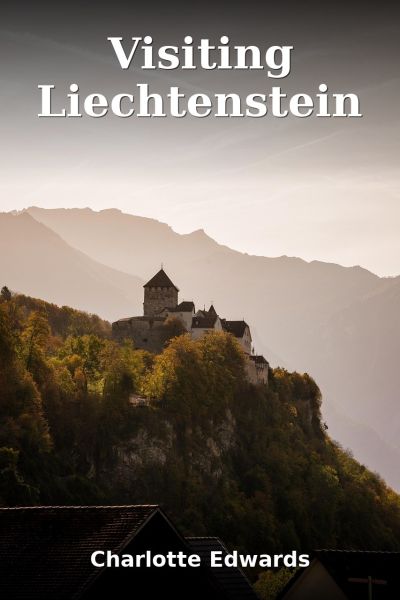
Most travelers see Liechtenstein as a map footnote — a sliver between Switzerland and Austria, smaller than many city parks. Charlotte Edwards' Visiting Liechtenstein: A Guide for Tourists makes the case that this microstate's compactness is exactly its superpower, concentrating castles, vineyards, Alpine peaks, and a functioning monarchy into a space you can cross by bicycle before lunch.
What the book is about
The guide spans 25 chapters, moving logically from big-picture context (history, geography, political system) through practical logistics (getting there, getting around, accommodation) into granular exploration of specific towns, activities, and seasons. It covers Vaduz's museums and castle views, Triesenberg's Walser heritage, Malbun's winter and summer identities, wine tasting at the Prince's own Hofkellerei, hiking the 75-kilometer Liechtenstein Trail, and niche experiences like the souvenir passport stamp or Funkensonntag bonfires. The tone is authoritative but conversational, aimed at independent travelers who want both efficient planning and cultural depth — whether they have a day or a week.
A living monarchy you can actually see
Unlike most European royals tucked away in distant palaces, Liechtenstein's Princely Family resides in Vaduz Castle, visible from almost anywhere in the capital. Chapter 1 explains how Prince Franz Josef II moved there permanently in 1938, "solidif[ying] the bond between the monarchy and the people," and Chapter 10 notes the castle remains "a functioning home" — interiors off-limits, but the exterior and grounds accessible for panoramic views. The National Day celebration on August 15th brings this into focus: after official speeches on the castle lawn, "the Princely Family mingles with the assembled crowds, shaking hands and exchanging greetings in an atmosphere of surprising informality" (Chapter 15). It's a rare chance to witness a constitutional hereditary monarchy operating in plain sight.
Compactness as a travel advantage
The book repeatedly returns to the practical payoff of Liechtenstein's 62 square miles. Chapter 2 frames it bluntly: "Where else in Europe can you realistically explore the length and breadth of an entire nation within a day or two, without feeling rushed?" Chapter 4 details the LIEmobil bus network that connects every village and links seamlessly to Swiss and Austrian train stations at Sargans, Buchs, and Feldkirch. Chapter 21 turns the scale into a unique experience: "Imagine setting out after breakfast with the realistic goal of traversing an entire nation before lunch." Whether by bus, car, or the Rhine Valley cycle path (part of EuroVelo 15), the country's dimensions eliminate transit fatigue and let visitors layer castle visits, vineyard walks, and Alpine hikes in a single afternoon.
Alpine adventures in two distinct modes
Malbun, at 1,600 meters, serves as the principality's adventure hub, but its character flips completely with the seasons. Chapter 12 walks through a winter day: 23 kilometers of groomed pistes, a dedicated Kinderland for beginners, cross-country tracks in the Valünatal valley, and snowshoe rentals for off-trail exploration. Summer (Chapter 12 again) brings the Sareis chairlift to 2,000 meters, the Forscherweg interactive family trail, falconry demonstrations at the Galina Falconry Centre, and a summer toboggan run. For serious hikers, Chapter 17 maps the Liechtenstein Trail's 75 kilometers across all eleven municipalities — augmented by the LIstory app's GPS-triggered stories — while Chapter 18 details via ferrata routes like the exposed Fürstensteig and summit attempts on Naafkopf (2,571 m), the tripoint with Austria and Switzerland.
Food and wine rooted in place
Chapter 7 introduces Käsknöpfle — "tiny, irregular dumplings" layered with local cheese and fried onions, served with apple puree that "cuts beautifully through the richness" — and Ribel, a roasted cornmeal staple from the Walser heritage. Chapter 13 reveals the wine story: south-facing slopes, Föhn wind, and calcareous shale produce Pinot Noir (Blauburgunder) of "finesse rather than overt power" and Müller-Thurgau with "crisp acidity." The Prince's Hofkellerei in Vaduz offers structured tastings, but smaller family wineries like Weinbau Hoop in Eschen reward advance appointments with "intimate insights into their philosophy" and wines "rarely leav[ing] the immediate vicinity." The guide treats culinary exploration as cultural access, not just dining.
Unique rituals you won't find elsewhere
Beyond standard sightseeing, Chapter 21 catalogs experiences tied to Liechtenstein's specific identity. The souvenir passport stamp at the Liechtenstein Center is "a fun bureaucratic transgression in the frictionless world of modern European travel." Funkensonntag (Spark Sunday) sees communities burn towering bonfires topped with a "witch" effigy to banish winter — "the collective gasp or cheer as the 'witch' atop catches fire, often accompanied by firecrackers, feels both cathartic and celebratory." The Walser dialect in Triesenberg preserves "archaic features and specific vocabulary derived directly from its Upper Valais roots." Even the border crossings feel distinct: the Swiss border is "often just a bridge over the Rhine" while the Austrian border retains "a slightly more formal feel." These moments accumulate into a visit defined by specificity rather than checklist tourism.
Who should read this
Travelers who value depth over breadth, enjoy Alpine landscapes without requiring elite fitness, and appreciate a destination where history feels lived-in rather than performed will find this guide indispensable. It's equally useful for a day-tripper from Zurich or Innsbruck needing efficient priorities and for a week-long visitor building a rhythm around hiking, wine, and village life. Readers seeking nightlife, massive shopping districts, or budget-hostel density should look elsewhere — Liechtenstein's prices track Swiss levels, and the youth hostel closes in winter. For everyone else, Edwards delivers a rare thing: a guidebook that makes a tiny country feel expansive.
Read “Visiting Liechtenstein” on MixCache.com →
Please log in or create an account to leave a comment.
No comments yet. Be the first to say something.