Browse by Category
Fiction
- Action & Adventure
- African American
- Anthologies
- Children's Fiction
- Classics
- Comics & Graphic Novels
- Coming of Age
- Contemporary
- Cultural & Regional
- Drama
- Erotica
- Fantasy
- General
- Historical Fiction
- Horror
- Humor & Satire
- Literary Fiction
- Mystery, Thriller & Suspense
- Poetry
- Religious & Inspirational
- Romance
- Science Fiction
- Short Stories
- War & Military
- Westerns
- Women's Fiction
- Young Adult
Non-Fiction
- Antiques & Collectibles
- Arts & Photography
- Biographies & Memoirs
- Business & Money
- Children's Non-Fiction
-
Computers & Technology
- Artificial Intelligence
- Computer Science
- Cybersecurity & Cryptography
- Data Science & Analytics
- Databases & Big Data
- Game Development & Design
- General
- Hardware & DIY
- Mobile App Development
- Networking & Cloud Computing
- Operating Systems
- Programming
- Robotics
- Software
- Software Engineering
- User Experience (UX) & Design
- Web Development & Design
- Cooking, Food & Wine
- Crafts, Hobbies & Home
- Education & Teaching
- Engineering
- General
- Health, Fitness & Dieting
-
History
- African History
- African History - North Africa
- African History - Sub-Saharan Africa
- American History
- American History - 20th Century
- American History - Civil War
- American History - Colonial Period
- Ancient History
- Asian History
- Asian History - China
- Asian History - India
- Asian History - Japan
- Asian History - Southeast Asia
- European History
- European History - Ancient Greece
- European History - Ancient Rome
- European History - Medieval
- European History - Modern
- European History - Renaissance
- General
- Middle Eastern History
- Military History
- Military History - Aviation
- Military History - Naval
- Social & Cultural History
- World History
- Humor & Entertainment
- Industrial Technology
- Language Learning
- Law
- LGBTQ+ Non-Fiction
- Literary Criticism
- Medical Books
- Parenting & Relationships
- Philosophy
- Politics & Social Sciences
- Reference
- Religion & Spirituality
-
Science & Math
- Agricultural Sciences
- Astronomy & Space Science
- Behavioral Sciences
- Biological Sciences
- Botany & Plant Science
- Chemistry
- Earth Sciences
- Engineering - Chemical
- Engineering - Civil
- Engineering - Electrical
- Engineering - Mechanical
- Environment
- General
- Geology
- Mathematics
- Nature & Ecology
- Oceanography
- Paleontology
- Physics
- Statistics
- Self-Help
- Sports & Outdoors
- Study Aids
- Sustainability & Green Living
- Textbooks
- Transportation
- Travel
- True Crime
- Urban Planning & Development
- Veterinary Medicine
- Writing & Publishing
Jump to Section

Want unlimited access to all books published by MixCache.com (plus their audiobooks)? Try MixCache.com Total Access. Look for the MTA badge on book covers to identify included titles.
Access to infinite ebooks: Don't see the book you want? Suggest it and we'll create it (free!) for you from scratch with our powerful AI book writer. Then read it with MTA - besides profiting from any sales it makes!
Suriname's Mosaic: A Dutch Colony's Legacy of Diversity
MTA
Creole, Hindustani, Javanese, and Indigenous Identities in the Amazon Basin
About this book:
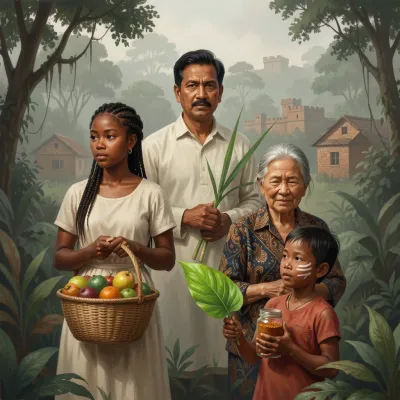
Suriname’s history is portrayed as a layered tapestry woven from the ambitions of European powers, the brutality of plantation slavery, and the relentless search for labor that brought successive waves of migrants to its shores. After early Dutch attempts at trade and settlement, the establishment of the Dutch West India Company transformed the coastal plains into a profitable plantation economy dependent on enslaved Africans, whose suffering—marked by extreme violence, high mortality, and the construction of elaborate drainage systems—laid the demographic and economic foundations of the colony. Resistance took many forms, from daily acts of sabotage to the large‑scale escape of enslaved people into the rainforest, where Maroon communities forged independent societies, negotiated treaties with the Dutch, and preserved African cultural traditions that continue to shape Surinamese identity.
The abolition of slavery in 1863, followed by a decade of state supervision, created a labor vacuum that the Dutch filled with indentured workers from British India and later from Java. These migrants arrived under contracts that often resembled slavery in practice, yet they brought distinct languages, religions, agricultural expertise, and cultural practices that gave rise to the Hindustani and Javanese communities. Smaller streams of Chinese, Levantine, and Caribbean migrants further diversified the population, while Indigenous peoples remained the original custodians of the Amazon interior, maintaining their languages, spiritual beliefs, and sustainable relationships with the forest despite repeated encroachments by colonial and post‑colonial interests.
In the post‑colonial era, Suriname’s quest for a unified national identity has been continually tested by political struggles, economic dependence on commodities such as bauxite and gold, and the lingering legacies of ethnic division and colonial exploitation. Universal suffrage in 1948 empowered ethnic‑based parties, leading to coalition politics, periodic coups, and a civil war in the interior, yet also fostered shared cultural expressions—through Sranan Tongo, festivals like Keti Koti and Diwali, music such as Kaseko and gamelan, and literary works that articulate a creolized Surinamese consciousness. Ongoing challenges include managing newfound offshore oil and gas wealth, safeguarding the rights of Indigenous and Maroon communities, preserving linguistic diversity, and balancing development with environmental stewardship in a nation that remains one of the world’s most forested, low‑deforestation countries. The book concludes that Suriname’s future hinges on transforming its rich mosaic of Creole, Hindustani, Javanese, Indigenous, and other identities into a source of strength through inclusive governance, equitable resource management, and a shared sense of belonging.
What You'll Find Inside:
- Suriname's diversity stems from Dutch colonial plantation slavery, Indian and Javanese indentured labor, and enduring Indigenous heritage in the Amazon Basin
- The book examines resistance traditions including Maroon communities formed by escaped slaves who established independent societies in the rainforest
- Four core identity groups are analyzed: Creole (African diaspora synthesis), Hindustani (Indian laborers), Javanese (Indonesian migrants), and Indigenous peoples
- Post-independence challenges are explored including political instability, economic dependence on resources like bauxite and gold, and efforts to forge national unity
- Contemporary issues covered include environmental conservation, offshore oil/gas potential, linguistic diversity, and Suriname's role in Caribbean and South American regional dynamics
Who's It For:
This book is ideal for students, researchers, and general readers interested in Caribbean history, post-colonial studies, multicultural societies, and ethnic identity formation. It will particularly benefit those seeking to understand how colonial legacies shape contemporary diversity in pluralistic nations, with specific relevance to anyone studying Suriname's unique position as a Dutch-colonized South American nation with Asian, African, Indigenous, and European influences. Academics in anthropology, history, and political science focusing on nation-building in multi-ethnic contexts will find valuable insights into Suriname's ongoing negotiation of diversity and unity.
Author:
Published By:
Date Published:
July 21, 2026
Type:
Nonfiction
Language:
English
Word Count:
41,073 words
Reading Time:
2 hours 53 minutes
Sample:
Order:
Order Suriname's Mosaic: A Dutch Colony's Legacy of Diversity (Paperback) on MixCache.com:
Buy NowPrint copy is made to order and ships worldwide. Includes the ebook free, ready to read instantly.
$5 account credit for all new MixCache.com accounts, usable toward any ebook purchase!*