
Browse by Category
Fiction
- Action & Adventure
- African American
- Anthologies
- Children's Fiction
- Classics
- Comics & Graphic Novels
- Coming of Age
- Contemporary
- Cultural & Regional
- Drama
- Erotica
- Fantasy
- General
- Historical Fiction
- Horror
- Humor & Satire
- Literary Fiction
- Mystery, Thriller & Suspense
- Poetry
- Religious & Inspirational
- Romance
- Science Fiction
- Short Stories
- War & Military
- Westerns
- Women's Fiction
- Young Adult
Non-Fiction
- Antiques & Collectibles
- Arts & Photography
- Biographies & Memoirs
- Business & Money
- Children's Non-Fiction
-
Computers & Technology
- Artificial Intelligence
- Computer Science
- Cybersecurity & Cryptography
- Data Science & Analytics
- Databases & Big Data
- Game Development & Design
- General
- Hardware & DIY
- Mobile App Development
- Networking & Cloud Computing
- Operating Systems
- Programming
- Robotics
- Software
- Software Engineering
- User Experience (UX) & Design
- Web Development & Design
- Cooking, Food & Wine
- Crafts, Hobbies & Home
- Education & Teaching
- Engineering
- General
- Health, Fitness & Dieting
-
History
- African History
- African History - North Africa
- African History - Sub-Saharan Africa
- American History
- American History - 20th Century
- American History - Civil War
- American History - Colonial Period
- Ancient History
- Asian History
- Asian History - China
- Asian History - India
- Asian History - Japan
- Asian History - Southeast Asia
- European History
- European History - Ancient Greece
- European History - Ancient Rome
- European History - Medieval
- European History - Modern
- European History - Renaissance
- General
- Middle Eastern History
- Military History
- Military History - Aviation
- Military History - Naval
- Social & Cultural History
- World History
- Humor & Entertainment
- Industrial Technology
- Language Learning
- Law
- LGBTQ+ Non-Fiction
- Literary Criticism
- Medical Books
- Parenting & Relationships
- Philosophy
- Politics & Social Sciences
- Reference
- Religion & Spirituality
-
Science & Math
- Agricultural Sciences
- Astronomy & Space Science
- Behavioral Sciences
- Biological Sciences
- Botany & Plant Science
- Chemistry
- Earth Sciences
- Engineering - Chemical
- Engineering - Civil
- Engineering - Electrical
- Engineering - Mechanical
- Environment
- General
- Geology
- Mathematics
- Nature & Ecology
- Oceanography
- Paleontology
- Physics
- Statistics
- Self-Help
- Sports & Outdoors
- Study Aids
- Sustainability & Green Living
- Textbooks
- Transportation
- Travel
- True Crime
- Urban Planning & Development
- Veterinary Medicine
- Writing & Publishing
Jump to Section

Want unlimited access to all books published by MixCache.com (plus their audiobooks)? Try MixCache.com Total Access. Look for the MTA badge on book covers to identify included titles.
Access to infinite ebooks: Don't see the book you want? Suggest it and we'll create it (free!) for you from scratch with our powerful AI book writer. Then read it with MTA - besides profiting from any sales it makes!
The Arranged Document
Walker Evans, Dorothea Lange, and the Controversy That Defined Documentary Photography
About this book:
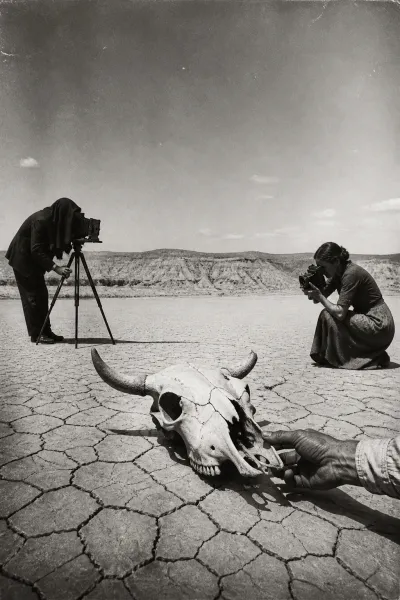 In the scorching summer of 1936, Arthur Rothstein nudged a bleached steer skull ten feet across the cracked clay of the South Dakota Badlands—and ignited a firestorm that nearly destroyed the Farm Security Administration's photographic project. Opponents of the New Deal screamed propaganda; defenders insisted the image captured a deeper psychological truth about the Dust Bowl. That single moved bone exposed the fault line running through documentary photography itself: Is the camera a passive witness, or an active author? *The Arranged Document* plunges readers into this explosive debate, tracing how a government publicity unit became the crucible where modern visual ethics were forged—and fractured.
Under Roy Stryker's exacting direction, two titans of the medium waged a quiet war over the soul of the archive. Walker Evans demanded cold objectivity, the camera as unblinking eye; Dorothea Lange chased emotional resonance, composing and cropping to reveal what she called "the essential truth." Between them stood Stryker, literally punching holes through negatives he deemed politically inconvenient, while his photographers smuggled their artistic integrity past his red pencil. From the skull that launched a congressional investigation to Lange's reframed migrant mothers and Evans's silent rebellion, this book reconstructs the darkroom battles and field negotiations that produced America's most iconic images—and the lies embedded in their frames.
The questions they fought over have never been more urgent. Long before Photoshop, deepfakes, and algorithmic feeds, the FSA photographers confronted the same dilemmas that haunt our visual culture: Can a machine ever be neutral? Does arranging a detail to serve a larger narrative constitute betrayal, or a higher honesty? With novelistic pacing and archival precision, *The Arranged Document* delivers a revelatory history of American photography that reads like a political thriller—one that will forever change how you look at any photograph, past or present.
Author:
Published By:
Type:
Nonfiction
Sample:
Order:
Click to order this hardcover:
Buy Now