
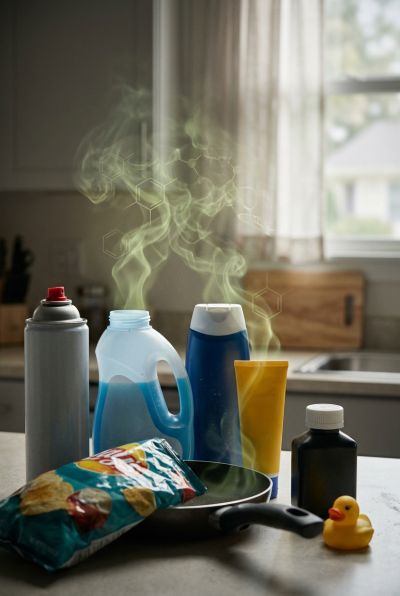
The Carcinogen Next Door invites readers to look beyond the obvious dangers of tobacco or UV light and examine the chemicals that quietly accompany daily life. Adrian Voss walks through each room of a typical home, identifying where substances like formaldehyde, phthalates, and PFAS appear and how they might contribute to cancer risk. The tone is measured, aiming to inform rather than alarm.
What the book is about
The book is a nonfiction guide that moves from scientific fundamentals to concrete, actionable advice. It begins with an introduction that defines carcinogens, explains the IARC classification system, and notes that risk depends on dose, duration, timing, and individual susceptibility. Subsequent chapters follow a room‑by‑tour of the modern home—bedroom, bathroom, kitchen, living spaces, garden, and workplace—detailing where specific chemicals such as flame retardants, bisphenols, parabens, and volatile organic compounds are commonly found. Later sections address body burden, the regulatory landscape, industry influence, and practical steps for reducing exposure, concluding with advice on advocacy and envisioning a safer future. The intended audience is anyone who uses everyday products and wants to understand the hidden health implications, especially parents, caregivers, and consumers interested in making informed choices without resorting to fear‑based messaging.
Understanding Carcinogens and Risk
Voss lays a clear foundation for what makes a substance a carcinogen and how risk is assessed. He explains that the International Agency for Research on Cancer (IARC) evaluates agents based on the strength of evidence, not potency, and places formaldehyde in Group 1, “carcinogenic to humans,” because of sufficient evidence linking it to nasopharyngeal cancer and leukemia. The book emphasizes the principle “The dose makes the poison” but notes that for genotoxic carcinogens many scientists believe there is no truly safe threshold, as even a single molecule could theoretically cause a DNA‑damaging mutation. It also discusses the “low‑dose hypothesis” for endocrine disruptors, which can have significant effects at concentrations once considered negligible, and the importance of the chemical cocktail effect, where combined exposures may produce synergistic toxicity greater than the sum of individual chemicals. These concepts help readers see why evaluating chemicals in isolation can underestimate real‑world risk.
Room‑by‑Room Exposure Sources
Each chapter treats a different part of the home as a case study. In the bedroom, Voss describes how mattresses made of polyurethane foam can off‑gassing volatile organic compounds like benzene and toluene, and how flame retardants such as PBDEs and their replacements (e.g., TDCPP) migrate into dust, posing inhalation and dermal exposure risks. He notes that “The bedroom, a place intended for safety and rest, can become a chamber of low‑level, chronic chemical exposure.” In the bathroom, the focus shifts to personal care products: sulfates that may be contaminated with 1,4‑dioxane, parabens that mimic estrogen, formaldehyde‑releasing preservatives, and the “fragrance” loophole that hides phthalates. The kitchen chapter examines food packaging, highlighting how bisphenols from can linings, phthalates from plastic wrap, and PFAS‑treated paper can migrate into food, especially when heated or fatty. Cleaning supplies are discussed in Chapter 5, where quaternary ammonium compounds, glycol ethers like 2‑butoxyethanol, and the formation of chloroform from bleach reactions are identified as concerns. Clothing and detergents (Chapter 6) bring up azo dyes that can release carcinogenic aromatic amines, formaldehyde resins in wrinkle‑free finishes, and PFAS used for stain resistance. By moving systematically through these environments, the book shows how numerous, often unseen, sources add up over time.
Practical Reduction Strategies
After outlining the hazards, Voss shifts to empowerment through concrete, low‑cost actions. He proposes three pillars: ventilate, filter, and clean smart. For ventilation, he advises making it a daily habit to open windows for at least fifteen minutes to flush out VOCs and formaldehyde, and to use exhaust fans that vent outdoors during cooking and showering. Filtration recommendations include using a vacuum with a HEPA filter to trap chemical‑laden dust, installing activated carbon or reverse osmosis systems for water, and employing air purifiers that combine true HEPA and substantial activated carbon filters to capture both particles and gases like benzene and formaldehyde. In cleaning, he suggests simple swaps: a 50/50 vinegar‑water spray for surfaces, baking soda for scouring, and liquid castile soap for greasy messes, thereby avoiding quaternary ammonium compounds and undisclosed fragrances. The book also encourages choosing products verified by trusted third parties—such as MADE SAFE, EWG Verified, or GREENGUARD Gold—and provides tips for reading labels, like avoiding “fragrance” and spotting red‑flag ingredients such as parabens, formaldehyde‑releasers (e.g., quaternium‑15), and sulfates. These strategies are presented not as a drastic overhaul but as a series of manageable steps that, over time, can lower a family’s overall chemical burden.
Advocacy and Systemic Change
Recognizing that individual action alone cannot fix a broken system, Voss devotes chapters to the power of consumer voice and the need for stronger regulations. He argues that every purchase is a vote, citing the rise of BPA‑free products as an example where consumer demand led industry change before federal bans. Readers are encouraged to contact manufacturers directly—asking, for instance, whether a sofa’s foam contains flame retardants—and to use social media to request transparency or reward good practices. The book also points to nonprofit organizations like the Environmental Working Group, Safer Chemicals, Healthy Families, and Toxic‑Free Future as resources for tracking legislation and preparing pre‑written messages to elected officials. It notes that state‑level efforts, such as California’s Proposition 65, often pave the way for broader reform, and that community actions—like advocating for fragrance‑free cleaning supplies in schools—can amplify impact. By framing advocacy as a natural extension of informed consumption, Voss shows how knowledge can be translated into collective pressure for safer products and more protective policies.
Who should read this? The book will resonate with readers who are curious about the invisible ingredients in their daily routines and want realistic, evidence‑based ways to reduce exposure without succumbing to panic. It is especially useful for parents, caregivers, and anyone managing a household who seeks practical steps grounded in scientific consensus rather than marketing claims. Those looking for a sensational exposé or a quick‑fix detox plan may find the measured tone less satisfying, but for anyone interested in understanding how everyday chemicals intersect with health and how to act on that understanding, The Carcinogen Next Door offers a clear, well‑sourced roadmap.
Read “The Carcinogen Next Door” on MixCache.com →
Please log in or create an account to leave a comment.
No comments yet. Be the first to say something.