
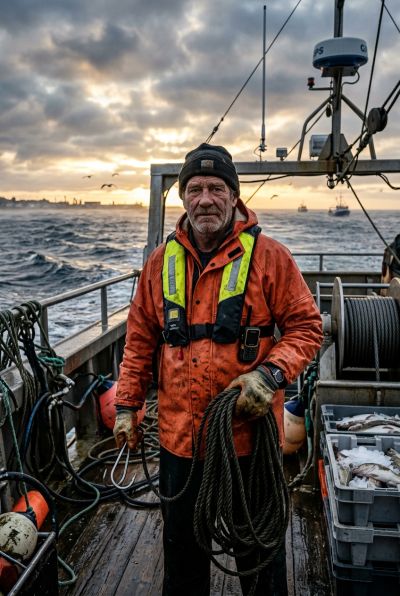
The alarm isn’t a shriek but a sharp, metallic clang – the signal that starts the clock. Thirty seconds. In the dim glow of the deck light, a greenhorn fumbles with the heavy orange bundle pulled from its locker. Neoprene resists, stiff and unyielding. A boot gets caught, sending a stumble that sends the suit sliding across the wet deck. Fingers, numb from the night watch’s biting wind, struggle to grip the material. Legs plunge in first, but the left foot catches on the inner cuff, requiring an awkward hop to free it while balancing on one leg on the heaving deck. Arms follow, but the sleeves feel like they’re shrinking, elbows jutting painfully as the wearer forces them through. Sweat beads on the upper lip, not from exertion alone but from the rising panic of time slipping away. Then the hood – the final, most feared obstacle. Pulling it over the head means pressing against the tight seal that will soon be the only barrier between skin and lethal cold. For a heartbeat, the world narrows to the rubber pressing against nostrils, the sound of ragged breathing in the enclosed space, the terrifying thought: what if I can’t get it sealed in time?
Why the Suit Matters
This isn’t hypothetical drill ground; it’s a monthly reality on commercial fishing vessels from the Gulf of Mexico to the Bering Sea. The command – often a sharp whistle or a shouted “Suits up!” – cuts through the rhythm of work or rest, initiating a countdown where lives hang in the balance. Coast Guard regulations are clear: every crew member must be able to don a fully sealed immersion suit in sixty seconds or less. Why so strict? The answer lies in the water temperature where these vessels operate. In the sub-zero seas of Alaska’s winter fisheries, the North Atlantic’s fishing grounds, or the frigid Pacific Northwest, an unprotected person immersed in the ocean has mere minutes before cold incapacitates muscles and clouds judgment. Hypothermia sets in fast; without intervention, death follows swiftly. But a properly worn survival suit changes the equation dramatically. Engineered from thick neoprene with integrated boots, gloves and an insulated hood, it creates a microclimate that traps body heat. Official estimates state that in near-freezing water, survival time jumps from a frustratingly brief two to ten minutes to several hours – sometimes stretching into a full day or more, depending on conditions and the suit’s integrity. That extension isn’t just a number; it’s the window that allows a rescue helicopter to arrive, a lifeboat to reach the scene, or a fellow fisherman to effect a recovery. The suit doesn’t promise comfort; it promises a fighting chance. In an occupation where the workplace itself – a pitching deck hundreds of miles from shore – is a constant hazard, that sixty-second drill transforms a piece of gear into a lifeline.
The Drill in Detail
The suit emerges from its storage bag not as a ready-to-wear garment but as a formidable opponent. It’s heavy, cold to the touch, and smells faintly of rubber and salt – a sensory reminder of its purpose. First, the legs. The wearer sits on a deck hatch or pulls one leg up onto a rail to gain leverage, but the neoprene offers little give. A foot slides in easily enough, but the calf often catches on the reinforced inner lining where the material folds over itself. Freeing it requires a sharp, upward yank that risks overbalancing, especially when the boat rolls beneath them. The second leg follows, but now both feet are encased, making standing a precarious affair on the slick, moving deck. Next, the arms. The sleeves are deliberately narrow to maintain a watertight seal at the wrists, but this means fabric bunches uncomfortably at the biceps, requiring deliberate effort to pull each sleeve fully to the shoulder. The wearer might find themselves doing a strange, ineffective dance – shifting weight from foot to foot while wrestling with rubber that seems to cling to every curve. Then comes the hood, the moment many dread most. To pull it over the head, the wearer must first gather the loose material at the back of the neck, then stretch the seal wide enough to clear the chin and nose. As the seal slides over the face, it presses firmly against the cheeks, jaw, and throat, creating an immediate sensation of pressure. Vision may dim as the seal conforms to facial contours, and for several seconds, the wearer inhales and exhales the same stagnant air trapped in the hood’s dead space – a warm, moist mixture that fogs any inner lens and heightens the claustrophobia. Breathing becomes shallow and rapid, not from lack of air but from the psychological trigger of enclosed space. Finally, the closure. Heavy-duty zippers, often stiff from disuse or salt corrosion, demand two-handed operation. The wearer grips the pull tab with one hand while guiding the teeth with the other, willing the slider past the waist, then the chest, and finally to the throat seal. Only when the zipper is fully engaged do they turn to the straps: locating the chest band, pulling it snug across the sternum, fastening the buckle; repeating the process for the leg straps, ensuring each lies flat without twisting. Every step must be completed before the sixty-second timer hits zero – a deadline that feels less like a guideline and more like a precipice when fingers are fumbling and the suit refuses to cooperate.
From Drill to Reality
In the relative safety of a drill, the struggle is primarily against the suit and one’s own inexperience. Laughter might ripple through the crew as a particularly tangled greenhorn emerges, sweat-drenched and slightly disoriented, having beaten the clock by mere seconds. But the drill’s true purpose reveals itself only when the scenario shifts from practice to peril. Consider the moment not of a shouted command but of a sudden, violent lurch – the deck tilting violently as water rushes into a compromised hull, or the deafening crack of parting steel signaling a catastrophic failure. In that instant, there is no time for thought, only reaction. The wind howls louder than any alarm, spray stings the eyes, and the cold kiss of seawater might already be touching ankles or boots. Adrenaline surges, narrowing focus to primal instincts while simultaneously threatening to overwhelm fine motor control. It is precisely in this storm of sensation that muscle memory becomes indispensable. The hours spent repeatedly stepping into the suit, fighting the sleeves, wrestling the hood, and fastening the straps have buried the sequence deep in the procedural memory – not as a conscious checklist but as an automatic response, as reliable as blinking or breathing. A wearer who has drilled sufficiently doesn’t think “left leg first, then right”; their body simply moves. They don’t recall which strap buckles where; their hands find the buckles and fasten them without hesitation. This automation is critical because panic, the inevitable companion of real emergencies, hijacks the prefrontal cortex – the brain region responsible for planning and deliberate action. When panic strikes, conscious thought falters, but well-practiced physical routines can persist. Thus, the greenhorn who still consults an internal step-by-step guide during drills will likely find that guide vanishing under stress, leaving them fumbling with zippers or misplacing straps as vital seconds bleed away. In contrast, the seasoned crew member whose suit-donning has become second nature can execute the entire process while scanning the environment for threats, assisting others, or bracing against the ship’s movement. Their mastery isn’t measured in speed alone but in the ability to maintain situational awareness while performing the life-saving act – a skill that could mean the difference between securing their own suit and helping a shipmate do the same before both are swept into the waves. There’s no fanfare for mastering this skill; no certificate is issued, no shore-leave bragging rights earned. The validation comes silently, in the unspoken trust between crew members that when the alarm sounds for real, everyone will be ready. It’s knowledge stored not in accolades but in the quiet certainty that, should the sea claim the vessel, the suit will go on fast enough to defy its most lethal promise. Consider the alternative: a suit left half-donned, a zipper stalled at the chest, a strap forgotten – scenarios that turn minutes into moments and moments into tragedy. The orange rubber will never be soft, never be cool, never be anything but hot, awkward, and deeply undignified. Yet in those frantic seconds when it transforms from locker burden to second skin, it holds the power to turn a potential tragedy into a story of survival – and that makes every strained muscle, every moment of near-panic, every second of the struggle not just worthwhile, but essential.
This is one episode in a much longer story. For the full account of commercial fishing, read “Life As A Commercial Fisherman” by Tony Roberts on MixCache.com.
Please log in or create an account to leave a comment.
No comments yet. Be the first to say something.