

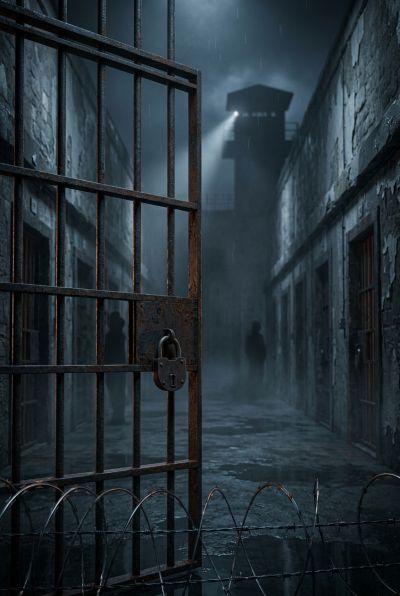
The fog clung to San Francisco Bay on the morning of June 12, 1962, thick enough to swallow a ship whole. Inside the cellhouse on Alcatraz, the count proceeded as normal. Guards shone flashlights into the darkened cells of B-Block, checking the sleeping forms of the inmates. In cells 138, 140, and 142, the heads on the pillows looked ordinary enough — flesh-toned, hair in place, the slow rise and fall of breathing simulated by the angle of the shoulders. It was not until a guard reached through the bars to shake a shoulder that the ruse collapsed. The head rolled off the pillow, revealing a construction of plaster, paint, and real human hair swept from the barbershop floor. Frank Morris, John Anglin, and Clarence Anglin were gone.
The Fortress on the Bay
Alcatraz had been designed to be the end of the line. When the Federal Bureau of Prisons took over the former Army fort in 1934, they rebuilt it into a showcase of modern penology: tool-proof steel cell fronts, iron grilles on every window, guard towers at every corner, and a rule of silence that turned the cellhouse into a monastery of punishment. The island's geography did the rest. The water surrounding the Rock averaged 50 degrees Fahrenheit. Currents ran at three to five knots. Sharks — or so the inmates were told — patrolled the crossing. Warden James Johnston liked to say that the only way off the island was on a government boat, and only two kinds of men rode those: the newly arrived and the newly released.
Yet the prison's 29-year history as a federal penitentiary recorded 14 escape attempts involving 36 men. Joe Bowers was shot on the fence in 1936. Theodore Cole and Ralph Roe filed through window bars during a storm in 1937 and vanished into the bay, presumed drowned. Arthur "Doc" Barker and four others fought their way out of D-Block in 1939 only to be caught at the shoreline, Barker dying of his wounds. The most violent episode, the "Battle of Alcatraz" in May 1946, left two officers and three inmates dead after a three-day siege. Every attempt had ended in death or recapture. The Morris-Anglin escape would be different.
Ten Months of Quiet Work
Frank Morris arrived at Alcatraz in January 1960, transferred from Atlanta after a string of escapes from other institutions. The Anglin brothers, John and Clarence, followed in 1961, bank robbers from Georgia with a reputation for patience. All three were housed on the top tier of B-Block, their cells adjacent along the same corridor. Behind the cell walls ran an unguarded utility corridor, three feet wide, accessible only through the ventilation grilles at the back of each cell — grilles secured by rivets that could be drilled out.
The work began in earnest sometime in late 1961. Using a motor stolen from a vacuum cleaner in the prison workshop, a spoon soldered with silver from a dime, and a drill bit fashioned from a spring, the men took turns chipping away at the concrete around the grille openings. The noise was masked by Morris's accordion playing during music hour, a privilege earned through good behavior. Concrete dust was flushed down the toilets or scattered in the yard during exercise. By May 1962, each man had enlarged his vent enough to wriggle through into the utility corridor.
From there, they climbed a network of pipes to the roof of the cellhouse, crossed the roof, and descended a ventilator shaft to the ground. They had also built a workshop atop the cellblock, concealed behind a false wall, where they assembled their getaway vehicle: a raft and life vests stitched and vulcanized from more than 50 stolen raincoats, the rubber cemented together with glue pilfered from the prison industries. The dummy heads — each sculpted from plaster mixed with toilet paper, painted with skin tones from art-kit oils, and topped with hair from the barbershop — were the final touch.
The Night of June 11
Lights out at 9:30 p.m. The last count at 11:30 showed all three men in their bunks. Sometime after midnight, they moved. They slipped through the vents, climbed to the roof, descended the shaft, and made their way to the northeast shore of the island, a stretch of rocks and driftwood screened from the guard towers by the angle of the building. There, they inflated the raft with a concertina stolen from the music room, donned the life vests, and pushed off into the black water.
The tide was ebbing, pulling toward the Golden Gate and the open Pacific. The water temperature was 54 degrees. They had no compass, no map, no provisions beyond what they could carry in waterproofed bundles. The crossing to Angel Island, the nearest landfall, was 1.25 miles — a 45-minute paddle in ideal conditions for a fit man. Conditions were not ideal.
The Search and the Silence
The alarm was raised at 7:15 a.m. when a guard discovered the dummies. The FBI, Coast Guard, and local law enforcement launched a massive search. Debris washed up on Angel Island and the Marin County shore over the following days: a paddle, a wallet wrapped in plastic containing names and addresses of the Anglins' relatives, a piece of raincoat material, a deflated life vest with teeth marks in the inflation tube. Footprints led away from the beach on Angel Island, but the trail vanished in the brush. A homemade life vest was found on Cronkhite Beach, 50 miles north, two weeks later.
The official FBI conclusion, issued in 1979 after a 17-year investigation, was that the men drowned. The bureau cited the water temperature, the current, the lack of any credible sighting, and the physical unlikelihood of surviving the crossing without preparation. The U.S. Marshals Service, which inherited the case, keeps it open. A 2013 letter, allegedly from John Anglin, claimed all three survived and that he was the last living escapee, offering to surrender in exchange for medical care. The handwriting was inconclusive. A 2015 History Channel documentary presented a photograph of two men on a Brazilian farm in 1975, said to be the Anglins. Forensic analysis could not confirm their identities.
The Aftermath
Alcatraz did not survive the escape by much. Attorney General Robert F. Kennedy had already ordered a study of the prison's future; the 1962 breakout accelerated the timeline. The salt-corroded concrete required millions in repairs. The per-inmate cost was three times the federal average. On March 21, 1963, the last 27 inmates were transferred to other institutions, and the Rock closed its doors.
Morris and the Anglin brothers entered American folklore. The dummy heads remain on display in the cells where they fooled the guards, hair still combed, expressions frozen in a parody of sleep. The utility corridor vents are visible to the million-plus tourists who visit each year, the concrete still chipped where the drill bit bit deep. No one knows whether the raft capsized in the first hour, whether the men made landfall and died of exposure, or whether they walked out of the fog onto a beach in Marin County and disappeared into the life they had spent ten months planning. The bay keeps its secrets. The only certainty is that on one night in June 1962, the escape-proof prison proved anything but.
This is one episode in a much longer story. For the full account of the history of Alcatraz Federal Penitentiary, read “The World's Most Notorious Prisons” by Chester West on MixCache.com.
Please log in or create an account to leave a comment.
No comments yet. Be the first to say something.