
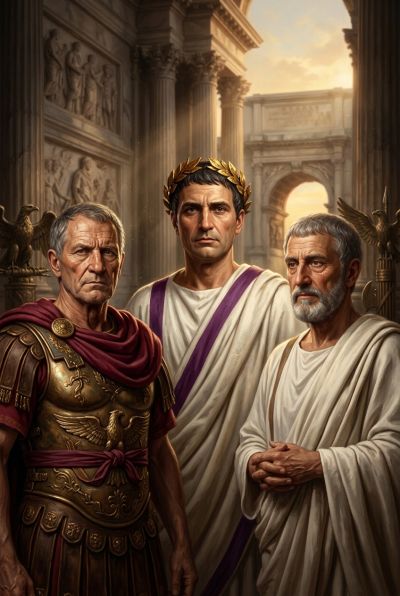
The morning mist still clung to the lagoon when the first Roman soldiers slipped into the cold water. They were not legionaries in formation but a handpicked corps of five hundred, stripped of heavy gear, carrying only swords and scaling ladders. Ahead of them lay the western wall of New Carthage, the jewel of Carthaginian power in Spain — unguarded, unthreatened, and, for the moment, reachable. The tide was turning.
A War Going Badly
By 210 BCE, Rome's position in Spain had nearly collapsed. Two years earlier, the Carthaginians had defeated and killed both of the Scipio brothers — Publius and Gnaeus — leaving the peninsula's Roman communities leaderless and the local tribes wavering. The three Carthaginian armies in the region operated with impunity, their supply lines secure, their treasury full. When the Roman assemblies met to choose a new commander, no senior magistrate would take the post. The war in Spain was seen as a graveyard for reputations.
Into that vacuum stepped Publius Cornelius Scipio, the son and nephew of the dead generals. He was twenty-four or twenty-five, had held only the junior office of aedile, and possessed no legal authority to command an army abroad. Yet he volunteered. The people, moved by his family's sacrifice and his own bearing, granted him proconsular imperium — an extraordinary leap over the heads of the Senate's preferred candidates.
Scipio arrived at Tarraco with 27,500 men and spent his first winter not chasing enemies but gathering intelligence. He learned that the three Carthaginian commanders — Hasdrubal Barca, Mago Barca, and Hasdrubal Gisco — were widely separated, each pursuing his own objectives. More crucially, he discovered that New Carthage, the Punic capital on the Iberian coast, served as the central depot for their war effort: hostages from Spanish tribes, the war treasury, naval stores, and the output of the silver mines all flowed through its gates. Its garrison numbered barely a thousand men.
The Fishermen's Secret
The city sat on a peninsula, protected on three sides by water — the Mediterranean to the east and south, a wide lagoon to the west. Only a narrow isthmus connected it to the mainland, where the landward gate and walls presented a formidable front. A direct assault there would be costly and slow. But Scipio's scouts, talking to local fishermen, uncovered a detail the Carthaginians had dismissed: the lagoon was shallow, and at certain hours, particularly during the evening ebb tide, a man could wade across it.
The Carthaginians knew the lagoon's depth varied. They had simply never believed an army would attempt it. Their western wall, facing the water, was lightly manned — an afterthought. Scipio saw the opening. He drew up a plan that combined a thunderous frontal feint with a silent approach through the water.
The Assault
On the day of the attack, Scipio ordered his fleet, commanded by his friend Gaius Laelius, to station itself off the lagoon's mouth. At first light, the Roman army advanced on the isthmus. The assault on the landward gate began with full fury — siege engines, scaling ladders, trumpets blaring. The Carthaginian garrison rushed to defend the threatened sector, pouring reinforcements into the streets behind the main wall.
Meanwhile, Scipio led his five hundred volunteers into the lagoon.
The water reached their chests at first, then dropped to their waists as the tide fell. They moved in silence, guided by the fishermen who had shown them the path. When they reached the western shore, they found the wall unmanned. The ladders went up. The first Romans over the top dropped into empty streets. Within minutes, they had seized the gatehouse and thrown it open.
The diversion had worked perfectly. By the time the Carthaginian commanders realized the western wall was lost, Roman troops were pouring through both gates. The garrison, caught between two fires, disintegrated. By nightfall, New Carthage was Roman.
The Spoils and the Signal
The capture yielded an immediate strategic windfall. The silver mines, the naval stores, the war chest — all fell intact into Roman hands. But Scipio understood that metal and grain were not the only currencies of war. In the city's citadel, he found hundreds of Spanish hostages, the sons and daughters of tribal chiefs held to guarantee their fathers' loyalty. He ordered them released, unharmed, to return to their people.
One hostage stood out: a young woman of exceptional beauty, betrothed to a powerful Celtiberian chieftain named Allucius. When she was brought before Scipio, he summoned Allucius and returned her to him, untouched, with her dowry intact. The chieftain, overwhelmed, pledged his tribe's allegiance on the spot. Within weeks, tribe after tribe followed suit, abandoning the Carthaginian cause for a Roman general who fought with discipline and kept his word.
Scipio's leniency was calculated. "He put his captured prizes to immediate use," the record notes. "He treated the city's inhabitants with leniency and freed the Spanish hostages... This act of clemency, combined with his famous gesture of returning a beautiful captive princess untouched to her fiancé... did more to win over the Spanish than any battle could have."
The Ripple Effect
The fall of New Carthage did not end the war in Spain — Hasdrubal Barca escaped with his field army and eventually marched for Italy — but it broke the Carthaginian logistical backbone. Without the city's stores, their armies in the peninsula could not be sustained. Scipio followed up with victories at Baecula and Ilipa, the latter a tactical masterpiece where he reversed his own deployment mid-battle to crush the enemy flanks. By 206 BCE, Carthaginian power in Spain was extinguished.
The lagoon crossing became the template for Scipio's career: audacity grounded in reconnaissance, speed married to discipline, psychology deployed as ruthlessly as steel. He took the city with fewer casualties than a standard siege would have cost, and he turned its capture into a diplomatic earthquake. When he returned to Rome, the people made him consul at thirty-one — below the legal age — and the Senate, despite Fabius Maximus's furious opposition, eventually granted him the African command that would end the war at Zama.
That evening in 209 BCE, as the tide rushed back into the lagoon, covering the path his men had used, Scipio stood on the captured walls. Behind him lay a city that had fed Hannibal's war machine for years. Ahead lay the long road to Africa. The crossing had taken hours; its consequences would last decades.
This is one episode in a much longer story. For the full account of the Second Punic War, read “Great Leaders of Rome” by Dr Alex Bugeja PhD on MixCache.com.
Please log in or create an account to leave a comment.
No comments yet. Be the first to say something.