
The following is an excerpt from “The Cherokee” by Hector George, available on MixCache.com.
Introduction
To tell the story of the Cherokee people is to tell a story of humanity itself, in all its complexity, resilience, and contradiction. It is a narrative that stretches back to time immemorial, rooted in the ancient mountains and river valleys of the Southeastern Woodlands, a place they knew as the center of the world. They called themselves the Aniyunwiya, the "Principal People" or "Real People." On ceremonial occasions, they might refer to themselves as the Ani-Kituwagi, the people of Kituwa, their ancient mother town nestled on the Tuckasegee River, a place of origin and enduring spiritual significance. The name by which they are most widely known, Cherokee, is an external label, likely derived from a Choctaw word meaning "people of the land of caves" or from a Muscogee term for "people of different speech." While the name has been adopted and is used today, the story of the Cherokee is, at its heart, the story of the Aniyunwiya and their unyielding journey to remain the Principal People in their own eyes and in the eyes of the world.
This book traces that epic journey across millennia, landscapes, and profound transformations. It is a history that defies simple categorization. It is not merely a tale of tragedy, though it contains one of the most heart-wrenching episodes in American history, the forced removal known as the Trail of Tears. Nor is it solely a story of conflict, though the Cherokee were formidable warriors who navigated the treacherous currents of colonial power struggles with strategic acumen. It is, instead, a chronicle of a people defined by a fierce and abiding commitment to their sovereignty, a remarkable capacity for adaptation and innovation, and a spirit of endurance that has allowed them not only to survive but to thrive as a nation in the twenty-first century.
Our story begins in the mist-shrouded Appalachian highlands, a sprawling territory of roughly 40,000 square miles that once encompassed parts of eight modern states, from Virginia and the Carolinas down to Georgia and Alabama. Here, for thousands of years, their ancestors lived, building towns with ceremonial mounds, cultivating the "three sisters" of corn, beans, and squash, and developing a sophisticated society governed by balance and consensus. The world was ordered into three interconnected realms—upper, middle, and underworld—and life was guided by the pursuit of tohi, a concept of balance and peace. This was a world structured around the clan, a matrilineal system where identity, property, and power flowed through the mother's line. Women were the heads of households, the land and children belonged to them, and the most important male figure in a child's life was not his father, but his mother's brother. Each person belonged to one of seven clans, and this kinship network formed the bedrock of law, politics, and social obligation, a system of mutual support that bound the autonomous towns into a coherent nation.
The arrival of Europeans, beginning with Hernando de Soto's brutal expedition in 1540, irrevocably shattered this world. This first contact heralded centuries of change, challenge, and conflict. The introduction of new diseases, technologies, and economic systems like the deerskin trade reshaped Cherokee life in ways both subtle and profound. They became key players in the imperial rivalries between the British, French, and Spanish, forging alliances to protect their interests and preserve their lands. They fought alongside the British in the French and Indian War and again in the American Revolution, a strategic choice that ultimately proved disastrous when the victorious American colonists turned their insatiable hunger for land toward Cherokee territory.
Yet, in the face of this relentless pressure, the Cherokee people demonstrated an extraordinary genius for adaptation, a theme that echoes throughout their history. Rather than simply resisting American encroachment through warfare alone, they chose to fight for their sovereignty by selectively adopting the tools of their adversaries. This period, often called the era of "civilization," saw the Cherokee Nation transform itself in ways that were both revolutionary and deeply controversial. They established a constitutional government modeled after that of the United States, with a principal chief, a two-house legislature, and a supreme court. They built schools, cultivated farms, and embraced new forms of dress and architecture.
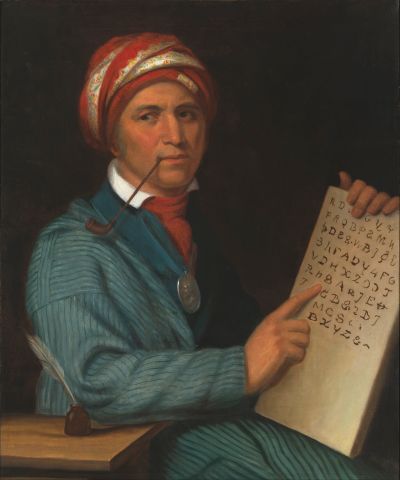
The pinnacle of this era of innovation was the work of a man who could neither read nor write any language. His name was Sequoyah. Fascinated by the "talking leaves" of the white man, he spent over a decade developing a system for writing the Cherokee language. After initial suspicion and even accusations of witchcraft, his invention—a syllabary of 85 characters representing the sounds of the language—was adopted by the Cherokee Council in 1821. The result was an explosion of literacy. Within a few years, a majority of the Cherokee people could read and write their own language, a rate of literacy that far surpassed that of their white neighbors. In 1828, the nation began publishing the Cherokee Phoenix, the first bilingual newspaper in the United States, a testament to their intellectual sovereignty and a powerful tool in their political struggle for survival.
This remarkable national project, however, could not stem the tide of greed. The discovery of gold in Georgia in 1828 sealed the fate of the Cherokee in their ancestral lands. Despite their constitution, their newspaper, and their farms, and in defiance of a U.S. Supreme Court victory that affirmed their sovereignty, the state of Georgia and President Andrew Jackson were determined to remove them. The Indian Removal Act of 1830 provided the political mechanism, and a fraudulent treaty signed by a small, unauthorized faction of Cherokees in 1835—the Treaty of New Echota—provided the thin veneer of legality.
What followed was the Trail of Tears, a forced march of nearly 15,000 Cherokee men, women, and children over a thousand miles to Indian Territory, now Oklahoma. Rounded up by soldiers, held in squalid internment camps, and driven from the land they had known for millennia, they suffered unimaginably from starvation, disease, and exposure. An estimated 4,000 people—a quarter of the nation—perished on the journey. It remains a profound stain on American history, an act of ethnic cleansing driven by avarice and racial prejudice.
But the story does not end there. The Trail of Tears is a central, defining tragedy, but it is not the final word. The survivors, though shattered by loss and divided by the bitter internal politics that had led to removal, began the arduous process of rebuilding. In the West, they re-established their government, founded new towns, and created a public school system. They endured the further divisions of the American Civil War, in which the Cherokee Nation was once again torn between factions allied with the Union and the Confederacy. They weathered the post-war policies of allotment, which sought to dismantle their communal land base and tribal government in the lead-up to Oklahoma statehood.
Throughout the 20th century and into the 21st, the Cherokee people have continued their fight for self-determination. Today, there are three federally recognized Cherokee tribes: the Cherokee Nation and the United Keetoowah Band of Cherokee Indians, both headquartered in Oklahoma, and the Eastern Band of Cherokee Indians, descendants of those who resisted removal and remained in their North Carolina homeland. These are sovereign nations with their own constitutions, courts, law enforcement, and thriving economies. They are engaged in a powerful cultural renaissance, working to revitalize their language, preserve their traditions, and educate a new generation about the history and values of the Aniyunwiya.
This book will guide you through this long and complex history. It will explore the richness of pre-contact life, the difficult choices made in the crucible of colonialism, the intellectual brilliance of Sequoyah's syllabary, the political battles of Chief John Ross, the horror of removal, and the unyielding resilience that has characterized the Cherokee people from their ancient mountain home to their modern, dynamic nations. It is a story that must be told, not only to honor the past, but to understand the present and the enduring power of a people who have always defined themselves as principal, as real, and as unconquered.
Read “The Cherokee” on MixCache.com →
Please log in or create an account to leave a comment.
No comments yet. Be the first to say something.