
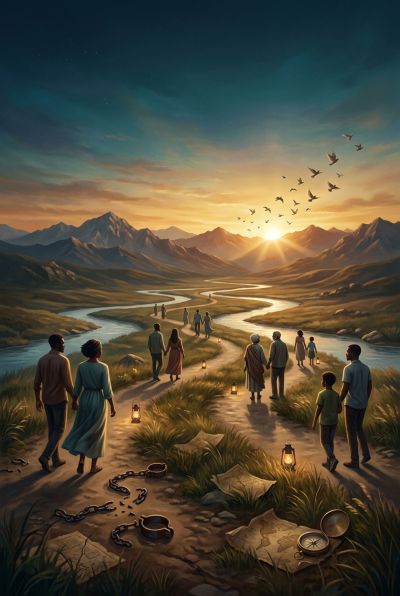
The following is an excerpt from “Stories of Independence” by Luis Rodriguez, available on MixCache.com.
Introduction
What makes a country? Is it a line on a map, a shared language, a common government, or something more intangible? At its heart, a country is a community of people with a shared identity and the right to govern themselves. This right, often called national sovereignty, is the power of a nation to manage its own affairs without outside interference. It is the bedrock principle of the international order, affirming a state's independence and authority over its own territory and people. Yet, the world map as we know it is not a static and timeless creation. It is the product of centuries of shifting borders, rising and falling empires, and the persistent, often passionate, quest by peoples around the globe to achieve self-determination.
The principle of self-determination is the idea that all peoples have the right to freely choose their own political destiny. This concept, now enshrined in international law and the Charter of the United Nations, asserts that a people can decide to establish a sovereign and independent state, freely associate with another, or pursue any other political status they choose. It is a powerful and transformative idea, one that has fueled countless movements for independence and reshaped the political landscape of the modern world. The drive for self-governance is a fundamental human aspiration, a desire to be the author of one's own story rather than a character in someone else's.
The sparks that ignite the flame of an independence movement are as varied as the cultures and histories of the people involved. Often, the catalyst is the experience of colonialism, where a distant power imposes its rule and exploits the resources of a land and its people. For decades, and in some cases centuries, vast empires stretched their dominion across continents, drawing lines on maps with little regard for the ethnic, linguistic, and cultural realities on the ground. The post-World War II era, in particular, saw a wave of decolonization as peoples in Asia and Africa rose up to cast off the shackles of European rule.
In other instances, the push for independence stems from a sense of distinct national identity that feels stifled within a larger state. This can be rooted in a unique language, a shared history of oppression, or religious differences. Economic grievances also play a crucial role. When a particular region feels that its wealth is being unfairly extracted and its people are denied opportunities, the call for "taxation without representation" can echo across generations and galvanize a population towards separation. The feeling of being ignored, of having one's legitimate concerns dismissed by a central government, can erode loyalty and foster a desire for a clean break.
This book, 'Stories of Independence', delves into the myriad ways that nations have traveled the road to statehood. The path is rarely straight or simple. For some, independence is won through the crucible of war, in long and bloody conflicts that pit neighbor against neighbor and subjects against their rulers. These wars of national liberation can involve everything from conventional battles between armies to protracted guerrilla campaigns and acts of terrorism. The American Revolution, a foundational story of a colony throwing off the yoke of an empire, serves as a powerful model for many who came after.
However, the battlefield is not the only arena where independence is fought for and won. History is also filled with inspiring examples of nations born through peaceful means. Nonviolent resistance, a strategy of civil disobedience, protests, and economic noncooperation, has proven to be a potent weapon for oppressed peoples. By refusing to cooperate with an unjust system and highlighting its inherent inhumanity, movements can capture the moral high ground, sway international opinion, and make the cost of continued rule untenable for the governing power.
In the modern era, the ballot box has also become a powerful tool for self-determination. Through carefully negotiated referendums, peoples have been given the chance to vote on their own future, to decide peacefully whether to remain part of a larger state or to strike out on their own. The dissolution of unions, sometimes amicable and sometimes fraught with tension, offers another model. Two nations, once bound together, may decide that their paths have diverged and that a "velvet divorce" is the most sensible way forward.
The 25 chapters that follow will explore this rich and complex tapestry of independence. Each chapter profiles a different nation, examining the unique historical circumstances, the key figures, and the specific methods that led to its sovereignty. From the revolutionary fervor of the Thirteen Colonies to the Singing Revolution in Estonia, from India's Salt March to freedom to the peaceful separation of Norway and Sweden, these stories showcase the remarkable diversity of the human struggle for self-governance. We will journey through tales of protracted warfare, nonviolent uprisings, negotiated settlements, and democratic votes.
These are not just political histories. They are human stories of courage, sacrifice, and the enduring hope for a future where a people can govern themselves. They illustrate that the path to independence is not a single, well-trodden highway but a multitude of trails, some violent and arduous, others peaceful and negotiated. By exploring these diverse narratives, we gain a deeper understanding of the forces that have shaped our world and the powerful, persistent idea that a people have the right to determine their own destiny.
Read “Stories of Independence” on MixCache.com →
Please log in or create an account to leave a comment.
No comments yet. Be the first to say something.