
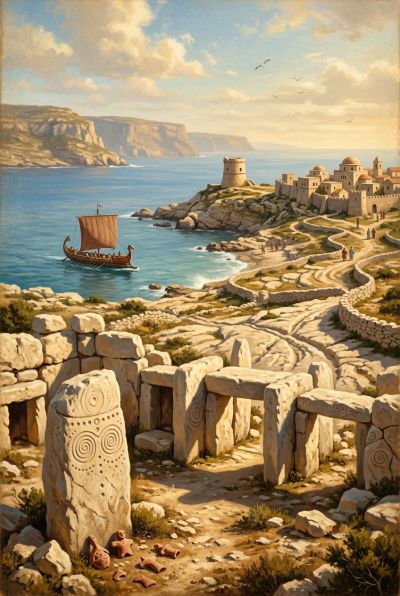
Nestled in the heart of the Mediterranean Sea, roughly eighty kilometres south of Sicily and a few hundred east of Tunisia, the Maltese Islands – Malta, Gozo, and Comino, along with a scattering of even smaller islets – have long been a nexus of civilizations. This opening line from Bugeja’s introduction instantly frames the book as more than a local history; it is a lens onto the broader currents that have shaped Europe and North Africa.
The Ancient History of Malta walks readers through eight millennia, from the island’s limestone origins to the eve of the Knights of St. John, offering a chronological scaffold that balances archaeological detail with readable narrative. Rather than a mere catalogue of dates, the work stresses how geography, environment, and successive waves of peoples interacted to produce a resilient, hybrid culture.
Geological Foundations and the First Settlers
Bugeja begins not with people but with the rock itself, describing how Malta’s limestone ridge emerged from ancient seas and later became a land bridge during periods of low sea level. This geological stage allowed African elephants and European brown bears to cross, leaving their bones in caves such as Għar Dalam. The narrative then turns to the first Neolithic arrivals around 5900 BC, who cleared conifer forests for farming and animal husbandry. The author notes that these pioneers were "a fusion of peoples, carrying with them the heritage of different coastal communities, all drawn to these new, uninhabited lands."
Their early success proved fragile; intensive agriculture degraded the thin soils, and a prolonged drought rendered the islands uninhabitable by roughly 3850 BC. Bugeja cites the FRAGSUS project’s soil‑core analysis, which showed "significant climate change fluctuations rendered Malta uninhabitable at certain points in its prehistory." This early collapse sets a recurring theme: the island’s limited resources repeatedly challenge human settlement, forcing adaptation or abandonment.
The Megalithic Temple Culture
After a millennium of abandonment, a new wave of settlers arrived circa 3850 BC, ushering in the Temple Period that would last fifteen centuries. Bugeja traces the architectural evolution from simple lobed plans to the imposing five‑apsed Ġgantija temples on Gozo, remarking that "The Ġgantija temples, standing majestically on the Xagħra plateau in Gozo and facing south‑east, are the eponymous stars of this phase. The name 'Ġgantija' derives from the Maltese word 'ġgant', meaning giant."
Beyond stone, the author explores the symbolic world of the builders. Chapter 5 highlights the iconic "fat lady" statues, describing them as "the most striking and iconic artistic creations… popularly, if somewhat misleadingly, termed 'fat ladies.'" These corpulent figures, alongside spiral motifs and animal reliefs, suggest a belief system tied to fertility, death‑rebirth cycles, and possibly ancestor veneration. The discussion of the Hypogeum of Ħal‑Saflieni in Chapter 6 further illustrates how the community extended its sacred architecture underground, carving a three‑level necropolis that also functioned as a ritual sanctuary.
Bugeja does not shy away from the mystery of the culture’s end. Chapter 8 presents evidence of rising child mortality and environmental stress, arguing that "a cascade of interconnected factors probably played out: a deteriorating environment, prolonged drought, failing agricultural yields, widespread famine, high child mortality, and the resultant social and possibly religious upheaval."
Phoenician Traders and Punic Power
Around 700 BC the Phoenicians transformed Malta from a prehistoric backwater into a Mediterranean hub. Bugeja records that "They called the principal island 'Ann'. The main port, located in the area of modern Cospicua within the Grand Harbour, was known simply as 'Maleth', meaning 'The Port' or 'The Harbour.'" This Semitic name would echo through Greek Melite and Roman Melita, forming the linguistic root of modern Malta.
The book details how the islands became a Carthaginian stronghold by the sixth century BC, serving as a waypoint for metal, grain, and luxury goods moving between Iberia, Sicily, and North Africa. Hellenistic influence seeped in through trade, evidenced by bilingual dedicatory stones such as the Cippi of Melqart, whose Punic and Greek inscriptions helped scholars decipher the Phoenician alphabet. Bugeja emphasizes that Malta’s role was never that of a passive colony; its harbours and position made it an active node in the Punic maritime network.
Arab Rule and the Birth of Maltese
The Aghlabid conquest of 870 AD marked a decisive shift, bringing Malta into the Dar al‑Islam. Bugeja recounts the violent siege and the reported massacre of Melite’s inhabitants, after which al‑Himyarī described the island as an "uninhabited ruin" for nearly two centuries. Archaeological evidence, however, suggests a Muslim community began resettling earlier, rebuilding Medina as a fortified Arab centre.
Most enduring was the linguistic legacy. The author states that "The Arabic spoken by the settlers, a dialect closely related to those of North Africa and Sicily (Siculo-Arabic), became the dominant language of the islands. Over time, this Siculo-Arabic vernacular evolved into the Maltese language (Malti)." This Semitic core, later overlaid with Sicilian, Italian, and English vocabulary, explains why Maltese remains the only Semitic language written in Latin script and an official EU language.
Bugeja also notes the agricultural innovations introduced during this period, such as the noria waterwheel and the cultivation of cotton, citrus, and new fig varieties, which reshaped the island’s economy and landscape for centuries to come.
Norman Conquest and the Re‑Christianization Process
The Norman arrival in 1091 AD, led by Count Roger I, began a slow reorientation toward Christian Europe. Bugeja clarifies that this initial expedition was more a raid than a conquest: the Muslim administration in Medina was left in place, obliged to pay tribute and release Christian captives. The author quotes Goffredo Malaterra’s account of the freed Christians fashioning "rudimentary crosses from wood or reeds" and singing the Kyrie eleison in gratitude.
True transformation came under Roger II in 1127 AD, when the islands were formally integrated into the Kingdom of Sicily. Bugeja outlines the gradual re‑Christianization driven by Latin‑speaking settlers, the establishment of a Latin church hierarchy, and the pragmatic tolerance that allowed Muslims to practice their faith—though they remained a demographic majority well into the thirteenth century, as shown by the 1240‑1241 Gililberto Abbate report enumerating 836 Muslim families versus 250 Christian ones.
The linguistic synthesis that emerged from this coexistence is highlighted as a key takeaway: Romance vocabulary entered the Maltese lexicon while the underlying Semitic structure persisted, producing the unique hybrid language spoken today. Bugeja closes the medieval section by noting that the process of conversion was neither swift nor total, creating a "medieval mosaic" where Muslim, Christian, and Jewish communities interacted, exchanged ideas, and forged a distinctive cultural identity.
Who should read this book? It will appeal to readers interested in Mediterranean archaeology, the longue durée of island societies, and how language, religion, and landscape intertwine over millennia. Scholars seeking a well‑referenced, up‑to‑date synthesis will find the extensive footnotes and engagement with debates (such as the Christian continuity question) valuable. Casual readers looking for a light travelogue may find the density of detail overwhelming, but anyone curious about how a tiny archipelago became a crossroads of civilizations will finish with a deep appreciation of Malta’s layered past.
Read “The Ancient History Of Malta” on MixCache.com →
Please log in or create an account to leave a comment.
No comments yet. Be the first to say something.