
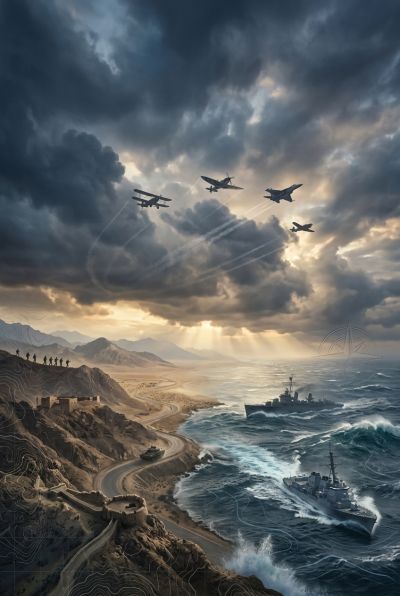
Geography is often treated as a passive stage for human drama, yet this book argues that the physical world is an active participant in every conflict. From the deserts of North Africa to the icy waters of the Arctic, the author shows how land, sea, and sky have repeatedly dictated the flow of battle, the success of supply lines, and the psychology of combatants. The work moves chronologically and thematically, using detailed case studies to illustrate how ignoring geographic realities leads to defeat while mastering them produces victory.
What the book is about
The volume is organized into twenty‑five chapters that progress from foundational principles to contemporary challenges. Early chapters examine classic terrains—rivers, mountains, deserts, jungles, and urban settings—through the lens of historical battles such as Napoleon’s Russian campaign, the Battle of Stalingrad, and the island‑hopping operations of the Pacific War. Later sections shift to the maritime domain, discussing naval power, littoral warfare, and the strategic importance of straits and canals. The narrative then rises into the air and beyond, covering the rise of air power, space as the ultimate high ground, and the geography of cyberspace. The final chapters confront modern pressures: insurgency, geopolitical hotspots, and the accelerating impact of climate change on military readiness and future flashpoints. The intended reader is anyone interested in military history, strategic studies, or the interplay of environment and conflict—students, professionals, or curious non‑specialists who want a clear, evidence‑based framework for understanding why battles unfold where they do.
Sun Tzu’s Timeless Terrain Framework
The book opens its analytical core with a close reading of Sun Tzu’s treatise, emphasizing that the ancient commander treated terrain not as scenery but as a decisive variable. As the text notes, "know the terrain" is the silent third pillar of his strategic tripod, alongside knowing the enemy and oneself. Sun Tzu classified ground into six types—accessible, entangling, temporizing, narrow passes, precipitous heights, and positions at a great distance—each demanding a specific tactical response. The author validates this framework with vivid historical examples: the Roman annihilation in the Teutoburg Forest illustrates the peril of entangling ground, while the French defeat at Dien Bien Phu shows the cost of ignoring precipitous heights. By linking these ancient classifications to modern contexts—tank commanders in the desert, drone operators in the mountains—the chapter demonstrates that the basic grammar of geography remains unchanged across millennia.
Rivers as Strategic Arteries and Barriers
Chapter two explores the dual nature of rivers, describing them as "a line on a map that both connects and divides." The narrative traces how rivers have served as highways for invasion—Viking longships slipping deep into Europe—and as formidable obstacles that have halted armies, from the Roman limes along the Rhine and Danube to the Soviet struggle to cross the Dnieper in World War II. The book highlights the logistical calculus that turns a river into a lifeline or a death trap, using the Vicksburg campaign as a masterclass: Grant’s feint south of the city, the ironclad run past Confederate guns, and the eventual siege that split the Confederacy. Conversely, the disastrous Allied attempt to cross the Rapido River near Cassino underscores how underestimating a riverine defense can lead to catastrophic loss. These cases reinforce the idea that mastery of river geography—timing, tide, bank conditions—can determine the fate of entire campaigns.
The Logistics Imperative Across Vast Spaces
Logistics emerges as a recurring theme, especially in chapters covering deserts, steppes, and global supply chains. The author quotes Frederick the Great’s observation that "An army, as the Prussian king Frederick the Great is said to have remarked, marches on its stomach," to stress that sustained operations depend on moving food, fuel, and ammunition across hostile terrain. The North African theater of World II illustrates this principle: both the British Eighth Army and Rommel’s Panzer Army advanced only as far as their supply lines allowed, creating a pendulum effect where victory in one battle often set the stage for defeat in the next. The book details how geography imposes a "tyranny of distance"—the farther an army advances, the more its logistical tail stretches, consuming an ever‑greater share of its effort. Modern examples, such as the Red Ball Express in France after D‑Day, show that even with technological advances, the last tactical mile remains bound by terrain, whether it be a mountain pass, a desert track, or a swampy road.
Air, Sea, and Sky: The Evolution of the High Ground
The work traces the expansion of the battlefield from two dimensions to three and beyond, beginning with the assertion that "The sky became the new high ground." Early advocates like Giulio Douhet envisioned air power as a means to bypass trenches and strike directly at an enemy’s industrial heartland, a theory tested in the World War II bomber offensives. The book then shows how air superiority became a prerequisite for success in ground and naval operations, citing the Allied domination of the skies over Normandy that enabled the D‑Day landings and the subsequent interdiction of German supply lines. The narrative continues upward into space, describing Low Earth Orbit as "the domain of observation" and Geostationary Orbit as the "perfect location for communications and missile warning satellites." It argues that space has become the ultimate high ground, where control of satellite constellations can blind an adversary’s reconnaissance, jam GPS signals, or threaten nuclear deterrence. By linking these domains, the chapter illustrates how modern warfare now requires mastery of a vertical stack of environments, each with its own geographic constraints and advantages.
Geography in the Age of Climate Change and Future Warfare
The final sections confront the reality that the physical world is no longer static. The author notes that "Climate change has been described by security analysts as a 'threat multiplier,'" a force that exacerbates existing tensions by altering coastlines, opening new Arctic waterways, and intensifying extreme weather. Rising seas threaten naval bases such as Naval Station Norfolk, where "recurrent or 'sunny‑day' flooding" already disrupts operations. Melting Arctic ice is creating new strategic choke points—the Northern Sea Route and the Northwest Passage—potentially reshaping global trade and prompting a new scramble for resources and military presence. The book also links environmental stress to human migration, warning that climate‑driven displacement could destabilize regions and draw militaries into humanitarian roles that erode traditional warfighting readiness. By presenting these trends as geographic realities rather than speculative scenarios, the work underscores that understanding the evolving physical landscape remains essential for anticipating where future conflicts may arise and how they might be fought.
Read “The Impact of Geography on Warfare” on MixCache.com →
Please log in or create an account to leave a comment.
No comments yet. Be the first to say something.