

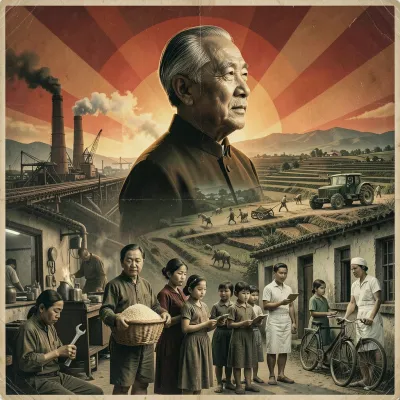
Between 1949 and 1976, the People's Republic of China did not merely build a state — it attempted to remake the daily rhythms of nearly a billion people. Austin Russell's Revolution and Remaking follows that ambition from the first land reform meetings to the final factional struggles of Mao's last years, showing how policies became lived experience in mess halls, work units, and household courtyards.
What the book is about
The book spans 25 chapters organized both chronologically and thematically, moving from the founding of the PRC through state-building, land reform, urban takeover, the First Five-Year Plan, collectivization, the Great Leap Forward, the famine years, the Cultural Revolution, and the diplomatic opening to the United States. Russell adopts a deliberately dual lens: a top-down narrative of policy conception paired with a bottom-up social history of implementation. He treats campaigns — land reform, collectivization, the Great Leap, the Socialist Education Movement, the Cultural Revolution — as a "governing technology" that mobilized people, resources, and emotions. At the same time, he tracks how the work unit (danwei), the hukou system, rationing, and propaganda structured everyday choices about food, housing, marriage, and belief. The result is a comprehensive, empathetic account aimed at readers who want both the political arc and the texture of daily life under Maoist rule.
Campaigns as governing technology
One of the book's central arguments is that mass mobilization campaigns were not occasional eruptions but the regime's standard operating procedure. The Introduction frames campaigns as "time-bounded drives that mobilized people, resources, and emotions to achieve moral and material ends," and Chapter 10 shows this in action during the Great Leap Forward, when "the country became a patchwork of small furnaces that smoked by day and glowed by night." Chapter 16 traces how the Socialist Education Movement (1963–1965) evolved from the "Four Clean-ups" — targeting corruption in accounts, granaries, property, and work points — into a broader hunt for "those in power taking the capitalist road." Chapter 17 then depicts the Red Guard phase as the ultimate escalation: "The summer of 1966 arrived with a heat that felt less like weather and more like a warning." Across these episodes, Russell shows how campaign logic — struggle sessions, public criticism, quotas, model emulation — created a reusable toolkit that could be aimed at landlords, "rightists," "capitalist roaders," or "four olds" with minimal adjustment.
The work unit and hukou as everyday architecture
If campaigns provided the rhythm, the work unit and household registration system provided the skeleton of urban life. Chapter 6 details how the danwei became a "total institution" that "knitted together a person's hours, meals, housing, and standing in a single clumsy but effective bundle." Housing allocation "produced maps of the city that looked like topographies of loyalty," while the hukou matured into "a tool for steering migration and opportunity" that "sorted people into streams of entitlement." Chapter 21 extends this into the economy of shortage: ration coupons became "passports to the lawful economy," and queues turned into "social spaces where information flowed as freely as rumors." The shadow economy that grew alongside official distribution — barter, connections (guanxi), side production in factories — was not a breakdown of the system but "its necessary complement," tolerated because "strict enforcement would paralyze production." Together, these chapters reveal a society where formal rules set the baseline and informal networks made daily survival possible.
Women, family, and the limits of legal equality
Chapter 8 gives the 1950 Marriage Law its due as a "small bomb" that outlawed arranged marriages, concubinage, and unilateral divorce while granting women property rights and legal personhood. But the law's implementation was uneven: urban women entered factories with new protections, yet "the double burden of paid labor and domestic responsibility persisted with little formal relief." In villages, collectivization pressed women into fieldwork on an unprecedented scale, and "childcare remained haphazard, with grandparents and older siblings filling gaps." The law also intersected with the hukou system, creating "a gray market in marriage, where legal and practical motives tangled like roots under a sidewalk." By the 1970s, propaganda celebrated women as "iron girls" in Dazhai-style labor (Chapter 24), but Revolutionary Committees remained male-dominated, and traditional gender expectations "persisted beneath the revolutionary rhetoric." Russell avoids both celebration and dismissal, showing how legal change created new leverage without fully restructuring the domestic division of labor.
Famine, survival, and the recalibration of the 1960s
The Great Leap Forward's catastrophic famine (Chapters 10–11) receives unflinching attention. Chapter 11 opens with "a sense of fatigue that settled in the bones like damp weather" and describes how communal mess halls served "thinner porridge" while "substitute foods were promoted with earnest posters showing how to make nutritious meals from things that were not usually food at all." The state's response mixed genuine relief with political theater: grain shipments arrived alongside officials who "inspected, reported, and sometimes confiscated what they found." Crucially, Chapter 12 shows the readjustment period (1961–1965) not as a clean break but as "a patient untangling of knots." Private plots were "quietly tolerated again," rural markets "pulsed again," and the work unit shifted from "a theater of transformation" to "a manager of routines." This interlude demonstrated that the system could bend — "prioritizing survival over spectacle" — without abandoning its core structures, setting a pattern of pragmatic retrenchment that would recur after later upheavals.
Culture, belief, and the persistence of the unofficial
Chapters 7, 14, and 22 trace how the state sought to remake culture and belief while unofficial practices endured in the margins. Chapter 7 describes thought reform in universities where "scholars learned to tuck complexity into prefaces or footnotes while keeping the main text marchable," and in radio broadcasts where "even skeptics found themselves humming campaign tunes while washing clothes." Chapter 14 examines the model operas as "exemplars for other creators to study and emulate," noting that audiences "laughed at lines that were meant to be sober" and "whispered about characters who got away with things." Chapter 22 follows religion from the 1950s "patriotic associations" through the Cultural Revolution's destruction of temples to the 1970s compromise where "faith could exist, but it had to be domesticated." Families "hid scriptures under floorboards" and "visited shrines under cover of darkness," producing a "selective amnesia" where rituals continued but their meanings faded. The state learned that "iconoclasm was easier than it looked, and that the human need for meaning could not be legislated away."
Who should read this
Readers looking for a single-volume history that integrates high politics with social experience will find this book unusually thorough. It rewards those willing to move between Politburo debates and village struggle sessions, between steel quotas and mess-hall menus. Specialists will appreciate the chapter-level depth on topics like the laogai system (Chapter 20), the sent-down youth (Chapter 19), and the 1971–1972 rapprochement (Chapter 23). General readers should be prepared for density: the prose is analytical rather than narrative-driven, and the sheer number of campaigns, models, and factions requires sustained attention. Anyone primarily interested in military history, elite biography, or post-1978 reform will want to look elsewhere. But for understanding how Maoist governance worked — and how ordinary people navigated it — Revolution and Remaking is a substantial, clear-eyed guide.
Read “Revolution and Remaking: Mao Zedong and the People's Republic, 1949–1976” on MixCache.com →
Please log in or create an account to leave a comment.
No comments yet. Be the first to say something.