

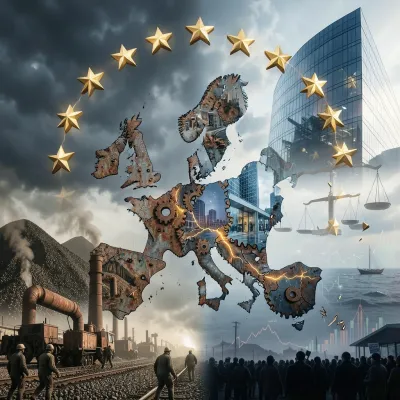
The European Union began not with a constitution but with a wager: that pooling coal and steel would make war between France and Germany materially impossible. Robert Evans's The EU Story follows that wager across seven decades, showing how a functionalist fix for heavy industry grew into a polity that now shapes the daily lives of over 400 million people — and why its legitimacy remains perpetually unsettled.
What the book is about
The EU Story is a 25-chapter political and policy history that moves chronologically from the 1951 European Coal and Steel Community through the 2020s polycrisis. Each chapter pairs historical narrative with institutional analysis, covering the Treaty of Rome, the Single European Act, Maastricht and the euro, eastern enlargement, the eurozone crisis, migration, Brexit, rule-of-law conflicts, the Green Deal, digital regulation, energy security after Russia's invasion of Ukraine, trade geoeconomics, defense integration, budget battles, and competing future scenarios. The book is structured as both a narrative and a primer: it reconstructs key moments while supplying conceptual tools — delegation, veto players, the political economy of monetary union, comitology, judicial review — for readers who want to understand how the EU actually works. It assumes no prior expertise but rewards readers willing to engage with treaty mechanics and bargaining dynamics.
The functionalist logic that started it all
Evans opens with Jean Monnet's insight that "if you could make cooperation more profitable than conflict, statesmen would follow the money even when their national pride screamed at them not to." Chapter One details how the 1950 Schuman Declaration turned that insight into the ECSC, creating a High Authority with binding decisions, a Court of Justice, and a budget funded by a levy on production — a template that "would endure long after the coal and steel themselves faded into relative economic insignificance." The ECSC's mixed economic record mattered less than its conceptual breakthrough: sovereign states accepted a supranational executive with real power, proving the functionalist premise that sectoral integration could seed broader political cooperation.
Crises as tutors, not interruptions
A recurring argument is that crises "did not merely interrupt integration — they redirected it." The eurozone crisis (Chapter Twelve) forced the creation of the ESM, the banking union's SSM and SRM, and a tightened Stability and Growth Pact. The 2015–2016 migration emergency (Chapter Thirteen) exposed the Dublin Regulation's collapse and produced the EU-Turkey deal, which "effectively turned Turkey into Europe's gatekeeper." Brexit (Chapter Fourteen) became a "clarifying moment" that paradoxically increased support for membership in remaining states. Russia's 2022 invasion (Chapter Eighteen) triggered REPowerEU, the fastest energy reconfiguration in EU history. In each case, the Union improvised institutions — trilogues, the "whatever it takes" OMT, the conditionality regulation — that later hardened into permanent features.
The institutional triangle and the Court's quiet revolution
Chapter Three unpacks the Commission, Council, Parliament, and Court as "living arenas where power is exercised, contested, and sometimes quietly redistributed." The Court of Justice emerges as the most consequential: through Van Gend en Loos (1963) and Costa v ENEL (1964), it established direct effect and supremacy, transforming the treaties into "a new legal order" that individuals could invoke in national courts. The preliminary ruling procedure then built "a vast body of case law that touches virtually every area of EU activity." Meanwhile, the Parliament evolved from a consultative assembly into a co-legislator under the ordinary legislative procedure, yet still cannot initiate legislation and struggles with a "representation gap" — most citizens don't know their MEP.
Rule of law and the limits of Article 7
Chapter Fifteen examines the EU's most uncomfortable reckoning: Hungary and Poland's dismantling of judicial independence and media freedom. Article 7, the treaty's "emergency brake," requires unanimity to sanction a member state — a "loaded gun with a safety catch that could not easily be released." The resulting stalemate produced the conditionality regulation (2020), linking recovery funds to rule-of-law compliance via qualified majority voting. Evans notes the mechanism's first application against Hungary was "messy" and "watered down," but it marked "the first time the EU had directly tied funding to governance standards in a way that could actually be enforced." The episode reveals a deeper tension: the EU treats values as enforceable obligations, yet lacks tools that don't require the cooperation of the very governments being sanctioned.
Three futures, one unresolved democratic deficit
The final chapter sketches three scenarios: deepening toward a federal core with a permanent fiscal capacity; decoupling into a loose free-trade area; or differentiated integration as a permanent architecture. Evans argues the Union's "unresolved democratic deficit and a mismatch between its economic scope and its cultural coherence" persist across all paths. The Spitzenkandidaten experiment stalled; transnational lists were shelved; the Conference on the Future of Europe produced recommendations but little institutional change. As the book concludes, the EU remains "a living, contested experiment that must continually renegotiate the balance between national sovereignty and supranational necessity to remain relevant in a multipolar world."
Who should read this
Readers who want a single volume that explains both the history and the machinery of European integration — students, policy professionals, journalists, or politically engaged citizens — will find this book unusually thorough. It is less suited for those seeking a purely cultural or narrative history; the focus stays squarely on institutions, treaties, and policy trade-offs. The density of detail (25 chapters, each with its own conceptual framework) demands sustained attention, but the payoff is a working mental model of how the EU actually decides, why it often appears paralyzed, and what might come next.
Read “The EU Story: From Coal and Steel to a Contested Union” on MixCache.com →
Please log in or create an account to leave a comment.
No comments yet. Be the first to say something.