
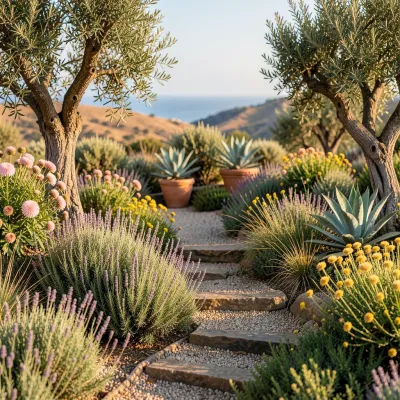
Mediterranean Natives for Hot, Dry Landscapes offers more than a plant list; it frames garden design as a partnership with climate patterns that have shaped flora for millennia. By grounding readers in the shared winter‑wet, summer‑dry rhythm of five distant regions, the book shows how to create landscapes that thrive on restraint rather than constant irrigation.
The work moves from climate science to hands‑on techniques, covering site analysis, soil biology, water budgeting, plant physiology, and long‑term maintenance. Its audience includes homeowners, designers, and land stewards who want gardens that are beautiful, ecologically sound, and attuned to the natural pulse of heat and drought.
Understanding the Mediterranean Climate Rhythm
The book opens by inviting readers to “stop thinking like a cloud and start thinking like a ridge,” emphasizing that the defining feature of these zones is not today’s rain but the months‑long absence of it. As Chapter 1 explains, “The year begins with rain that calls roots into action, then shifts to a period when the best move is to sit tight.” This seasonal choreography dictates when plants grow, when they rest, and how designers should align irrigation, pruning, and planting with those natural cycles rather than fighting them.
Each of the five regions—the Mediterranean Basin, California, Central Chile, the Cape Region of South Africa, and Southwestern Australia—shares this pattern despite differing geologies and aesthetics. Recognizing this common rhythm allows gardeners to borrow successful strategies across continents while respecting local nuances, turning a seemingly limiting climate into a design partner.
Waterwise Design and Hydrozoning
Chapter 2 reframes xeriscape not as deprivation but as a sequence of priorities: plan and design, improve soil, use efficient irrigation, choose appropriate plants, limit turf, mulch, and maintain with care. The author notes, “Waterwise design does not begin with a list of plants that can be ignored but with a plan that makes water matter where it falls.” This mindset shifts focus from simply cutting water use to directing it where it delivers the greatest aesthetic and ecological return.
Building on that, Chapter 9 introduces hydrozoning as “the art of grouping plants by thirst and then giving each group exactly the drink it needs without drowning the neighbors or running the well dry.” By placing high‑need plants near the house and letting drought‑tolerant species survive on rainfall alone, designers create irrigation zones that match actual plant demand, reducing waste and encouraging deeper rooting. The approach also supports visual contrast, letting lush, textured areas coexist with sparse, sculptural zones.
Soil as a Living Partner
Chapter 4 stresses that soil is “not an obstacle but a partner, and in Mediterranean‑climate regions it tends to be old, opinionated, and surprisingly competent when left to do what it does best.” Rather than imposing a universal garden loam, the book advises readers to assess texture, structure, and biology, then make targeted amendments that improve drainage or water retention without smothering native microbial communities.
Practical guidance includes using coarse sand or fine gravel to open heavy soils, adding modest organic matter to improve structure, and protecting the soil surface with mulches that moderate temperature and reduce evaporation. The text reminds us that “a healthy soil food web also helps plants fend off pathogens, cycle nutrients at a steady pace, and build stable aggregates that resist erosion,” underscoring the long‑term payoff of working with, rather than against, the soil’s inherent characteristics.
Plant Adaptations for Drought Tolerance
Chapter 7 details how native plants have evolved to cope with prolonged dry periods. A key observation is that “The most conspicuous adaptation in many Mediterranean natives is a reduction in leaf area or a transformation of leaf texture, both of which limit the surface available for water loss.” These adaptations—silvery, leathery, or waxy foliage, deep taproots, seasonal dormancy, and specialized photosynthesis—allow plants to conserve water while maintaining function.
Understanding these traits informs plant selection and placement. For example, deep‑rooted shrubs benefit from infrequent, deep soakings that encourage descent, while shallow‑rooted perennials thrive with lighter, more frequent watering during establishment. By matching a plant’s physiological strategy to site conditions, gardeners can reduce intervention and let the vegetation express its natural resilience.
Maintenance, Pruning, and Integrated Pest Management
Long‑term success hinges on maintenance that respects the garden’s seasonal rhythm. Chapter 23 advises that “Pruning in Mediterranean‑climate gardens is not a universal ritual to be performed on a strict calendar, but a nuanced conversation between the plant, the climate, and the gardener’s intent.” The text recommends timing cuts after bloom or during dormancy, favoring thinning cuts that preserve natural form over heading cuts that stimulate weak, leafy growth.
Chapter 24 expands this philosophy to pest and disease management, describing integrated management as “less a war and more a calibrated relationship, one that balances observation, restraint, and precise action so that gardens remain beautiful and productive without becoming intensive care wards.” The approach encourages monitoring, encouraging beneficial insects, using water sprays or horticultural oils only when thresholds are exceeded, and accepting a modest level of herbivory as part of a living ecosystem.
Together, these chapters provide a framework for seasonal care: major pruning and planting in winter, light grooming in summer, and ongoing observation that allows the garden to self‑regulate. The result is a landscape that matures with quiet confidence, requiring fewer inputs over time while supporting biodiversity and ecological health.
Who should read this book? Anyone involved in creating or managing gardens in summer‑dry climates—homeowners redesigning a yard, landscape architects working on public spaces, or ecological restoration practitioners—will find actionable, region‑specific guidance. Readers seeking a quick plant encyclopedia or those uninterested in soil science and water budgeting may find the depth overwhelming, but for those ready to work with climate rather than against it, the book offers a durable, practical roadmap.
Read “Mediterranean Natives for Hot, Dry Landscapes” on MixCache.com →
Please log in or create an account to leave a comment.
No comments yet. Be the first to say something.