

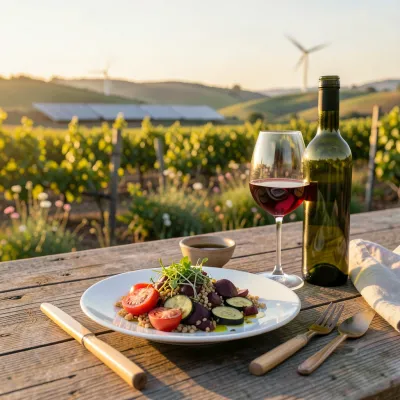
Our meals and our wines are daily votes for the kind of future we want, writes Madeline Silva in the introduction to Sustainable Plates, Sustainable Vines. That framing—pleasure as participation, not sacrifice—sets the tone for a book that refuses to treat sustainability as a joyless checklist. Instead, Silva builds a case that the most flavorful food and wine often emerge from the very practices that heal soil, conserve water, and sequester carbon.
What the book is about
Organized across 25 chapters, the book moves logically from field to cellar to kitchen. Early chapters establish the climate stakes: food systems account for roughly one-quarter to one-third of global greenhouse gas emissions, and "if food waste were a country, it would be the third-largest emitter of greenhouse gases in the world." From there, Silva walks through regenerative agriculture principles (minimizing soil disturbance, keeping soil covered, maximizing diversity, integrating livestock, minimizing synthetic inputs), low-impact viticulture (organic, biodynamic, and regenerative certifications), and a detailed certification decoder that distinguishes between USDA Organic, Demeter Biodynamic, Regenerative Organic Certified, and various sustainable winegrowing programs. The middle sections translate these ideas into sourcing strategies, seasonal menu planning, zero-waste kitchen fundamentals, fermentation and preservation, and ingredient-by-ingredient guidance on plant-forward proteins, responsible seafood, oils, grains, and wild or perennial foods. Later chapters address low-energy cooking, home cellar management, pairing principles for sustainable wines, and three recipe chapters organized by weeknight staples, crowd-pleasing dishes, and no-waste desserts and drinks. The book closes with a framework for building a climate-smart pantry and wine rack, plus a chapter on measuring personal impact and advocating beyond the kitchen. The intended reader is a home cook and wine drinker who wants practical, science-informed tools without dogma—someone ready to make "directionally better choices that fit your budget, taste, and context."
Regenerative agriculture as climate action, not just farming
Silva devotes Chapters 3 and 4 to making the case that regenerative practices are "a potent tool for carbon sequestration" because "healthy soils, rich in organic matter, act as massive carbon sinks." She explains the five core principles—minimizing soil disturbance, keeping soil covered (especially through cover cropping), maximizing crop diversity and rotation, integrating livestock through managed grazing, and minimizing synthetic inputs—as an interconnected system rather than a menu of options. The flavor payoff is explicit: "A living, breathing soil provides a nuanced palette of nutrients and compounds that can be absorbed by plants, influencing their biochemical composition." In vineyards, this translates to cover crops between rows, reduced tillage, and even grazing sheep or chickens, which "stimulate plant growth, distribute nutrients through their manure, and help to cycle carbon." The argument is that regenerative viticulture doesn't just reduce harm; it actively rebuilds the ecosystem that gives wine its sense of place.
Decoding the label maze without greenwashing
Chapter 9 serves as a field guide for the supermarket and wine shop. Silva breaks down what "Organic" actually guarantees (no synthetic pesticides, herbicides, fertilizers, or GMOs; for USDA Organic wine, no added sulfites), how "Biodynamic" adds "a holistic, almost mystical approach" with specific preparations and cosmic calendars, and why "Sustainable" certifications vary widely in rigor—some are "incredibly robust and transparent," others "less demanding, leading to potential 'greenwashing' concerns." She introduces Regenerative Organic Certified (ROC) as "the gold standard" requiring organic certification plus stringent soil health, animal welfare, and social fairness criteria. The chapter also covers Fair Trade, Climate Neutral, and B Corp labels, then offers a decision framework: prioritize certified products, understand each label's focus, recognize no single label is perfect, research specific programs, and "don't let perfection be the enemy of good"—especially since smaller producers may practice regeneration without affording certification.
Circular cooking and zero-waste fundamentals as daily practice
Chapters 12 and 13 reframe kitchen waste as "potential ingredients, rich in flavor and nutrients." Silva outlines a hierarchy: mindful shopping to avoid bringing waste home, proper storage to extend freshness, maximizing the entire ingredient (broccoli stems in stir-fries, onion skins for broth, citrus peels for vinegar or cleaning solutions), and composting what truly can't be eaten. The fermentation section is particularly thorough, covering lacto-fermented vegetables, yogurt, kefir, sourdough, kombucha, and homemade vinegar from fruit scraps. She introduces "circular cooking" as "a philosophy that aims to keep food resources in use for as long as possible, extracting maximum value from every ingredient, and minimizing anything that goes to waste." Practical techniques include root-to-stem cooking (radish greens, carrot tops, beet greens), nose-to-tail animal use (bones for broth, organ meats, rendered fat), and planned over-production for future meals. The message: "These practices are not about deprivation; they are about enrichment—enriching your palate, your health, and your contribution to a more sustainable planet."
Plant-forward proteins and responsible sourcing across land and sea
Chapters 14 through 16 tackle protein with nuance. Legumes are highlighted as "superheroes" because many "are nitrogen-fixers, meaning they can convert atmospheric nitrogen into a form usable by plants, thereby enriching the soil and reducing the need for synthetic nitrogen fertilizers." Whole grains, nuts, seeds, and soy products (with cautions about sourcing) round out the plant-forward toolkit. For animal products, Silva draws a sharp line: "Regeneratively raised animal products… are a different beast entirely" from CAFO systems. She recommends seeking "Grass-fed" and "Pasture-raised" labels backed by certifications like American Grassfed Association or Certified Humane, and frames these as "investing in an ecological service rather than just a commodity." Seafood gets its own chapter structured around three pillars: knowing what to buy (smaller, fast-reproducing species), how it was caught or farmed (pole-and-line, troll, FAD-free purse seine, RAS aquaculture, shellfish farming), and where it came from (traceability, MSC/ASC certifications, Seafood Watch guides). The through-line: diversification reduces pressure on any single stock and mirrors the biodiversity benefits of varied crops on land.
Wine storage, pairing, and the home cellar as climate practice
Chapters 19 and 20 extend sustainability into the glass after purchase. Silva argues that "when a bottle goes bad due to poor storage, all the energy, water, and care that went into producing it… was effectively for nothing." She details temperature consistency (ideally 55°F/13°C), humidity (50–80%), light protection, and bottle orientation—while noting that screw caps and synthetic corks eliminate cork taint ("ruins an estimated 3-5% of all cork-sealed bottles") and reduce the need for sideways storage. A pragmatic note: "not every wine benefits from long-term aging… Most wines produced for everyday enjoyment… are made to be consumed within a few years of release." Pairing principles start with weight and intensity but embrace the distinctive character of low-intervention wines: "These qualities are not flaws; they are signatures of authenticity, and they demand a slightly different approach at the table." Regional pairings leverage centuries of co-evolution, and serving temperature adjustments (cooler for natural reds, warmer for textured whites) ensure the wine expresses its full range. The chapter closes with a waste-reduction mindset: oxidized wine becomes cooking wine, then vinegar, then vinaigrette—"When every drop is used and enjoyed, the act of pairing becomes not just a sensory experience, but a final act of respect."
Who should read this
This book belongs on the shelf of anyone who cooks regularly, drinks wine with intention, and wants a single reference that connects agricultural science to kitchen decisions without requiring a specialist's background. It's especially useful for readers who already shop at farmers' markets or buy organic but feel unsure how to evaluate regenerative claims, choose between certifications, or translate those choices into weeknight meals and a functional home cellar. The recipe chapters offer accessible entry points, while the certification decoder and sourcing guide serve as ongoing references. Readers looking for a purely philosophical treatise or a strict zero-waste manifesto may find the tone too practical and the "progress over perfection" stance too flexible. But for the climate-aware eater who wants to understand why a cover-cropped vineyard yields a more expressive wine, how to turn carrot tops into pesto, or which questions to ask at the fish counter—and then actually do something with that knowledge—Silva delivers a thorough, usable, and genuinely appetizing roadmap.
Read “Sustainable Plates, Sustainable Vines” on MixCache.com →
Please log in or create an account to leave a comment.
No comments yet. Be the first to say something.