

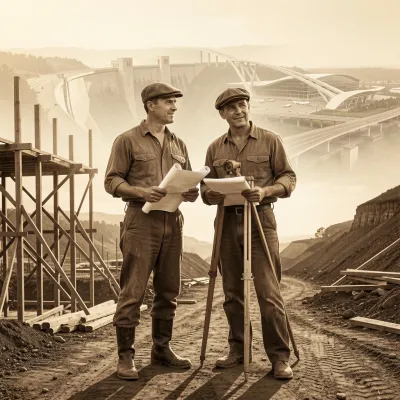
The story begins with a telephone number. In 1899, Parisian engineers Alexandre Giros and Louis Loucheur founded Société Générale d'Entreprises and nicknamed it "Girolou" — a portmanteau of their surnames that doubled as their phone contact. What started as a modest electrical and reinforced-concrete contractor became, over 125 years, a conglomerate managing 4,400 kilometers of French motorways, 70-plus airports across 13 countries, and energy networks spanning five continents. Margaret Ortiz's A History of VINCI doesn't just catalog projects; it reveals how a company built on technical credibility and concession foresight rewrote the rules of infrastructure finance.
What the book is about
Ortiz structures the narrative across 25 chapters that move chronologically from SGE's founding through the 2024 horizon. The first third covers domestic French expansion — electrification, post-war reconstruction, and the early concession experiments in gas and urban transport. The middle sections detail the pivot to public-private partnerships, the 2001 merger with Groupe GTM that created the VINCI name, and the acquisition spree (ASF, ANA Aeroportos, Cegelec) that built three distinct pillars: VINCI Construction, VINCI Energies, and VINCI Concessions. Later chapters examine innovation (BIM, IoT, digital twins), sustainability commitments, human-capital philosophy, crisis resilience (2008 crash, COVID-19), and the current global footprint. The book addresses professionals in infrastructure finance, engineering, and public policy, but its clear prose makes it accessible to any reader curious about how essential services get financed, built, and operated at planetary scale.
The concession model as strategic DNA
Long before "PPP" entered the policy lexicon, Giros and Loucheur secured a gas concession in Roubaix and took over urban transport in Roubaix and Tourcoing. Ortiz shows this wasn't opportunistic — it reflected a deliberate belief that "long-term management and operation of infrastructure offered stable revenue streams and a deeper integration into the national economy." The model matured with post-war motorway concessions, where SGE financed, built, and operated toll roads for decades. The 2006 acquisition of Autoroutes du Sud de la France (ASF) cemented VINCI as "the world's leading integrated concession/construction group." By 2024, VINCI Concessions generates the recurring cash flow that insulates the group from construction's cyclicality — a financial architecture traced directly to those 1900s gas and tramway deals.
Three pillars, one integrated logic
The book's clearest structural insight is how VINCI's three divisions reinforce each other. VINCI Construction delivers the build; VINCI Energies installs the "nervous system" — smart grids, building management, fiber networks, EV charging; VINCI Concessions operates the asset for 30–50 years. Ortiz illustrates this with a motorway example: Construction builds it, Concessions operates it, Energies provides "intelligent traffic management systems, smart lighting, and energy-efficient toll plazas." The same logic applies to airports: VINCI Airports manages terminals while Energies handles baggage systems, security networks, and 5G connectivity. This vertical integration lets VINCI bid for whole-lifecycle contracts few competitors can match, turning technical scope into commercial moat.
Innovation as continuous adaptation, not showcase
Ortiz avoids tech-hype language. She presents innovation as pragmatic problem-solving: reinforced concrete in 1903, Europe's first 60,000-volt line, prefabrication for speed, BIM for clash detection, IoT sensors for predictive maintenance, digital twins for whole-asset simulation. A telling passage notes that "the digital transformation was an ongoing journey, but the foundation had been laid, demonstrating that even the most physical of industries could be profoundly reshaped." VINCI Energies' 2009 Cegelec acquisition brought automation and ICT depth; today its 60-country network deploys smart-grid software and cybersecurity for critical infrastructure. The book frames each wave — materials, digital, AI — as response to client and planetary pressures, not marketing.
Resilience tested by 2008 and COVID-19
Two crises bookend the modern era. The 2008 financial crash saw construction pipelines dry up, yet "the stable, recurring revenues generated by its concessions businesses... provided a crucial counter-cyclical buffer." COVID-19 was sharper: airport traffic "virtually ceased overnight," motorway tolls plummeted, and sites locked down. Ortiz details the response — health protocols, remote management via digital tools, accelerated maintenance during downtime, and aggressive cost discipline at VINCI Airports. The group's balance sheet, built on concession cash flows, allowed it to "access capital markets and maintain its investment capacity" while competitors retrenched. The chapter concludes that crises "served as powerful learning experiences, refining VINCI's risk management frameworks" and accelerating digital adoption by years.
Sustainability as business logic, not compliance
Ortiz traces environmental awareness from site-level noise and waste rules to today's science-based targets. Low-carbon concrete, asphalt recycling, EV charging corridors, airport solar farms, and net-zero-by-2050 pledges for VINCI Airports are presented as operational imperatives: "The long-term nature of VINCI's concession assets provided a unique incentive for investing in sustainability. An airport or a motorway operating for 50 years would incur significant costs if not designed and managed with environmental efficiency in mind." Circular-economy thinking — designing for disassembly, reusing demolition materials — moves from pilot to standard practice. The book argues convincingly that for a concessionaire, decarbonization is asset-value protection.
Who should read this
Infrastructure investors, public-sector procurement officials, and engineering managers will find a rare inside view of how a global platform structures risk, capital, and technology across asset lifecycles. Business-history readers get a clean case study in corporate evolution from family firm to multinational without losing technical specificity. General readers interested in how the roads, airports, and power grids they use daily actually get financed and run will appreciate the lack of jargon. Skip it if you want a biography of leaders — Giros, Loucheur, and later CEOs appear but the focus stays on organizational choices — or if you expect critical exposé; the tone is institutional and admiring, not investigative.
Read “A History of VINCI” on MixCache.com →
Please log in or create an account to leave a comment.
No comments yet. Be the first to say something.