
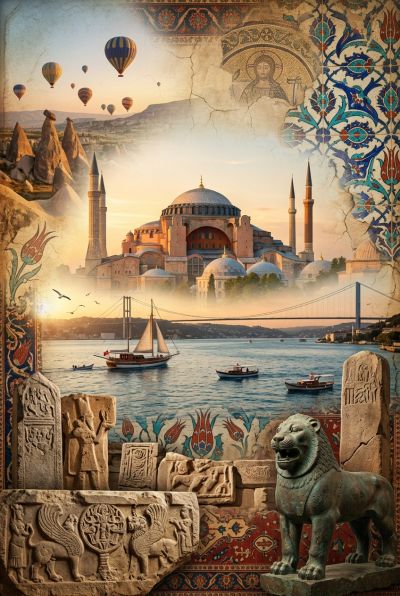
Few lands have witnessed as much human history as the Anatolian peninsula. From the enigmatic stone circles of Göbekli Tepe — predating Stonehenge by six millennia — to the bustling streets of contemporary Istanbul, this territory has served as a crossroads for empires, ideas, and migrations. Kemal Arslan's A History of Türkiye undertakes the formidable task of weaving these millennia into a single, coherent narrative, and largely succeeds through a blend of archaeological insight, political analysis, and attention to everyday life across the ages.
What the book is about
The volume spans 25 chapters, moving chronologically from the Neolithic dawn of civilization through the Hittite, Phrygian, Greek, Persian, Roman, Byzantine, Seljuk, and Ottoman eras, concluding with the Turkish Republic's first century. Arslan structures the work as a series of focused narratives — each chapter tackles a distinct period or theme, such as the Ionian Enlightenment, the Tanzimat reforms, or the Gallipoli campaign — while maintaining a through-line about geography as destiny. The prose is accessible but not simplistic; it assumes a reader willing to engage with complex dynastic shifts, theological disputes, and economic transformations. The intended audience appears to be the serious general reader or student seeking a one-volume synthesis that does not sacrifice nuance for brevity.
The deep roots: Göbekli Tepe and the rewriting of prehistory
Chapter One delivers one of the book's most arresting arguments: that religion may have birthed civilization, not the reverse. The discovery of Göbekli Tepe — "the world's first temple" — upends the standard Neolithic narrative. Arslan writes that its massive T-shaped pillars, carved with "a fearsome menagerie of the wild," were erected by hunter-gatherers who "had no pottery, no metal, and had not yet domesticated animals." Radiocarbon dates of 9600–8200 BCE make it "astonishingly old," predating the pyramids by 7,000 years. The deliberate burial of the site around 8000 BCE preserved it intact. Nearby, Çatalhöyük offers a contrasting model: a dense, streetless "proto-city" of 5,000–7,000 people with "no palaces for kings, no large temples for a priestly class," suggesting an egalitarian society organized around household ritual. Together, these sites frame Anatolia as a "crucible of innovation" long before the empires that followed.
The bridge between empires: Byzantines, Seljuks, and the arrival of the Turks
Chapters Seven and Eight illustrate how Anatolia's position as a land bridge shaped its medieval fate. The Byzantine Empire, which "never referred to themselves as 'Byzantines'" but as Rhomaioi, survived the western collapse by anchoring itself in Anatolian resources and the impregnable Theodosian Walls. The pivotal Battle of Manzikert (1071) did not immediately conquer the peninsula but "shattered the myth of Byzantine invincibility" and "kicked open the door to Anatolia." The subsequent Turkmen migration was "not a centrally organized conquest, but a massive, unstoppable migration." From this chaos emerged the Sultanate of Rum — "Rum" being "the Arabic and Persian word for Rome" — a hybrid state blending Turkic, Persian, and Byzantine elements. Its capital, Konya, became a refuge for scholars fleeing the Mongols, most famously Rumi, whose Masnavi and the Mevlevi Order's "whirling sema ceremony" remain global cultural touchstones.
The Ottoman synthesis: millets, coffeehouses, and a multi-confessional empire
Chapter Thirteen dissects the social architecture that allowed the Ottoman Empire to govern vast diversity for centuries. Society was divided into the askeri (military-administrative-religious elite) and the reaya ("the flock" — taxpaying producers of all faiths). The devşirme system created a meritocratic ruling class: "the majority of the Grand Viziers were products of this slave system," their loyalty owed solely to the sultan. The millet system granted religious communities — Orthodox Christians (the Rum Millet), Armenians, Jews — autonomy over education, family law, and taxation. Arslan notes its pragmatism: when Jews were expelled from Spain in 1492, Sultan Bayezid II "famously welcomed them into the empire, reportedly remarking that the Spanish king Ferdinand was 'a fool for impoverishing his country to enrich my own.'" Urban life revolved around guilds (esnaf), charitable foundations (waqf), and the novel institution of the coffeehouse, which authorities periodically shut down as "dens of sedition and idle gossip" but which persisted as a secular social space.
From empire to republic: Atatürk's radical remaking of Turkey
Chapters Eighteen and Nineteen trace the violent birth of the modern state. The Turkish War of Independence (1919–1922) transformed a defeated Ottoman rump into a sovereign nation through a mix of guerrilla resistance, conventional battles (Sakarya, Dumlupınar), and diplomatic finesse at Lausanne — "the only peace treaty concluding the First World War to be negotiated between equals." The Republic's proclamation on October 29, 1923, was followed by a legislative blitzkrieg: abolition of the Caliphate (March 3, 1924), adoption of Swiss civil code (1926), the Hat Law (1925), the Latin alphabet (1928), and women's suffrage (1934). Arslan captures the speed: "In a single stroke, the reform aimed to dramatically increase literacy while simultaneously severing the younger generation's direct textual link to their Ottoman and Islamic heritage." The Surname Law (1934) bestowed the name Atatürk — "Father of the Turks" — on the founder. The author does not shy from the costs: reforms were "imposed by an authoritarian single-party state and often met with resistance, which was forcefully suppressed."
The modern pivot: Cold War neutrality to 21st-century assertiveness
The final chapters track Türkiye's evolution from İnönü's "masterful diplomatic foot-dragging" during World War II — including the controversial Varlık Vergisi (Wealth Tax) that "shattered the economic and social fabric of the minority communities" — to NATO membership (1952), secured by the Turkish Brigade's heroism in Korea. The Cold War era brought repeated military interventions (1960, 1971, 1980, 1997), each justified as defending Kemalist secularism but each deepening democratic fragility. The AKP's rise after the 2001 financial crisis initially produced a "golden age" of EU-driven reforms, but the 2007 presidential crisis — the military's "e-memorandum" warning it was the "absolute defenders of secularism" — marked a turning point. Erdoğan's government faced down the generals, then turned on its Gülenist allies in a "secret war" that culminated in the failed 2016 coup. Since then, Arslan writes, Türkiye has pursued "a pragmatic and often risky realpolitik," balancing NATO ties with Russian partnership (S-400 purchase), projecting drone power in Libya and Nagorno-Karabakh, and asserting a "Blue Homeland" maritime doctrine in the Eastern Mediterranean. The 2023 centennial elections, held amid earthquake devastation and inflation, returned Erdoğan with 52.2 percent, underscoring the durability of his electoral coalition.
Who should read this
Readers seeking a single-volume framework for understanding Türkiye's long arc — from Neolithic ritual to 21st-century geopolitics — will find this book indispensable. Its chapter-by-chapter structure makes it equally useful as a reference for specific eras (the Seljuk synthesis, the Tanzimat, the War of Independence). Those primarily interested in cultural history or social movements may wish for deeper coverage of literature, art, or minority experiences beyond the millet framework. But for anyone needing to grasp how a peninsula shaped by "the relentless drive for reinvention" became the modern Turkish Republic, Arslan provides a clear, well-paced, and thoroughly grounded guide.
Read “A History of Türkiye” on MixCache.com →
Please log in or create an account to leave a comment.
No comments yet. Be the first to say something.