
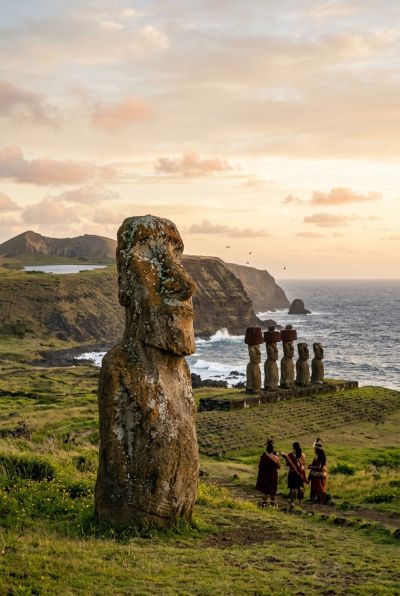
Far from being just another book about mysterious stone heads, Chester West's 'Isola di Pasqua' presents Rapa Nui as a living story of human ingenuity, ecological adaptation, and cultural survival against extraordinary odds. Rather than treating the island as a static puzzle, the book traces its complete journey - from volcanic birth to modern revival - showing how its people continuously reshaped their relationship with this remote speck of land.
What the book is about
This comprehensive nonfiction work examines Easter Island (Rapa Nui) through 25 detailed chapters that move chronologically from geological formation to contemporary life. Rather than focusing solely on the famous moai statues, West explores the island's volcanic origins, its unique pre-human ecology, the remarkable Polynesian settlement, the rise and fall of monument-building, the devastating impact of European contact, and the resilient cultural revival happening today. The book serves both as a deep historical narrative and a practical guide for those considering a visit, making it suitable for readers interested in anthropology, environmental history, Polynesian culture, or travel writing.
From Volcanic Fire to Isolated Land: Geological Origins
The book opens by establishing Rapa Nui's extraordinary geographical context, which fundamentally shaped its history. As West explains in Chapter 1, the island's isolation is extreme: "Il suo vicino abitato più vicino è l'Isola di Pitcairn, essa stessa un avamposto remoto famoso per i discendenti dell'ammutinamento del *Bounty*, situata a circa 2.075 chilometri (1.289 miglia) a ovest." Even the nearest continental landmass, central Chile, lies 3,512 kilometers away. This isolation created both the conditions for a unique culture to develop and its later vulnerability when outside contact finally occurred.
Chapter 2 details the island's volcanic birth, explaining how Rapa Nui emerged from the Easter hotspot as "La vetta emersa più prominente di una simile catena vulcanica: la Dorsale di Salas y Gómez, nota anche come Catena dei Monti Sottomarini di Pasqua." Formed by three main volcanoes (Poike, Rano Kau, and Terevaka) over hundreds of thousands of years, the island's geology directly provided the materials for its famous monuments - the soft tuff of Rano Raraku for moai carving, the red scoria of Puna Pau for pukao (topknots), and obsidian from Maunga Orito for sharp tools. This geological foundation wasn't just background; it actively enabled and constrained what humans could accomplish on the island.
The Moai: More Than Just Stone Heads
While the moai attract global attention, West presents them as deeply meaningful cultural expressions rather than mere curiosities. Chapter 6 clarifies their purpose: "Le statue sono ampiamente interpretate dagli studiosi come rappresentazioni di questi antenati divinizzati, principalmente i capostipiti dei lignaggi o i successivi capi supremi." These weren't decorations but vessels of ancestral power (mana), placed on ahu platforms to watch over and protect living descendants.
The quarry at Rano Raraku (Chapter 7) reveals the astonishing scale of the endeavor, with nearly 400 statues left unfinished when work abruptly ceased. Equally fascinating are the transport theories examined in Chapter 8. West details how researchers like Carl Lipo and Terry Hunt revived the oral tradition that moai "walked" to their destinations: "Le statue trovate cadute lungo strade in salita sono costantemente ritrovate a faccia in giù, mentre quelle in discesa sono ritrovate a faccia in su. Questo schema si allinea perfettamente con ciò che ci si aspetterebbe se statue in verticale perdessero l'equilibrio durante il trasporto – cadrebbero naturalmente in avanti quando tirate in salita e all'indietro quando trattenute in discesa." This challenges older theories requiring vast amounts of timber for sleds and rollers, suggesting instead a method requiring skilled coordination but fewer resources.
Ecological Transformation and the Deforestation Debate
One of the book's strongest sections confronts the dramatic environmental changes Rapa Nui experienced. Chapter 3 paints a vivid picture of the pre-human landscape: "Immaginate un'isola ricoperta non principalmente d'erba, ma di foresta. Gli studi paleobotanici [...] dipingono un quadro coerente di una Rapa Nui ben alberata." This forest was dominated by the giant palm Paschalococos disperta, related to Chile's wine palm, alongside diverse other tree species.
Chapter 12 traces how this landscape changed: "Collettivamente, questa evidenza dipinge un quadro chiaro: Rapa Nui era un tempo sostanzialmente boscosa. Il protagonista dominante di questo ecosistema era la palma di Rapa Nui, *Paschalococos disperta*, oggi estinta." The decline resulted from human activities (clearing for agriculture, canoe building, firewood) compounded by the Polynesian rat consuming palm seeds, preventing regeneration.
Most significantly, Chapter 13 presents the nuanced debate about why this transformation occurred. Rather than accepting the simple "ecocide" narrative (that the Rapa Nui destroyed their own environment through moai-building competition), West presents compelling evidence for a more complex reality: "Una prospettiva concorrente sostiene che la società Rapa Nui fosse notevolmente resiliente, adattandosi in modo innovativo ai cambiamenti ambientali, e che il vero collasso sia avvenuto solo *dopo* il contatto europeo, guidato da fattori esterni come malattie e violenza." This reframes the island's history not as a cautionary tale of self-destruction, but as a story of resilience overwhelmed by external forces.
Contact, Collapse, and Cultural Survival
The book doesn't shy from detailing the catastrophic impact of European contact, beginning with Chapter 16's account of early visitors. But the true devastation came in the 19th century, as Chapter 17 documents: "Nel corso di diversi mesi, attraverso violenza, inganno e inseguimento implacabile, i predoni peruviani riuscirono a catturare circa 1.500 Rapa Nui – grosso modo metà della popolazione stimata dell'isola all'epoca." These slave raids, followed by devastating epidemics of smallpox and tuberculosis introduced by survivors, reduced the population from thousands to just 111 by 1877.
Yet amid this tragedy, cultural adaptation emerged. Chapter 15 describes how the Birdman cult (Tangata Manu) at Orongo likely rose as the moai tradition declined: "Una volta sbarcati in salvo su Motu Nui, gli *hopu manu* si rifugiavano in piccole grotte o ripari rocciosi sull'isolotto. Il loro compito ora era attendere, potenzialmente per giorni o persino settimane, scrutando costantemente i cieli e i luoghi di nidificazione per l'arrivo delle prime Sterne Fuliginose e, criticamente, la deposizione del primissimo uovo della stagione." This dangerous annual competition - swimming to remote islets to retrieve the first sooty tern egg - represented a new way to acquire spiritual power and distribute resources.
Century revival began in earnest in the 20th century. Chapter 20 notes the pivotal 1966 Ley Pascua: "Sotto l'amministrazione del Presidente Frei Montalva, il Congresso cileno approvò la Legge N. 16.441, comunemente nota come *Ley Pascua* (Legge Pascua). Questa legislazione storica concesse finalmente la piena cittadinanza cilena al popolo Rapa Nui, ponendo fine al loro status di pupilli dello Stato." This opened the door for cultural revitalization, including efforts to preserve the Rapa Nui language discussed in Chapter 21.
Living Heritage: Modern Rapa Nui Culture
Far from being a relic of the past, West emphasizes that Rapa Nui culture continues to evolve today. Chapter 21 highlights language revitalization efforts despite pressures from Spanish: "Nonostante queste pressioni, la lingua Rapa Nui rimane un simbolo vitale di identità culturale e resilienza. Sono in corso sforzi per rivitalizzarne e promuoverne l'uso." The language retains unique features like the glottal stop lost in other Polynesian languages, serving as a vital link to ancestral knowledge.
The annual Tapati festival (Chapter 21) stands as "la vetrina più spettacolare della cultura Rapa Nui vivente" - a two-week celebration featuring traditional sports like Haka Pei (sliding down hills on banana logs), wood carving competitions, and body painting. Meanwhile, Chapter 22 details how conservation efforts have evolved: "Criticamente, la gestione del patrimonio di Rapa Nui è sempre più riconosciuta come intrinsecamente legata ai diritti e alle aspirazioni del popolo indigeno Rapa Nui. [...] il crescente movimento per i diritti indigeni ha persistentemente sostenuto un maggiore controllo Rapa Nui sulle loro terre ancestrali e sul patrimonio culturale." This shift toward co-management of Rapa Nui National Park by the indigenous Ma'u Henua community represents a significant step toward self-determination.
For those inspired to visit, Chapters 24-25 offer practical guidance while emphasizing respectful engagement. West reminds readers that sites are "luoghi sacri ancestrali per il popolo Rapa Nui e fragili risorse archeologiche" requiring visitors to "restare sui sentieri segnalati, astenersi dal toccare o arrampicarsi su qualsiasi statua (*moai*) o piattaforma (*ahu*), non disturbare pietre o manufatti, e portare via tutto ciò che si è portato con sé." This balance between sharing the island's wonders and protecting its fragile heritage encapsulates the book's overall approach - presenting Rapa Nui not as a mystery to be solved, but as a living culture deserving of understanding and respect.
Who should read this
This book will reward readers interested in deep historical narratives that move beyond stereotypes, particularly those fascinated by how isolated societies develop, adapt, and survive external shocks. It's ideal for anyone who appreciates nuanced takes on environmental history (avoiding simplistic "ecocide" narratives), Polynesian culture, or the interplay between geography and human development. The practical visiting information also makes it valuable for travelers planning a respectful trip to Easter Island. Those seeking only sensational mysteries or alien theories about the moai will find the book's evidence-based, culturally grounded approach less to their taste, but anyone wanting to understand Rapa Nui as a real place with a continuous human story will gain valuable insights from West's comprehensive work.
Read “Isola di Pasqua” on MixCache.com →
Please log in or create an account to leave a comment.
No comments yet. Be the first to say something.