
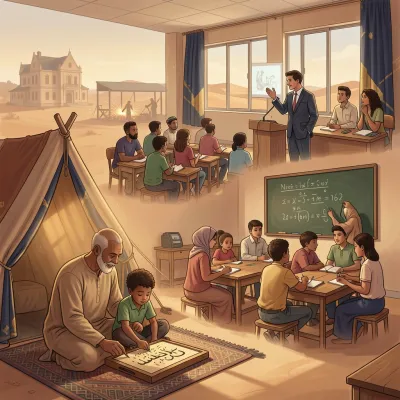
For readers curious about how education adapts to extreme environments, Education In Mauritania offers a detailed look at a system shaped by desert nomads, colonial legacies, and ongoing reform efforts.
The book moves beyond statistics to show how classrooms function under tents, in crowded urban schools, and through mobile units that follow wandering families.
What the book is about
Janice Jackson’s Education In Mauritania: A Comprehensive Overview from Early Childhood to Higher Education walks readers through every tier of the nation’s schooling, from Quranic desert schools known as Mahadras to the University of Nouakchott Al Aasriya.
Organized into twenty‑five chapters, the work blends historical narrative with structural analysis, policy discussion, and forward‑looking recommendations, targeting policymakers, educators, researchers, and anyone interested in comparative education.
Historical Foundations
The opening chapter traces Mauritania’s learning traditions back to the Mahadra, described as “the university of the desert,” where classes were held under tents and students memorized the Quran on wooden tablets.
Jackson notes that the Mahadra was “remarkably inclusive, open to everyone regardless of gender, age, or social background,” a progressive ideal that predated many modern philosophies.
She then outlines the French colonial dual system, which imposed French‑language schools in the south while accommodating Arabic for Arab‑Berber tribes, a policy that “had profound and sometimes divisive consequences” for language attitudes.
System Structure and Governance
Chapter two explains that the system is split between two ministries: the Ministry of National Education and Vocational Training oversees pre‑tertiary levels, while the Ministry of Higher Education and Scientific Research manages universities.
Governance is “a centralized affair, primarily overseen by the Ministry of National Education and Vocational Training,” with regional and local authorities implementing national policies.
Funding relies heavily on the state budget supplemented by international aid, and the text stresses that transparency and efficiency in financial management are “paramount to the success of educational initiatives.”
Challenges of Access and Equity
Across several chapters, Jackson highlights persistent barriers: limited access in rural and nomadic areas, overcrowded classrooms, teacher shortages, and inadequate learning materials.
In chapter eleven she writes that education in remote communities “has been an afterthought, a luxury rather than a right,” noting the difficulty of delivering static schooling to mobile populations.
Gender disparities receive dedicated coverage; chapter twelve observes that “poverty remains one of the most significant impediments” to girls’ schooling, with early marriage, safety concerns, and a shortage of female teachers further hindering enrollment and retention.
For children with special needs, chapter thirteen points out a “severe lack of awareness and understanding of special educational needs among the general public, parents, and even many educators,” leaving many learners excluded from formal education.
Language of Instruction and Multilingualism
Chapter ten examines the country’s linguistic landscape, where Arabic serves as the official language while French retains importance in science and higher education.
Jackson describes the current situation as “a dynamic and often blended affair, reflecting the nation's commitment to both its Arab identity and its diverse linguistic heritage, while also acknowledging the practical importance of French.”
She notes efforts to introduce national languages such as Pulaar, Soninke, and Wolof in early grades, recognizing that children learn best when taught in their mother tongue, though transitioning to Arabic and French remains a challenge.
Reforms and Future Prospects
The final chapters outline a reform agenda centered on expanding early childhood education, modernizing curricula, and strengthening teacher preparation.
Jackson recommends “universalizing quality early childhood education” through increased government investment, curriculum standardization, and professional development for ECE teachers.
She also calls for revitalizing TVET with industry‑responsive programs, modern equipment, and campaigns to raise its status, aligning higher education with labor market needs, and leveraging technology to bridge the digital divide.
Overall, the book concludes that sustainable financing, inclusive policies, and data‑driven governance are viewed as essential for equity and long‑term resilience of the Mauritanian education system.
Who should read this
This volume will be most useful for researchers, international development workers, and education officials seeking a comprehensive reference on Mauritania’s schooling landscape.
General readers interested in comparative education or African studies will find it informative, though its density of detail may make it less suited for casual browsing.
Read “Education In Mauritania” on MixCache.com →
Please log in or create an account to leave a comment.
No comments yet. Be the first to say something.