
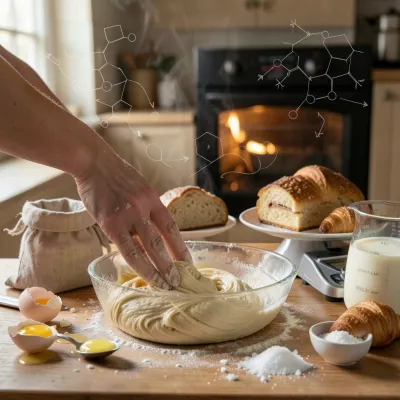
Most baking books hand you recipes and hope for the best. Few take the time to explain why those recipes work - or why they fail. Baking from First Principles flips this approach, treating baking not as magic but as a manageable system of variables you can learn to control.
What the book is about
This isn't another collection of tested recipes. Instead, Jerry Gardner presents baking as a scientific discipline where flour, water, fat, sugar, and heat interact according to predictable principles. The book systematically builds understanding from the ground up - starting with how individual ingredients behave, moving through mixing techniques and fermentation processes, and culminating in practical applications for breads, cakes, pastries, and more. Rather than expecting blind adherence to formulas, it teaches readers to think like both scientists and bakers: identifying variables, forming hypotheses, and observing outcomes. The intended reader is anyone who's ever wondered why their dough behaved strangely or wanted to adapt recipes confidently to their specific kitchen conditions.
The Systems Approach to Baking
The book opens by rejecting the notion of baking as mysterious alchemy. As Chapter 1 states: "Think of baking not as a series of rigid instructions, but as a system. A system, in this context, is a collection of interacting components that work together to achieve a certain outcome." Gardner explains how changing just one variable - like water temperature or mixing time - ripples through the entire process. This framework allows bakers to troubleshoot intelligently: when a dough isn't rising, they consider "the temperature of the room, the age of the yeast, or the proofing time" rather than randomly adjusting ingredients. By understanding baking as interconnected variables, readers learn to see cause and effect clearly, turning frustrating failures into valuable data points for refinement.
Mastering Baker's Percentages for True Flexibility
Chapters 15 and 16 reveal how baker's percentages transform recipe scaling from guesswork to precision. The system expresses every ingredient as a percentage of flour weight (which always equals 100%), eliminating the variability of volumetric measurements. As the text explains: "A cup of flour, lightly spooned into the measuring cup, might weigh 120 grams, while the same cup, scooped directly from the bag and compacted, could weigh 150 grams or more. This 25% difference in flour can dramatically alter the hydration of your dough." Gardner provides concrete examples showing how to scale recipes up or down while maintaining perfect balance, turning what could be frustration into a reliable framework for experimentation. Readers learn to adjust hydration by 2-3% when crumb is too tight or increase sugar by 1% for better crust color, building confidence through systematic cause-and-effect understanding rather than blind guessing.
Understanding Flour as an Active Architect
Chapter 2 dives deep into flour's role, revealing it's far from a passive blank canvas. "As soon as water arrives, flour begins to reorganize itself, mobilizing proteins that had waited dormant for this signal to link hands." The book explains how gluten forms from gliadin (extensibility) and glutenin (elasticity), and how factors like protein content, milling, and even ash content affect performance. Most valuably, it teaches readers to "read dough by feel" rather than chasing visual cues like the windowpane test: "Gluten windows, those translucent sheets you can stretch thin before they tear, are useful indicators of development but not absolute proof of quality." This tactile awareness - understanding how dough should resist, stretch, and rebound - becomes a diagnostic tool that works across different flours and environmental conditions, freeing bakers from rigid recipe dependence.
Heat Management as the Final Editor
Chapter 13 positions heat as "the great editor of baked goods," breaking down the three modes of heat transfer (conduction, convection, radiation) and how they interact with dough. Gardner explains why oven thermometers are essential: "Knowing your oven's quirks allows you to adjust baking times and positions to achieve even results." The book moves beyond simple temperature settings to teach readers how to "design bake curves" - planned progressions of temperature and steam over time that match the dough's needs. Readers learn that introducing steam at the start of baking "keeps the surface pliable and allows for maximum expansion" while venting it later "allows the crust to dry and brown," turning oven management from guesswork into a choreographed process where every adjustment serves a clear purpose in crust development and crumb set.
Troubleshooting Through Failure Autopsies
Perhaps most valuable is Chapter 25's approach to failure as data rather than disappointment. The book introduces "failure autopsies" that connect specific symptoms to root causes: "collapsed crumb, tunneling, greasy mouthfeel—to the underlying cause and the fix you can try next bake." Gardner emphasizes that "every 'failed' bake is actually a valuable data point, an opportunity to refine your understanding of the system." This mindset shift - from seeing mistakes as personal failures to viewing them as investigative opportunities - is central to developing true baking confidence. Readers learn to reconstruct what happened from mixing through cooling, asking whether dough felt sticky or stiff during fermentation, if the surface blistered early or remained pale, and if the crumb set with wet streaks or dry pockets. This systematic diagnostic approach transforms baking from a series of rigid steps into a responsive craft where understanding enables purposeful adaptation.
This book will resonate most with bakers who've moved beyond beginner recipes and find themselves frustrated when standard formulas fail in their specific kitchen conditions. It's ideal for those who enjoy understanding the 'why' behind techniques and want to design their own adaptations rather than just follow instructions. Beginners might find the technical depth overwhelming at first, but intermediate and advanced bakers will discover frameworks that transform their approach from hopeful guesswork to purposeful creation.
For anyone serious about developing intuitive, adaptable baking skills grounded in science rather than superstition, this book offers the tools to move from recipe follower to confident baker who understands how to steer outcomes. Rather than promising perfection on the first try, it provides the knowledge to make every adjustment meaningful - turning baking into a continuous conversation between baker and ingredients where confidence comes from clear understanding of cause and effect.
Read “Baking from First Principles: Foundations for Confident Bakers” on MixCache.com →
Please log in or create an account to leave a comment.
No comments yet. Be the first to say something.