
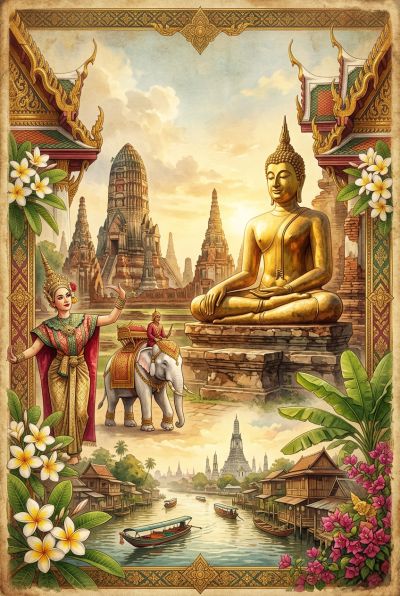
The following is an excerpt from “A History of Thailand” by Chaiwat Srisai, available on MixCache.com.
Introduction
Nestled in the heart of mainland Southeast Asia, the Kingdom of Thailand boasts a history as vibrant and complex as the intricate patterns of its famed silk. A crossroads for trade, culture, and conflict, its story is one of resilience, adaptation, and a fierce spirit of independence. Unlike any of its neighbors, Thailand stands alone as a nation that has never been subjected to European colonial rule, a fact that has profoundly shaped its national identity and its path to modernity. From the mists of prehistory, through the rise and fall of glorious ancient kingdoms, to the turbulent currents of contemporary politics, the journey of the Thai people is a compelling narrative of a nation constantly reinventing itself while holding fast to its cultural moorings. This book will trace that remarkable journey, exploring the key events, influential figures, and societal shifts that have forged the Thailand we see today.
The geographical stage upon which this history unfolds is of paramount importance. Bordered by Myanmar, Laos, Cambodia, and Malaysia, Thailand's central location has made it a strategic nexus for commerce and cultural exchange for millennia. Its fertile central plains, nurtured by the Chao Phraya River, have been the rice bowl of the region, while its long coastlines along the Gulf of Thailand and the Andaman Sea have connected it to maritime trade networks stretching from China to India and beyond. This unique position has been both a blessing and a curse, fostering a rich cultural tapestry woven from diverse influences while also attracting the covetous eyes of powerful neighbors and distant empires. The very landscape, from the mountainous highlands of the north to the sun-drenched southern peninsula, has shaped the distinct regional identities that contribute to the nation's complex character.
Our story begins long before the emergence of the Thai people as a distinct political entity. Archaeological evidence, most notably from the UNESCO World Heritage site of Ban Chiang, reveals a sophisticated Bronze Age culture flourishing in the northeastern plateau as far back as 3600 BC. These early inhabitants cultivated rice and were skilled artisans, leaving behind a legacy of striking painted pottery. Over subsequent centuries, the region that is now Thailand was home to a succession of kingdoms and city-states, each leaving their indelible mark. The Mon people established the Dvaravati kingdom, which from the 7th to the 10th centuries served as a major center for the transmission of Theravada Buddhism. To the east, the mighty Khmer empire, with its capital at Angkor, extended its influence over vast swathes of the territory, leaving behind magnificent stone temples that stand as a testament to its power and artistry.
It was into this diverse and already ancient land that the Tai-speaking peoples began to migrate from southern China around the 10th century. This was not a sudden invasion but a gradual process of settlement and assimilation. These newcomers brought with them their own distinct language, social structures, and cultural practices. Over time, they established their own principalities, gradually coalescing into more powerful kingdoms. In 1238, a pivotal moment in Thai history occurred when two chieftains declared their independence from the waning Khmer empire and established the kingdom of Sukhothai. This is traditionally regarded as the first true Thai kingdom, a "golden age" where the foundations of Thai art, literature, and political thought were laid. It was during this period that the Thai script was created, and Theravada Buddhism was embraced as the state religion, forging a powerful and enduring link between faith and national identity.
The decline of Sukhothai gave rise to a new and even more powerful kingdom to the south: Ayutthaya. Founded in 1351, Ayutthaya would become a major regional power and a bustling cosmopolitan center of international trade. For over four centuries, its magnificent capital, an island city crisscrossed by canals, welcomed merchants from across Asia and Europe. Portuguese, Dutch, French, and British traders all established outposts there, drawn by the kingdom's wealth and strategic location. This period of intense interaction with the outside world brought new ideas, technologies, and challenges. Yet, Ayutthaya's golden age came to a dramatic and violent end in 1767 when it was sacked and burned by an invading Burmese army.
The destruction of Ayutthaya was a profound national trauma, but it also marked the beginning of a remarkable story of recovery and rebirth. A charismatic general, Taksin, rallied the scattered Thai forces, drove out the Burmese, and established a new capital at Thonburi, across the river from modern-day Bangkok. His reign was short-lived, but he laid the groundwork for the founding of the current Chakri dynasty in 1782 by his successor, who became King Rama I. The capital was moved to Bangkok, and a new era, known as the Rattanakosin period, began. The early Chakri kings focused on consolidating the kingdom and reviving the cultural glories of Ayutthaya.
The 19th and early 20th centuries presented a new and existential threat: Western imperialism. As European powers carved up Southeast Asia, the kingdom, then known as Siam, found itself in a precarious position. Through a combination of astute diplomacy, strategic concessions of territory, and a program of ambitious modernization, the Siamese monarchs, particularly King Mongkut (Rama IV) and his son King Chulalongkorn (Rama V), managed to preserve their nation's independence. This period saw sweeping reforms in government, the military, education, and social structures, including the abolition of slavery. These changes, while necessary for survival, also set in motion a process of profound social and political transformation that would continue to unfold in the decades to come.
The 20th century was a period of dramatic and often tumultuous change for Thailand. In 1932, a bloodless coup brought an end to absolute monarchy and ushered in an era of constitutional government. The country's name was officially changed from Siam to Thailand in 1939, a reflection of a growing sense of nationalism. The Second World War saw Thailand reluctantly ally with Japan, a decision that was deftly navigated by a clandestine Free Thai Movement that worked with the Allies. The post-war era was dominated by the Cold War, during which Thailand became a key ally of the United States in its efforts to contain the spread of communism in Southeast Asia. This period was also marked by a succession of military coups and brief periods of democratic rule, establishing a pattern of political instability that has continued to the present day.
In recent decades, Thailand has experienced rapid economic development, transforming it into one of the "Asian Tiger" economies. This has been accompanied by significant social change, including rapid urbanization and a growing middle class. However, this period of prosperity has also been punctuated by political crises, including the 1997 Asian financial crisis, the rise and fall of the populist leader Thaksin Shinawatra, and military coups in 2006 and 2014. These events have exposed deep divisions within Thai society, particularly between the urban elite and the rural majority, and have raised fundamental questions about the nature of Thai democracy and the role of the monarchy.
Today, Thailand stands at a crossroads, facing a host of challenges and opportunities in the 21st century. It is a nation of stark contrasts: a deeply spiritual and traditional society that is also remarkably open to modern influences; a country renowned for its natural beauty and warm hospitality that has also been scarred by political violence; a kingdom that reveres its ancient monarchy while grappling with the demands of a modern democracy. Understanding the historical forces that have shaped this complex and fascinating nation is essential to appreciating its present and contemplating its future. This book aims to provide that understanding, offering a comprehensive and engaging account of the long and eventful history of Thailand, the "Land of the Free."
Read “A History of Thailand” on MixCache.com →
Please log in or create an account to leave a comment.
No comments yet. Be the first to say something.