
The following is an excerpt from “A History of Mizoram” by Oliver Kingsley, available on MixCache.com.
Introduction
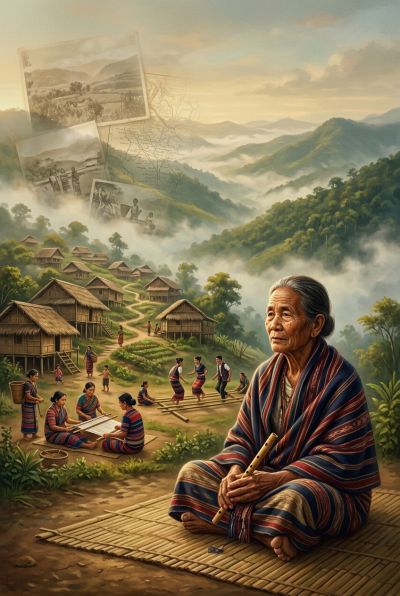
There is a land of rolling hills, deep gorges, and precipitous ridges, a place where the clouds often seem to settle in the valleys below, creating a vast, ethereal sea of white. This is Mizoram, the "Land of the Highlanders," a sliver of territory wedged between Myanmar and Bangladesh in the far northeastern corner of India. Its story is one of dramatic transformation, a journey across centuries from remoteness and oral tradition to a vibrant, modern statehood. The history of Mizoram is not merely a chronicle of events; it is the epic saga of a people who, shaped by their formidable geography and a unique cultural ethos, navigated the currents of colonialism, faith, war, and peace to forge a distinct identity in the Indian subcontinent.
For much of its existence, the land now known as Mizoram was a world unto itself. The rugged terrain, a part of the Rakhine mountain range, served as a natural fortress, fostering a society that was independent and largely isolated from the empires and kingdoms of the plains. This geographical seclusion was the crucible in which the Mizo character was forged. Life was a constant negotiation with the environment, a reality that bred resilience, self-reliance, and a deep-seated sense of community. The hills were not just a backdrop; they were the primary force shaping the history, culture, and worldview of the people who called them home.
The term "Mizo," meaning "highlander" or "people of the hills," is a collective name for various closely related clans and tribes. Historically, they were known to outsiders by different names, such as Kuki, Chin, or Lushai. The British, upon their arrival, encountered the dominant Lusei clan and consequently named the area the Lushai Hills, a label that would stick for nearly a century. However, the people themselves have long identified with the overarching term "Mizo," a cultural and ethnic identifier that transcends individual clan loyalties and unites them under a shared heritage.
The origins of the Mizo people are veiled in the mists of oral tradition, their history passed down through generations in the form of songs, folktales, and legends. The most prevalent belief traces their ancestry to a great Mongoloid wave of migration from China. A key legend speaks of their emergence from a cave or a rock known as "Chhinlung," a place thought to be somewhere in southern China or the northern hills of Burma. From this mythical point of origin, they are believed to have journeyed south, settling for a time in the Shan State and the Kabaw Valley in present-day Myanmar before moving westward into the Chin Hills.
This long and arduous migration, driven by inter-tribal conflicts, the search for better land, and perhaps even famine, was a defining experience. It was a period of constant movement and adaptation, a time when the core tenets of their society were solidified. By the 16th and 17th centuries, various Mizo clans began crossing the Tiau River, pushing into the hills of what would become their permanent homeland. Here, they established villages on defensible hilltops, each an independent republic ruled by a hereditary chief who acted as a guardian and protector of his people.
Life in the pre-colonial era was governed by the rhythms of slash-and-burn agriculture, known as jhum, and the ever-present realities of inter-village warfare and headhunting. Yet, it was also a society bound by a sophisticated and deeply ingrained moral code known as Tlawmngaihna. This untranslatable concept encompasses a blend of courage, selflessness, hospitality, and an unwavering commitment to the community's welfare. It demanded that an individual be courteous, industrious, and ready to help others, even at great personal cost. Tlawmngaihna was the social glue that held Mizo society together, fostering a spirit of cooperation and mutual obligation essential for survival in the challenging hill environment.
This secluded world of chieftainship and ancient traditions was irrevocably altered in the mid-19th century with the arrival of a new, formidable power: the British Empire. Initial contact was marked by conflict, as Mizo raids into British-controlled territories in Cachar and Chittagong prompted retaliatory expeditions. These punitive campaigns, launched in 1871 and again in the late 1880s, were designed to pacify the "unruly" tribes. By 1895, the Mizo Hills were formally annexed and declared a part of British India, eventually consolidated into the Lushai Hills District of Assam in 1898.
The imposition of colonial rule marked the end of Mizoram's long isolation. It brought an end to the endemic tribal warfare and headhunting, establishing a centralized administration under a British Superintendent. While the chiefs were allowed to retain a degree of authority in their villages, their power was now subordinate to the colonial government. This period of British administration, detailed in subsequent chapters, laid the groundwork for a new political and social order, connecting the remote hills to the wider world in ways that were previously unimaginable.
Close on the heels of the administrators came the Christian missionaries. The arrival of two Welsh missionaries, J.H. Lorrain and F.W. Savidge, in 1894 was a watershed moment in Mizo history. They introduced a new faith that would, within half a century, transform the very fabric of Mizo society. The missionaries brought with them not just the Bible, but also the Roman script, giving the Mizo language a written form for the first time. This act of linguistic transcription was revolutionary, paving the way for education and literacy.
The spread of Christianity was rapid and profound. It challenged and eventually replaced the traditional animistic beliefs and rituals. The Church became the new center of village life, and being Mizo gradually became synonymous with being Christian. This religious conversion had far-reaching consequences, influencing everything from social customs and cultural practices to the political consciousness of the people. It fostered a new sense of unity among the disparate Mizo clans, binding them together under a common faith and a shared worldview that would play a crucial role in the political developments of the 20th century.
The first stirrings of modern political consciousness emerged during the British era, leading to the formation of the Mizo Union in 1946, the region's first political party. As India moved towards independence, the Mizo Union initially sought to determine the future of the Lushai Hills, even considering options outside of the Indian Union. Ultimately, the district remained a part of Assam after 1947. However, the post-independence years were marked by a growing sense of discontent, fueled by perceptions of neglect and cultural insensitivity from the Assam government.
This simmering discontent erupted into a full-blown crisis with the onset of the Mautam famine in 1959. This cyclical ecological event, caused by the flowering of bamboo which leads to a massive increase in the rat population, devastated the region's crops and resulted in widespread starvation. The government's response was widely seen as inadequate and inept. The immense suffering and the perceived indifference of the authorities created a fertile ground for political extremism.
In response to the famine, a volunteer organization called the Mizo National Famine Front (MNFF) was formed to provide relief. Led by a charismatic former soldier named Laldenga, the MNFF gained immense popularity and goodwill. In 1961, having served its initial purpose, the organization transformed into the Mizo National Front (MNF), a political party with a radical new agenda: complete sovereignty for the Mizo people. The famine had been the spark that ignited the flames of secession.
On the 28th of February 1966, the MNF launched "Operation Jericho," a series of coordinated attacks on government installations across the Mizo Hills, and declared independence from India. This marked the beginning of a two-decade-long insurgency that would plunge the region into turmoil. The Indian government responded with a massive military crackdown. In a controversial move, the Indian Air Force was even used to carry out airstrikes in the town of Aizawl, the only known instance of India using air power against its own civilian territory.
The years of insurgency were a period of intense suffering and disruption for the Mizo people. Daily life was caught between the militants and the security forces. The military implemented a policy of "grouping" villages, forcibly relocating people from their ancestral homes into larger, guarded settlements in an effort to cut off the MNF's supply lines and support base. This period of conflict, known as the Rambuai or "time of troubles," left deep scars on the Mizo psyche and brought immense hardship to the civilian population.
Despite the violence, the desire for peace grew stronger over the years. The Church and various civil society organizations played a crucial role in initiating peace overtures and fostering an environment for dialogue. After years of protracted negotiations, a historic breakthrough was achieved. On June 30, 1986, the Government of India, led by Prime Minister Rajiv Gandhi, and the Mizo National Front, led by Laldenga, signed the Mizoram Peace Accord. This landmark agreement brought the two-decade-long insurgency to an end.
The Mizoram Peace Accord is widely regarded as the most successful peace agreement in post-independence India. The MNF agreed to lay down its arms and work within the framework of the Indian Constitution. In return, the central government promised to grant Mizoram full-fledged statehood. On February 20, 1987, Mizoram became the 23rd state of the Indian Union, a momentous occasion that marked the dawn of a new era of peace and self-governance.
The post-accord era has been one of reconstruction, reconciliation, and remarkable progress. The transition from insurgency to democratic politics was largely peaceful, with former underground leaders integrating into the political mainstream. The state has made enormous strides in social development, most notably achieving one of the highest literacy rates in India, a legacy of the early missionary emphasis on education. The economy has gradually diversified from its near-total reliance on jhum cultivation, with the government promoting new agricultural policies and investing in infrastructure.
This book, 'A History of Mizoram', will delve into each of these transformative periods in detail. It will explore the rich tapestry of pre-colonial Mizo society, the profound impact of the British and the missionaries, and the complex chain of events that led from the Mautam famine to the MNF uprising. It will chronicle the painful years of the Rambuai and examine the long and difficult road to the Mizoram Peace Accord. Finally, it will trace the state's journey since 1987, analyzing its political, economic, and social development, as well as the contemporary challenges and opportunities it faces. The story of Mizoram is a testament to the resilience of a people who have navigated a century of cataclysmic change to build a peaceful, progressive, and uniquely modern society, all while holding fast to their cultural identity as the proud highlanders of a land cloaked in clouds.
Read “A History of Mizoram” on MixCache.com →
Please log in or create an account to leave a comment.
No comments yet. Be the first to say something.