Browse by Category
Fiction
- Action & Adventure
- African American
- Anthologies
- Children's Fiction
- Classics
- Comics & Graphic Novels
- Coming of Age
- Contemporary
- Cultural & Regional
- Drama
- Erotica
- Fantasy
- General
- Historical Fiction
- Horror
- Humor & Satire
- Literary Fiction
- Mystery, Thriller & Suspense
- Poetry
- Religious & Inspirational
- Romance
- Science Fiction
- Short Stories
- War & Military
- Westerns
- Women's Fiction
- Young Adult
Non-Fiction
- Antiques & Collectibles
- Arts & Photography
- Biographies & Memoirs
- Business & Money
- Children's Non-Fiction
-
Computers & Technology
- Artificial Intelligence
- Computer Science
- Cybersecurity & Cryptography
- Data Science & Analytics
- Databases & Big Data
- Game Development & Design
- General
- Hardware & DIY
- Mobile App Development
- Networking & Cloud Computing
- Operating Systems
- Programming
- Robotics
- Software
- Software Engineering
- User Experience (UX) & Design
- Web Development & Design
- Cooking, Food & Wine
- Crafts, Hobbies & Home
- Education & Teaching
- Engineering
- General
- Health, Fitness & Dieting
-
History
- African History
- African History - North Africa
- African History - Sub-Saharan Africa
- American History
- American History - 20th Century
- American History - Civil War
- American History - Colonial Period
- Ancient History
- Asian History
- Asian History - China
- Asian History - India
- Asian History - Japan
- Asian History - Southeast Asia
- European History
- European History - Ancient Greece
- European History - Ancient Rome
- European History - Medieval
- European History - Modern
- European History - Renaissance
- General
- Middle Eastern History
- Military History
- Military History - Aviation
- Military History - Naval
- Social & Cultural History
- World History
- Humor & Entertainment
- Industrial Technology
- Language Learning
- Law
- LGBTQ+ Non-Fiction
- Literary Criticism
- Medical Books
- Parenting & Relationships
- Philosophy
- Politics & Social Sciences
- Reference
- Religion & Spirituality
-
Science & Math
- Agricultural Sciences
- Astronomy & Space Science
- Behavioral Sciences
- Biological Sciences
- Botany & Plant Science
- Chemistry
- Earth Sciences
- Engineering - Chemical
- Engineering - Civil
- Engineering - Electrical
- Engineering - Mechanical
- Environment
- General
- Geology
- Mathematics
- Nature & Ecology
- Oceanography
- Paleontology
- Physics
- Statistics
- Self-Help
- Sports & Outdoors
- Study Aids
- Sustainability & Green Living
- Textbooks
- Transportation
- Travel
- True Crime
- Urban Planning & Development
- Veterinary Medicine
- Writing & Publishing
Jump to Section
MixCache.com Total Access
Unlimited reading and audiobooks for every book published by MixCache.com.
Included titles carry the MTA badge.
Learn more →
Education In North Korea
MTA
A Comprehensive Overview from Early Childhood to Higher Education
About this book:
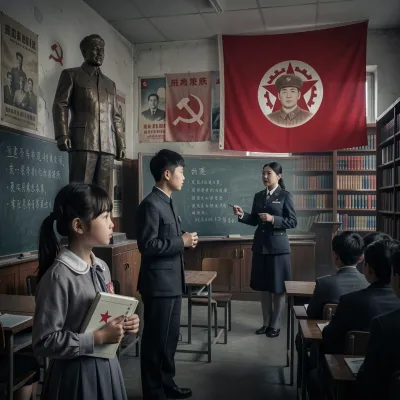
Education in North Korea is a tightly controlled system designed to cultivate loyal citizens devoted to the Workers' Party, the Kim family, and the Juche ideology of self‑reliance. Rooted in a historical trajectory that moved from traditional Confucian schooling through Japanese colonial repression and Soviet‑influenced socialist reforms, the post‑war era established universal compulsory education—now 12 years—as a vehicle for ideological indoctrination and national development. Juche permeates every level, from nurseries where children first hear praises of the leaders to universities where mandatory philosophy and revolutionary history courses accompany technical training. The state administers education through a hierarchical chain extending from the Ministry of Education down to provincial committees, with the Workers' Party embedding cells in all institutions to enforce ideological conformity, monitor teachers, and guide curriculum.
Curriculum and teaching methods emphasize rote memorization, collective labor, and the fusion of academic subjects with political content; textbooks glorify the Kim dynasty, portray history through an anti‑imperialist lens, and link scientific and technical knowledge to national self‑reliance and defense. Teacher training focuses equally on pedagogical skill and ideological purity, while extracurricular activities via the Korean Children's Union and the Kim Il Sung Socialist Youth Alliance reinforce loyalty through self‑criticism sessions, mass rallies, and labor mobilization. Special tracks exist for gifted students in arts, sciences, and languages, and vocational schools supply skilled labor for industry and agriculture, though resources remain uneven, with elite institutions in Pyongyang receiving preferential treatment. Higher education is highly selective, weighing academic performance, songbun (social background), and political loyalty, and graduates are assigned state‑directed jobs that serve the planned economy.
Despite official claims of universal, free education, chronic economic hardship since the 1990s has shifted costs onto families through informal payments for supplies, uniforms, and even teacher supplements, creating disparities between urban and rural schools. The system faces widespread criticism for suppressing academic freedom, enforcing ideological conformity, discriminating via songbun, exploiting student labor, and neglecting disabled children. Defector testimonies reveal intense pressure to memorize leaders’ biographies, fear of self‑criticism sessions, and gaps in practical knowledge and critical thinking upon leaving the country. Internationally, the education system is viewed as a tool of state control and propaganda, though limited engagement occurs through projects like the Pyongyang University of Science and Technology and targeted humanitarian aid. Future reforms are expected to focus on strengthening science, technology, and vocational training to boost national capabilities while preserving the core Juche framework and the paramount goal of producing ideologically loyal, disciplined citizens.
What You'll Find Inside:
- Explores how the Juche ideology and the Kim family's cult of personality shape every aspect of education, from curriculum design to daily classroom routines.
- Details the structure of North Korea's education system, including early childhood, primary, secondary, vocational, and higher education stages, with insights into admissions processes.
- Analyzes the pervasive political indoctrination woven into all subjects, emphasizing ideological loyalty, youth organizations, and the suppression of critical thinking.
- Examines challenges such as economic resource disparities, funding constraints, and rural-urban gaps, alongside state-driven solutions like the Education Support Fund.
- Highlights defector testimonies and international criticisms that reveal systemic discrimination, human rights concerns, and the psychological impact of ideological conditioning.
Who's It For:
This book is essential for academics, educators, and policy analysts studying authoritarian systems, East Asian politics, or educational development under restrictive regimes. It also appeals to researchers and readers interested in comparative education, international relations, and human rights advocacy, particularly those seeking to understand how institutional frameworks shape societal values and individual identity in closed societies.
Table of Contents:
- Introduction
- Chapter 1: Historical Foundations of North Korean Education
- Chapter 2: The Juche Ideology and its Influence on Education
- Chapter 3: Structure and Administration of the Education System
- Chapter 4: Early Childhood Education: Nurseries and Kindergartens
- Chapter 5: Primary Education: The Four-Year People's School
- Chapter 6: Secondary Education: Middle Schools and Senior Middle Schools
- Chapter 7: Curriculum Design and Development
- Chapter 8: Teacher Training and Professional Development
- Chapter 9: The Role of Textbooks and Educational Materials
- Chapter 10: Political Education and Ideological Indoctrination
- Chapter 11: Science and Technology Education
- Chapter 12: Arts, Culture, and Physical Education
- Chapter 13: Vocational and Technical Education
- Chapter 14: Higher Education Institutions: Universities and Colleges
- Chapter 15: Admissions and Student Life in Higher Education
- Chapter 16: Research and Academic Freedom in North Korea
- Chapter 17: Education for Gifted and Talented Students
- Chapter 18: Special Education for Students with Disabilities
- Chapter 19: Extracurricular Activities and Youth Organizations
- Chapter 20: The Role of the Family in Education
- Chapter 21: Funding and Resources for Education
- Chapter 22: Challenges and Criticisms of the North Korean Education System
- Chapter 23: Defector Perspectives on Education in North Korea
- Chapter 24: International Perceptions and Engagements in North Korean Education
- Chapter 25: Future Directions and Potential Reforms in North Korean Education
Author:
Published By:
Date Published:
June 28, 2026
Type:
Nonfiction
Language:
English
Word Count:
38,633 words
Reading Time:
2 hours 42 minutes
Sample:
Order:
Order Education In North Korea (Paperback) on MixCache.com:
Buy NowPrint copy is made to order and ships worldwide. Includes the ebook free, ready to read instantly.
$5 account credit for all new MixCache.com accounts, usable toward any ebook purchase!*