
Browse by Category
Fiction
- Action & Adventure
- African American
- Anthologies
- Children's Fiction
- Classics
- Comics & Graphic Novels
- Coming of Age
- Contemporary
- Cultural & Regional
- Drama
- Erotica
- Fantasy
- General
- Historical Fiction
- Horror
- Humor & Satire
- Literary Fiction
- Mystery, Thriller & Suspense
- Poetry
- Religious & Inspirational
- Romance
- Science Fiction
- Short Stories
- War & Military
- Westerns
- Women's Fiction
- Young Adult
Non-Fiction
- Antiques & Collectibles
- Arts & Photography
- Biographies & Memoirs
- Business & Money
- Children's Non-Fiction
-
Computers & Technology
- Artificial Intelligence
- Computer Science
- Cybersecurity & Cryptography
- Data Science & Analytics
- Databases & Big Data
- Game Development & Design
- General
- Hardware & DIY
- Mobile App Development
- Networking & Cloud Computing
- Operating Systems
- Programming
- Robotics
- Software
- Software Engineering
- User Experience (UX) & Design
- Web Development & Design
- Cooking, Food & Wine
- Crafts, Hobbies & Home
- Education & Teaching
- Engineering
- General
- Health, Fitness & Dieting
-
History
- African History
- African History - North Africa
- African History - Sub-Saharan Africa
- American History
- American History - 20th Century
- American History - Civil War
- American History - Colonial Period
- Ancient History
- Asian History
- Asian History - China
- Asian History - India
- Asian History - Japan
- Asian History - Southeast Asia
- European History
- European History - Ancient Greece
- European History - Ancient Rome
- European History - Medieval
- European History - Modern
- European History - Renaissance
- General
- Middle Eastern History
- Military History
- Military History - Aviation
- Military History - Naval
- Social & Cultural History
- World History
- Humor & Entertainment
- Industrial Technology
- Language Learning
- Law
- LGBTQ+ Non-Fiction
- Literary Criticism
- Medical Books
- Parenting & Relationships
- Philosophy
- Politics & Social Sciences
- Reference
- Religion & Spirituality
-
Science & Math
- Agricultural Sciences
- Astronomy & Space Science
- Behavioral Sciences
- Biological Sciences
- Botany & Plant Science
- Chemistry
- Earth Sciences
- Engineering - Chemical
- Engineering - Civil
- Engineering - Electrical
- Engineering - Mechanical
- Environment
- General
- Geology
- Mathematics
- Nature & Ecology
- Oceanography
- Paleontology
- Physics
- Statistics
- Self-Help
- Sports & Outdoors
- Study Aids
- Sustainability & Green Living
- Textbooks
- Transportation
- Travel
- True Crime
- Urban Planning & Development
- Veterinary Medicine
- Writing & Publishing
Jump to Section
MixCache.com Total Access
Unlimited reading and audiobooks for every book published by MixCache.com.
Included titles carry the MTA badge.
Learn more →
Revolutions of Liberty: Independence Movements in Latin America
MTA
From creole juntas to Bolivarian visions — politics, warfare, and nation building in the early 19th century
About this book:
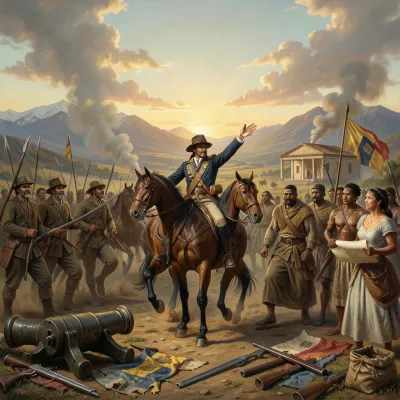
"Revolutions of Liberty" provides a comprehensive analysis of the early 19th-century independence movements across Spanish and Portuguese America. The book begins by examining the late 18th-century Bourbon and Pombaline reforms, which tightened imperial control and fostered creole resentment. This structural tension was brought to a breaking point in 1808 by the Napoleonic invasion of the Iberian Peninsula, an event that triggered a catastrophic crisis of sovereignty. In the absence of a clear monarchical authority, local juntas and municipal cabildos emerged as laboratories for self-governance, blending Enlightenment rhetoric with Catholic political thought and deep-seated fears of social revolution inspired by the Haitian precedent.
The narrative details the diverse regional trajectories of the conflict, from the popular insurgencies of Hidalgo and Morelos in Mexico to the strategic military campaigns of Simón Bolívar in the north and José de San Martín in the south. The book highlights the unique path taken by Brazil, which transitioned to independence as a centralized monarchy following the relocation of the Portuguese court to Rio de Janeiro. Throughout these campaigns, the text emphasizes the critical roles of marginalized groups—including indigenous polities, Afro-descendant militias, and women—whose labor, intelligence, and military service were essential to the war effort, even as they navigated republican promises that often clashed with persistent colonial hierarchies.
The final section of the book evaluates the complex process of nation-building and the difficult transition to peace. It examines the fiscal challenges of war, the influence of foreign diplomacy and British credit, and the proliferation of constitutional experiments like the Constitution of Cádiz and the short-lived Gran Colombia federation. The authors argue that while military victory was achieved, it gave rise to the enduring challenges of caudillismo, regional fragmentation, and economic dependency. The book concludes by reflecting on the legacies of these "unfinished revolutions," noting that the struggle to define citizenship, social equity, and stable order continues to shape the political landscape of the Americas today.
What You'll Find Inside:
- The 1808 abdications of Spanish monarchs shattered imperial authority, prompting creole juntas to claim local power while preserving loyalty to Ferdinand VII.
- Independence was shaped by a mix of Enlightenment ideas, Catholic political thought, and republican ideals, which juntas used to justify authority and draft constitutions.
- The Haitian Revolution served as both inspiration and warning, intensifying fears of social revolution and influencing debates over race, slavery, and citizenship across the region.
- Military mobilization relied on diverse groups—creoles, indigenous peoples, Afro-descendants, llaneros, and foreign mercenaries—revealing tensions between promises of liberty and persistent hierarchies.
- Postwar nation-building struggled with federalism versus centralism, citizenship restricted by property, literacy, and race, and the enduring influence of caudillos and regional strongmen.
Who's It For:
This book is intended for undergraduate and graduate students of Latin American history, scholars of independence movements, and general readers interested in the political, social, and military transformations of early nineteenth‑century Spanish and Portuguese America. It will benefit anyone seeking a nuanced, comparative account of how local initiatives, ideological currents, and international forces combined to forge new nations from imperial crisis.
Table of Contents:
- Introduction
- Chapter 1 <Imperial Reforms and Atlantic Upheaval, 1760s–1808>
- Chapter 2 <The Shock of 1808: Abdications and the Crisis of Sovereignty>
- Chapter 3 <Creole Juntas and the Invention of Local Authority>
- Chapter 4 <Words of Freedom: Enlightenment, Catholicism, and Republican Ideals>
- Chapter 5 <The Haitian Precedent and the Fear of Social Revolution>
- Chapter 6 <Mexico’s First Insurgency: Hidalgo, Morelos, and the Popular Fire>
- Chapter 7 <Río de la Plata Experiments: Buenos Aires, Artigas, and Federal Visions>
- Chapter 8 <The Andes in Arms: From Chuquisaca to Upper Peru>
- Chapter 9 <Chile’s Path: O’Higgins, the Carrera Brothers, and Cochrane’s Navy>
- Chapter 10 <The Llanos and the Liberators: Bolívar, Páez, and the War of the Plains>
- Chapter 11 <San Martín’s Strategy: Crossing the Andes and the Road to Peru>
- Chapter 12 <Brazil’s Divergent Road: Court in Rio, 1820 Liberalism, and Pedro I>
- Chapter 13 <Royalists, Patriots, and the Common Soldier: Mobilization, Race, and Class>
- Chapter 14 <Women in War and Politics: From Manuela Sáenz to Market Women>
- Chapter 15 <Indigenous Polities and Republican Promises>
- Chapter 16 <Afro-Descendant Communities, Militias, and Emancipation Pathways>
- Chapter 17 <Diplomacy, Blockades, and Privateers: Britain, the United States, and Europe>
- Chapter 18 <Financing Independence: Loans, Customs, and the Political Economy of War>
- Chapter 19 <Constitutions in the Making: From Cádiz (1812) to First Charters>
- Chapter 20 <Central America and the Iturbide Interlude: Federation and Fragments>
- Chapter 21 <Gran Colombia: Unity, Caudillismo, and the Limits of Integration>
- Chapter 22 <Peru and Bolivia: Sucre, the Bolivian Experiment, and Unfinished Revolutions>
- Chapter 23 <Mexico’s Tumult: Empire, Republic, and the Struggle for Order>
- Chapter 24 <Paraguay’s Autonomous Path: Francia and the Closed Republic>
- Chapter 25 <Legacies and Long Shadows: Citizenship, Order, and the Politics of Memory>
Author:
Published By:
Date Published:
May 5, 2026
Type:
Nonfiction
Language:
English
Word Count:
69,598 words
Reading Time:
4 hours 52 minutes
Sample:
MixCache.com Total Access
Get unlimited access to this book + all books published by MixCache.com for $11.99/month
Subscribe to MTAOr purchase this book individually below
Order:
Buy the Revolutions of Liberty: Independence Movements in Latin America ebook on MixCache.com:
Buy Now
Full ebook will be available immediately
- read online or download as a PDF file.
$5 account credit for all new MixCache.com accounts, usable toward any ebook purchase!*





Ratings & Reviews
Ask Questions About This Book
Have a question about the content? Ask our AI assistant!
Start by asking a question about "Revolutions of Liberty: Independence Movements in Latin America"
Example: "Does this book mention William Shakespeare?"
Thinking...