Browse by Category
Fiction
- Action & Adventure
- African American
- Anthologies
- Children's Fiction
- Classics
- Comics & Graphic Novels
- Coming of Age
- Contemporary
- Cultural & Regional
- Drama
- Erotica
- Fantasy
- General
- Historical Fiction
- Horror
- Humor & Satire
- Literary Fiction
- Mystery, Thriller & Suspense
- Poetry
- Religious & Inspirational
- Romance
- Science Fiction
- Short Stories
- War & Military
- Westerns
- Women's Fiction
- Young Adult
Non-Fiction
- Antiques & Collectibles
- Arts & Photography
- Biographies & Memoirs
- Business & Money
- Children's Non-Fiction
-
Computers & Technology
- Artificial Intelligence
- Computer Science
- Cybersecurity & Cryptography
- Data Science & Analytics
- Databases & Big Data
- Game Development & Design
- General
- Hardware & DIY
- Mobile App Development
- Networking & Cloud Computing
- Operating Systems
- Programming
- Robotics
- Software
- Software Engineering
- User Experience (UX) & Design
- Web Development & Design
- Cooking, Food & Wine
- Crafts, Hobbies & Home
- Education & Teaching
- Engineering
- General
- Health, Fitness & Dieting
-
History
- African History
- African History - North Africa
- African History - Sub-Saharan Africa
- American History
- American History - 20th Century
- American History - Civil War
- American History - Colonial Period
- Ancient History
- Asian History
- Asian History - China
- Asian History - India
- Asian History - Japan
- Asian History - Southeast Asia
- European History
- European History - Ancient Greece
- European History - Ancient Rome
- European History - Medieval
- European History - Modern
- European History - Renaissance
- General
- Middle Eastern History
- Military History
- Military History - Aviation
- Military History - Naval
- Social & Cultural History
- World History
- Humor & Entertainment
- Industrial Technology
- Language Learning
- Law
- LGBTQ+ Non-Fiction
- Literary Criticism
- Medical Books
- Parenting & Relationships
- Philosophy
- Politics & Social Sciences
- Reference
- Religion & Spirituality
-
Science & Math
- Agricultural Sciences
- Astronomy & Space Science
- Behavioral Sciences
- Biological Sciences
- Botany & Plant Science
- Chemistry
- Earth Sciences
- Engineering - Chemical
- Engineering - Civil
- Engineering - Electrical
- Engineering - Mechanical
- Environment
- General
- Geology
- Mathematics
- Nature & Ecology
- Oceanography
- Paleontology
- Physics
- Statistics
- Self-Help
- Sports & Outdoors
- Study Aids
- Sustainability & Green Living
- Textbooks
- Transportation
- Travel
- True Crime
- Urban Planning & Development
- Veterinary Medicine
- Writing & Publishing
Jump to Section

Want unlimited access to all books published by MixCache.com (plus their audiobooks)? Try MixCache.com Total Access. Look for the MTA badge on book covers to identify included titles.
Access to infinite ebooks: Don't see the book you want? Suggest it and we'll create it (free!) for you from scratch with our powerful AI book writer. Then read it with MTA - besides profiting from any sales it makes!
Autonomy at Sea: Designing and Deploying Ocean Robots
MTA
Engineering and operational guidance for AUVs, gliders, and ROV mission success
About this book:
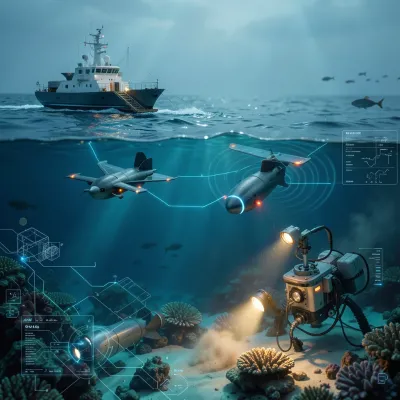
*Autonomy at Sea: Designing and Deploying Ocean Robots* provides a comprehensive technical and operational framework for the engineering of Autonomous Underwater Vehicles (AUVs), gliders, and Remotely Operated Vehicles (ROVs). The book emphasizes a systems-thinking approach, beginning with the fundamental physical constraints of the marine environment—pressure, corrosion, and biofouling—and how these dictate mechanical design, material selection, and power system architecture. It contrasts the differing philosophies of these platforms, from the energy-hoarding persistence of buoyancy-driven gliders to the high-bandwidth, human-in-the-loop dexterity of tethered ROVs, providing guidance on vehicle selection based on mission objectives.
The technical core of the text explores the "autonomy stack," detailing the integration of navigation, communication, and control systems. It provides an in-depth analysis of sensor fusion—combining Inertial Navigation Systems (INS) with Doppler Velocity Logs (DVL) and acoustic positioning—to manage the inevitable drift encountered in GPS-denied environments. The book also addresses the severe bandwidth constraints of underwater acoustics, advocating for edge computing and onboard AI to process data locally and transmit only high-value summaries. Software frameworks such as ROS and MOOS-IvP are evaluated for their ability to manage complex behaviors and multi-vehicle coordination.
Beyond engineering, the book focuses heavily on the realities of field operations, including mobilization, launch and recovery, and mission design for long-term observing programs. It bridges the gap between laboratory development and sea trials, offering practical advice on risk management, fault tolerance, and the human factors involved in supervising autonomous fleets from Remote Operations Centers (ROCs). The text stresses that mission success is dependent on disciplined data stewardship, rigorous maintenance cycles, and a deep understanding of the total lifecycle costs of persistent presence.
The final sections address the broader landscape of modern oceanography, including international logistics, regulatory compliance, and the emerging need for interoperability standards. By analyzing contemporary case studies ranging from under-ice exploration to deep-sea infrastructure inspection, the book distills lessons learned from both triumphs and failures. It concludes by looking toward the future, examining the ethical implications of autonomous decision-making and the environmental responsibilities of deploying large-scale robotic networks in the world's most vulnerable and least understood ecosystems.
What You'll Find Inside:
- Systems thinking is essential: trade‑offs between endurance, payload, power, and navigation must be made explicit early and revisited throughout design, testing, and operations.
- AUVs, gliders, and ROVs differ fundamentally in energy strategy, control philosophy, and operational constraints, shaping their suitability for distinct missions and environments.
- Robust navigation relies on fusing INS, DVL, GPS, and acoustic aids while managing uncertainty through calibrated filters and conservative abort logic.
- The autonomy stack—mission planning, state estimation, and control—must handle uncertainty, limited communication, and fault detection to enable reliable, long‑duration missions.
- Persistent presence is achieved through docking, charging, edge computing, and disciplined data management, turning episodic dives into continuous ocean observation.
Who's It For:
This book is intended for engineers, scientists, and operators involved in the design, integration, or field operation of autonomous underwater vehicles, gliders, and ROVs. It is especially valuable for teams developing long‑term ocean observing programs, naval or offshore inspection missions, and polar or deep‑sea research where reliability, endurance, and data quality are critical. Graduate students and professionals seeking a practical, systems‑level guide to ocean robotics will also benefit.
Author:
Published By:
Date Published:
May 3, 2026
Type:
Nonfiction
Language:
English
Word Count:
54,490 words
Reading Time:
3 hours 49 minutes
Sample:
Order:
Order Autonomy at Sea: Designing and Deploying Ocean Robots (Paperback) on MixCache.com:
Buy NowPrint copy is made to order and ships worldwide. Includes the ebook free, ready to read instantly.
$5 account credit for all new MixCache.com accounts, usable toward any ebook purchase!*