Browse by Category
Fiction
- Action & Adventure
- African American
- Anthologies
- Children's Fiction
- Classics
- Comics & Graphic Novels
- Coming of Age
- Contemporary
- Cultural & Regional
- Drama
- Erotica
- Fantasy
- General
- Historical Fiction
- Horror
- Humor & Satire
- Literary Fiction
- Mystery, Thriller & Suspense
- Poetry
- Religious & Inspirational
- Romance
- Science Fiction
- Short Stories
- War & Military
- Westerns
- Women's Fiction
- Young Adult
Non-Fiction
- Antiques & Collectibles
- Arts & Photography
- Biographies & Memoirs
- Business & Money
- Children's Non-Fiction
-
Computers & Technology
- Artificial Intelligence
- Computer Science
- Cybersecurity & Cryptography
- Data Science & Analytics
- Databases & Big Data
- Game Development & Design
- General
- Hardware & DIY
- Mobile App Development
- Networking & Cloud Computing
- Operating Systems
- Programming
- Robotics
- Software
- Software Engineering
- User Experience (UX) & Design
- Web Development & Design
- Cooking, Food & Wine
- Crafts, Hobbies & Home
- Education & Teaching
- Engineering
- General
- Health, Fitness & Dieting
-
History
- African History
- African History - North Africa
- African History - Sub-Saharan Africa
- American History
- American History - 20th Century
- American History - Civil War
- American History - Colonial Period
- Ancient History
- Asian History
- Asian History - China
- Asian History - India
- Asian History - Japan
- Asian History - Southeast Asia
- European History
- European History - Ancient Greece
- European History - Ancient Rome
- European History - Medieval
- European History - Modern
- European History - Renaissance
- General
- Middle Eastern History
- Military History
- Military History - Aviation
- Military History - Naval
- Social & Cultural History
- World History
- Humor & Entertainment
- Industrial Technology
- Language Learning
- Law
- LGBTQ+ Non-Fiction
- Literary Criticism
- Medical Books
- Parenting & Relationships
- Philosophy
- Politics & Social Sciences
- Reference
- Religion & Spirituality
-
Science & Math
- Agricultural Sciences
- Astronomy & Space Science
- Behavioral Sciences
- Biological Sciences
- Botany & Plant Science
- Chemistry
- Earth Sciences
- Engineering - Chemical
- Engineering - Civil
- Engineering - Electrical
- Engineering - Mechanical
- Environment
- General
- Geology
- Mathematics
- Nature & Ecology
- Oceanography
- Paleontology
- Physics
- Statistics
- Self-Help
- Sports & Outdoors
- Study Aids
- Sustainability & Green Living
- Textbooks
- Transportation
- Travel
- True Crime
- Urban Planning & Development
- Veterinary Medicine
- Writing & Publishing
Jump to Section
MixCache.com Total Access
Unlimited reading and audiobooks for every book published by MixCache.com.
Included titles carry the MTA badge.
Learn more →
Education In Spain
MTA
A Comprehensive Overview from Early Childhood to Higher Education
About this book:
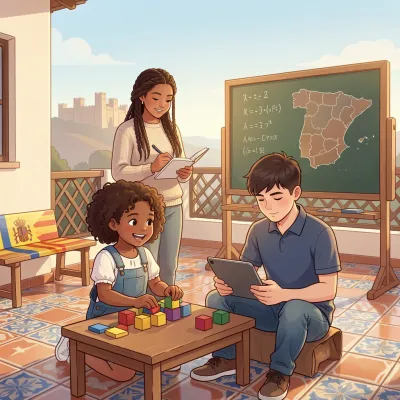
Spain's education system is characterized by its decentralized structure, where the national Ministry of Education sets overarching frameworks while Spain's seventeen autonomous communities hold significant authority over curriculum adaptation, implementation, and funding allocation. This creates a system that balances national standards with regional cultural and linguistic diversity, particularly evident in co-official language regions like Catalonia, the Basque Country, and Galicia. Historically, the system has evolved from Roman and Moorish educational traditions through periods of Church dominance, Francoist repression, and democratic reforms, with key legislative milestones including the 1978 Constitution, LOGSE (1990), LOE (2006), LOMCE (2013), and the most recent LOMLOE (2020), which emphasizes equity, inclusion, and competency-based learning.
The educational journey begins with non-compulsory but widely utilized Early Childhood Education (0-6 years), followed by six years of compulsory Primary Education (6-12 years) and four years of Compulsory Secondary Education (ESO, 12-16 years). Post-16, students choose between the academically oriented Bachillerato (preparing for university) or Vocational Training (Formación Profesional), which offers three levels (Basic, Middle Grade, Higher Grade) with strong practical components and mandatory work placements. Higher education follows the Bologna Process structure, offering Grado (Bachelor's, typically 4 years), Máster (Master's, 1-2 years), and Doctorado (PhD, 3-4 years) degrees, alongside specialized artistic and sports institutions, with access governed by the EBAU university entrance examination or direct pathways from Vocational Training.
Contemporary challenges include addressing early school leaving, reducing socioeconomic disparities in outcomes, integrating technology effectively, managing the balance between public, private, and concerted schools, and ensuring educational equity across regions. The system prioritizes inclusive education for students with special educational needs, promotes bilingual and multilingual education (including Content and Language Integrated Learning), and emphasizes teacher training through rigorous initial qualifications and ongoing professional development. Ongoing debates center on legislative stability, the role of assessment (particularly grade repetition and EBAU), aligning curricula with labor market demands, and maintaining quality while expanding access, with future perspectives focusing on deepening digital transformation, strengthening dual vocational training, enhancing inclusion, and fostering internationalization and sustainable education practices.
What You'll Find Inside:
- An in-depth exploration of Spain's education structure, covering Early Childhood Education through Higher Education, including the roles of national and regional governance.
- Historical evolution of education in Spain, from Roman times to modern democratic reforms, highlighting key legislative changes and their societal impacts.
- Detailed insights into Vocational Training and bilingual education, emphasizing pathways for employability and multilingual competencies in regions like Catalonia and Galicia.
- Analysis of educational challenges such as early school leaving, funding disparities, and the balance between public and private education systems.
- Focus on contemporary issues including technological integration, inclusive education practices, and Spain's strategies for internationalization and lifelong learning.
Who's It For:
This book is essential for educators, policymakers, researchers, and international students seeking a comprehensive understanding of Spain's education system. It offers valuable insights for those interested in comparative education models, vocational training strategies, or the historical and cultural factors shaping educational policies in Spain.
Table of Contents:
- Introduction
- Chapter 1: The Spanish Education System: Structure and Governance
- Chapter 2: Historical Evolution of Education in Spain
- Chapter 3: Early Childhood Education (Educación Infantil): 0-6 Years
- Chapter 4: Primary Education (Educación Primaria): 6-12 Years
- Chapter 5: Compulsory Secondary Education (ESO): 12-16 Years
- Chapter 6: Post-Compulsory Secondary Education: Bachillerato and Vocational Training
- Chapter 7: Vocational Training (Formación Profesional) System
- Chapter 8: Higher Education System: Universities and Other Institutions
- Chapter 9: Access to Higher Education: Selectividad and Admission Processes
- Chapter 10: University Degrees: Grado, Máster, and Doctorado
- Chapter 11: Funding and Financing of Education in Spain
- Chapter 12: Teacher Training and Professional Development
- Chapter 13: Curriculum Development and Educational Standards
- Chapter 14: Assessment and Evaluation in the Spanish Education System
- Chapter 15: Inclusive Education and Special Educational Needs
- Chapter 16: Bilingualism and Multilingual Education
- Chapter 17: The Role of Technology in Spanish Education
- Chapter 18: Private and Concerted Education vs. Public Education
- Chapter 19: Internationalization of Spanish Education
- Chapter 20: Challenges and Debates in Spanish Education
- Chapter 21: Educational Reforms and Future Perspectives
- Chapter 22: Adult Education and Lifelong Learning
- Chapter 23: Education in Autonomous Communities: Regional Differences
- Chapter 24: Educational Outcomes and Employability
- Chapter 25: The Impact of Socioeconomic Factors on Education
Author:
Published By:
Date Published:
July 4, 2026
Type:
Nonfiction
Language:
English
Word Count:
46,778 words
Reading Time:
3 hours 17 minutes
Sample:
Order:
Order Education In Spain (Hardcover) on MixCache.com:
Buy NowPrint copy is made to order and ships worldwide. Includes the ebook free, ready to read instantly.
$5 account credit for all new MixCache.com accounts, usable toward any ebook purchase!*