
Browse by Category
Fiction
- Action & Adventure
- African American
- Anthologies
- Children's Fiction
- Classics
- Comics & Graphic Novels
- Coming of Age
- Contemporary
- Cultural & Regional
- Drama
- Erotica
- Fantasy
- General
- Historical Fiction
- Horror
- Humor & Satire
- Literary Fiction
- Mystery, Thriller & Suspense
- Poetry
- Religious & Inspirational
- Romance
- Science Fiction
- Short Stories
- War & Military
- Westerns
- Women's Fiction
- Young Adult
Non-Fiction
- Antiques & Collectibles
- Arts & Photography
- Biographies & Memoirs
- Business & Money
- Children's Non-Fiction
-
Computers & Technology
- Artificial Intelligence
- Computer Science
- Cybersecurity & Cryptography
- Data Science & Analytics
- Databases & Big Data
- Game Development & Design
- General
- Hardware & DIY
- Mobile App Development
- Networking & Cloud Computing
- Operating Systems
- Programming
- Robotics
- Software
- Software Engineering
- User Experience (UX) & Design
- Web Development & Design
- Cooking, Food & Wine
- Crafts, Hobbies & Home
- Education & Teaching
- Engineering
- General
- Health, Fitness & Dieting
-
History
- African History
- African History - North Africa
- African History - Sub-Saharan Africa
- American History
- American History - 20th Century
- American History - Civil War
- American History - Colonial Period
- Ancient History
- Asian History
- Asian History - China
- Asian History - India
- Asian History - Japan
- Asian History - Southeast Asia
- European History
- European History - Ancient Greece
- European History - Ancient Rome
- European History - Medieval
- European History - Modern
- European History - Renaissance
- General
- Middle Eastern History
- Military History
- Military History - Aviation
- Military History - Naval
- Social & Cultural History
- World History
- Humor & Entertainment
- Industrial Technology
- Language Learning
- Law
- LGBTQ+ Non-Fiction
- Literary Criticism
- Medical Books
- Parenting & Relationships
- Philosophy
- Politics & Social Sciences
- Reference
- Religion & Spirituality
-
Science & Math
- Agricultural Sciences
- Astronomy & Space Science
- Behavioral Sciences
- Biological Sciences
- Botany & Plant Science
- Chemistry
- Earth Sciences
- Engineering - Chemical
- Engineering - Civil
- Engineering - Electrical
- Engineering - Mechanical
- Environment
- General
- Geology
- Mathematics
- Nature & Ecology
- Oceanography
- Paleontology
- Physics
- Statistics
- Self-Help
- Sports & Outdoors
- Study Aids
- Sustainability & Green Living
- Textbooks
- Transportation
- Travel
- True Crime
- Urban Planning & Development
- Veterinary Medicine
- Writing & Publishing
Jump to Section
MixCache.com Total Access
Unlimited reading and audiobooks for every book published by MixCache.com.
Included titles carry the MTA badge.
Learn more →
Education In Syria
MTA
A Comprehensive Overview from Early Childhood to Higher Education
About this book:
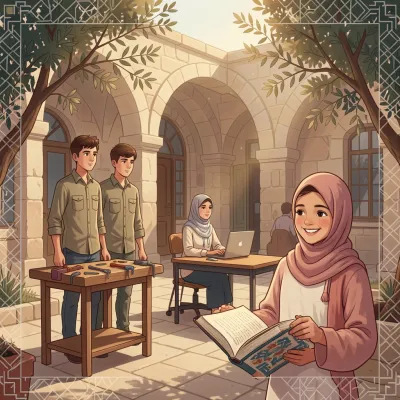
The Syrian educational system, shaped by a rich history from ancient civilizations to the modern era, has long been a cornerstone of national identity and development. Prior to the conflict, the Ministry of Education and Ministry of Higher Education oversaw a structured system encompassing early childhood, primary, preparatory, and secondary education, with distinct academic and vocational tracks. Technical and Vocational Education and Training (TVET) aimed to meet labor market demands, while the Syrian Virtual University pioneered distance learning. Despite challenges like overcrowded classrooms, resource disparities, and the high-stakes Baccalaureate examination, the system emphasized national unity, scientific advancement, and equitable access, particularly through free public schooling and efforts to improve girls' enrollment and inclusive practices for children with disabilities.
The devastating impact of the ongoing conflict has wreaked havoc on Syria’s educational infrastructure. Schools have been destroyed, displaced millions of students and teachers, and fractured administrative systems, leading to a "lost generation" of learners. Refugee education in neighboring countries has relied on humanitarian aid, host-country public schools, and informal programs, though disparities persist in access, curriculum standardization, and accreditation. Within Syria, emergency education efforts have utilized makeshift spaces, psychosocial support, and non-formal pathways, often without recognized qualifications. Teacher shortages, funding gaps, and the digital divide have further eroded educational quality, while societal trauma and economic hardship have intensified barriers to learning, particularly for vulnerable groups like children with disabilities and female students.
International cooperation and NGO initiatives have provided critical support, including emergency infrastructure, teacher training, and accelerated learning programs, though these efforts face logistical hurdles and fragmented coordination. The Syrian Virtual University has remained a vital resource for higher education continuity. Future reconstruction demands massive investment in rebuilding infrastructure, equitable resource distribution, and trauma-informed curricula. Emphasis must be placed on integrating technology, revitalizing TVET for post-war recovery, and fostering inclusive practices. Teacher training programs require overhaul to address conflict-related trauma, while psychosocial support and peace education must become central to pedagogical approaches. Sustained international aid, combined with community engagement and adaptive policies, will be essential for restoring Syria’s education system as a pillar of national healing and resilience.
Regional variations highlight distinct trajectories during the conflict, from government-controlled areas maintaining formal structures under strain to opposition-held regions relying on improvised learning spaces. Host countries like Turkey, Lebanon, and Jordan have hosted varied refugee education models, each facing unique integration, language, and accreditation challenges. Gender-specific disparities and cultural barriers have also emerged, particularly in rural or conservative areas. Despite these challenges, the resilience of Syrian communities, educators, and learners underscores the enduring value of education, offering hope for a rebuilt system that balances national heritage with global relevance, while ensuring no child is left behind in the recovery process.
What You'll Find Inside:
- Explores the historical evolution of Syria's educational system from ancient times through the Ottoman period to modern state-building.
- Details the structure and administration of Syria's education system, including public and private sectors, teacher training, and national examinations.
- Examines the severe impact of the ongoing conflict on education, including infrastructure destruction, displacement, and the role of NGOs in emergency learning.
- Analyzes challenges in teacher training, curriculum development, and equitable access, especially in conflict-affected and rural areas.
- Discusses international aid, refugee education strategies, and non-formal learning pathways as critical responses to educational disruption.
Who's It For:
This book is essential for policymakers, educators, researchers, and international development professionals seeking a comprehensive understanding of Syria's educational landscape. It offers critical insights for those involved in educational reform, emergency response planning, or post-conflict reconstruction efforts. Academics and students studying comparative education, Middle Eastern studies, or education in crisis zones will find valuable analysis of Syria's unique challenges. Additionally, NGOs and humanitarian workers focused on refugee education and inclusive practices will benefit from the detailed exploration of adaptive strategies during displacement and conflict.
Table of Contents:
- Introduction
- Chapter 1: Historical Context of Syrian Education
- Chapter 2: Educational Philosophy and Goals in Syria
- Chapter 3: Structure and Administration of the Syrian Educational System
- Chapter 4: Early Childhood Education: Nurseries and Kindergartens
- Chapter 5: Primary Education: Curriculum and Pedagogy
- Chapter 6: Preparatory Education: Transition and Specialization
- Chapter 7: Secondary Education: Academic and Vocational Tracks
- Chapter 8: Technical and Vocational Education and Training (TVET)
- Chapter 9: Higher Education System: Universities and Institutes
- Chapter 10: Access and Equity in Syrian Education
- Chapter 11: Curriculum Development and Reform Initiatives
- Chapter 12: Teacher Training and Professional Development
- Chapter 13: Assessment and Evaluation Practices
- Chapter 14: Educational Resources and Infrastructure
- Chapter 15: Role of Technology in Syrian Education
- Chapter 16: Challenges Facing Syrian Education
- Chapter 17: Impact of Conflict on the Educational Landscape
- Chapter 18: Refugee Education and Displaced Populations
- Chapter 19: International Aid and Cooperation in Education
- Chapter 20: Non-Formal and Informal Education Pathways
- Chapter 21: Adult Education and Lifelong Learning
- Chapter 22: Education for Special Needs and Inclusive Practices
- Chapter 23: The Role of Private Education in Syria
- Chapter 24: Future Prospects and Reconstruction of Education
- Chapter 25: Case Studies and Regional Variations in Syrian Education
Author:
Published By:
Date Published:
July 4, 2026
Type:
Nonfiction
Language:
English
Word Count:
46,029 words
Reading Time:
3 hours 13 minutes
Sample:
MixCache.com Total Access
Get unlimited access to this book + all books published by MixCache.com for $11.99/month
Subscribe to MTAOr purchase this book individually below
Order:
Buy the Education In Syria ebook on MixCache.com:
Buy Now
Full ebook will be available immediately
- read online or download as a PDF file.
$5 account credit for all new MixCache.com accounts, usable toward any ebook purchase!*





Ratings & Reviews
Ask Questions About This Book
Have a question about the content? Ask our AI assistant!
Start by asking a question about "Education In Syria"
Example: "Does this book mention William Shakespeare?"
Thinking...