Browse by Category
Fiction
- Action & Adventure
- African American
- Anthologies
- Children's Fiction
- Classics
- Comics & Graphic Novels
- Coming of Age
- Contemporary
- Cultural & Regional
- Drama
- Erotica
- Fantasy
- General
- Historical Fiction
- Horror
- Humor & Satire
- Literary Fiction
- Mystery, Thriller & Suspense
- Poetry
- Religious & Inspirational
- Romance
- Science Fiction
- Short Stories
- War & Military
- Westerns
- Women's Fiction
- Young Adult
Non-Fiction
- Antiques & Collectibles
- Arts & Photography
- Biographies & Memoirs
- Business & Money
- Children's Non-Fiction
-
Computers & Technology
- Artificial Intelligence
- Computer Science
- Cybersecurity & Cryptography
- Data Science & Analytics
- Databases & Big Data
- Game Development & Design
- General
- Hardware & DIY
- Mobile App Development
- Networking & Cloud Computing
- Operating Systems
- Programming
- Robotics
- Software
- Software Engineering
- User Experience (UX) & Design
- Web Development & Design
- Cooking, Food & Wine
- Crafts, Hobbies & Home
- Education & Teaching
- Engineering
- General
- Health, Fitness & Dieting
-
History
- African History
- African History - North Africa
- African History - Sub-Saharan Africa
- American History
- American History - 20th Century
- American History - Civil War
- American History - Colonial Period
- Ancient History
- Asian History
- Asian History - China
- Asian History - India
- Asian History - Japan
- Asian History - Southeast Asia
- European History
- European History - Ancient Greece
- European History - Ancient Rome
- European History - Medieval
- European History - Modern
- European History - Renaissance
- General
- Middle Eastern History
- Military History
- Military History - Aviation
- Military History - Naval
- Social & Cultural History
- World History
- Humor & Entertainment
- Industrial Technology
- Language Learning
- Law
- LGBTQ+ Non-Fiction
- Literary Criticism
- Medical Books
- Parenting & Relationships
- Philosophy
- Politics & Social Sciences
- Reference
- Religion & Spirituality
-
Science & Math
- Agricultural Sciences
- Astronomy & Space Science
- Behavioral Sciences
- Biological Sciences
- Botany & Plant Science
- Chemistry
- Earth Sciences
- Engineering - Chemical
- Engineering - Civil
- Engineering - Electrical
- Engineering - Mechanical
- Environment
- General
- Geology
- Mathematics
- Nature & Ecology
- Oceanography
- Paleontology
- Physics
- Statistics
- Self-Help
- Sports & Outdoors
- Study Aids
- Sustainability & Green Living
- Textbooks
- Transportation
- Travel
- True Crime
- Urban Planning & Development
- Veterinary Medicine
- Writing & Publishing
Jump to Section
MixCache.com Total Access
Unlimited reading and audiobooks for every book published by MixCache.com.
Included titles carry the MTA badge.
Learn more →
Education In Norway
MTA
A Comprehensive Overview from Early Childhood to Higher Education
About this book:
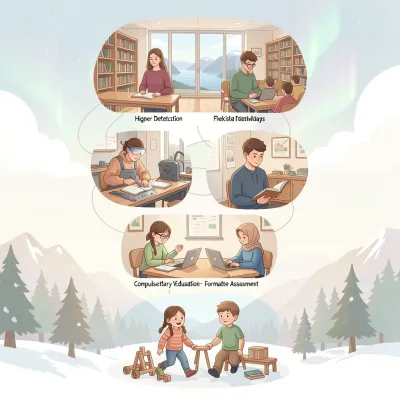
Norway’s education system is built on a foundation of equity, accessibility, and lifelong learning, integrating early childhood, compulsory, upper secondary, and higher education into a cohesive pathway. Early childhood education and care (*barnehage*), though not compulsory, is nearly universal and emphasizes play‑based, outdoor learning and professional staff to foster holistic development. Compulsory education (*grunnskole*) provides a unified ten‑year curriculum for all children, focusing on broad knowledge, basic skills, inclusive practices, and formative assessment rather than high‑stakes testing. Upper secondary education (*videregående skole*) offers distinct general studies and vocational tracks, with a strong 2+2 apprenticeship model in VET and a supplementary pathway (*påbygging*) that allows vocational students to gain university admissions certification, ensuring flexibility and high participation rates.
Higher education in Norway comprises universities and university colleges that are predominantly publicly funded, charge no tuition fees, and emphasize research, academic freedom, and international collaboration. Quality assurance is overseen by NOKUT, while adult education, lifelong learning, and folk high schools (*folkehøgskoler*) provide non‑formal and formal opportunities for upskilling, language acquisition, and personal development across the lifespan. Teacher education is rigorous, typically requiring a five‑year integrated master’s degree, and continuous professional development is embedded in the system. ICT is integrated as a transversal skill, and internationalization is pursued through English‑taught programs, student exchanges, and global research partnerships.
Despite its strengths, the system faces ongoing challenges such as teacher recruitment, maintaining learning outcomes, resource allocation for special needs, digital equity, mental health, and reducing dropout rates in upper secondary education. Policy debates continually seek to balance national standards with local autonomy, strengthen inclusion, align curricula with future labor market needs, and sustain investment in research and lifelong learning. Overall, Norway’s educational model reflects a commitment to egalitarianism, trust, connection to nature, and collective responsibility, producing a highly equitable, inclusive, and innovative system that serves as a reference point for global educational reform.
What You'll Find Inside:
- Comprehensive overview of Norway's education system from early childhood (barnehage) through higher education, emphasizing its unified structure and inclusive practices.
- Detailed exploration of funding mechanisms and governance structures, highlighting public investment in early childhood and the absence of tuition fees in higher education.
- In-depth analysis of special needs education and the commitment to inclusive practices within mainstream classrooms, supported by individualized education plans and specialized services.
- Examination of the role of ICT and digital competence across all educational levels, integrating technology as a foundational tool for learning and societal adaptation.
- Unique insights into folk high schools (folkehøgskoler) and their role in non-formal adult education, emphasizing personal growth and community engagement without formal qualifications.
Who's It For:
This book is essential for educators, policymakers, and researchers seeking to understand Norway's progressive educational model. Parents and families considering relocation to Norway will gain clarity on the country's inclusive approach to learning. It also serves students of comparative education and social welfare systems interested in how public investment and cultural values shape educational equity and excellence.
Table of Contents:
- Introduction
- Chapter 1: Historical Foundations of Norwegian Education
- Chapter 2: The Structure of the Norwegian Education System
- Chapter 3: Early Childhood Education and Care (Barnehage)
- Chapter 4: Funding and Governance of Early Childhood Institutions
- Chapter 5: Primary and Lower Secondary Education (Grunnskole)
- Chapter 6: Curriculum and Learning Objectives in Grunnskole
- Chapter 7: Assessment and Evaluation in Compulsory Education
- Chapter 8: Special Needs Education and Inclusive Practices
- Chapter 9: Upper Secondary Education (Videregående skole)
- Chapter 10: Vocational Education and Training (Yrkesfag)
- Chapter 11: General Studies and Higher Education Preparation
- Chapter 12: Admission to Higher Education in Norway
- Chapter 13: Universities and University Colleges (Universiteter og Høgskoler)
- Chapter 14: Research and Development in Norwegian Higher Education
- Chapter 15: Quality Assurance in Higher Education
- Chapter 16: Adult Education and Lifelong Learning
- Chapter 17: Folk High Schools (Folkehøgskoler) and Their Role
- Chapter 18: Teacher Education and Professional Development
- Chapter 19: The Role of ICT in Norwegian Education
- Chapter 20: Internationalization of Norwegian Education
- Chapter 21: Equity and Access in the Education System
- Chapter 22: Challenges and Debates in Norwegian Education
- Chapter 23: Educational Policy and Future Directions
- Chapter 24: The Impact of Culture on Norwegian Pedagogy
- Chapter 25: Comparative Perspectives: Norway in a Global Context
Author:
Published By:
Date Published:
July 2, 2026
Type:
Nonfiction
Language:
English
Word Count:
43,610 words
Reading Time:
3 hours 3 minutes
Sample:
Order:
Order Education In Norway (Hardcover) on MixCache.com:
Buy NowPrint copy is made to order and ships worldwide. Includes the ebook free, ready to read instantly.
$5 account credit for all new MixCache.com accounts, usable toward any ebook purchase!*